Dumbbell One-Arm Triceps Kickback: Form, Sets, Tips & FAQ
Learn the Dumbbell One-Arm Triceps Kickback with proper form, setup, sets by goal, common mistakes, FAQs, and recommended equipment to build stronger, more defined triceps.
Dumbbell One-Arm Triceps Kickback
This exercise is excellent for improving triceps definition, reinforcing elbow extension strength, and adding targeted arm volume without heavy joint stress. Because the movement is small and isolated, technique matters more than load. A proper kickback should feel like the triceps are doing the work from start to finish, not the shoulder, lower back, or torso swinging the weight.
Quick Overview
| Body Part | Triceps |
|---|---|
| Primary Muscle | Triceps brachii |
| Secondary Muscle | Rear deltoid, core stabilizers, forearm grip muscles |
| Equipment | One dumbbell; optional bench or thigh support |
| Difficulty | Beginner to Intermediate |
Sets & Reps (By Goal)
- Muscle tone / definition: 3–4 sets × 12–15 reps per arm (30–60 sec rest)
- Hypertrophy / muscle growth: 3–4 sets × 8–12 reps per arm (45–75 sec rest)
- Technique practice / isolation control: 2–3 sets × 10–12 reps per arm with lighter weight and strict pauses
- Arm finisher: 2–3 sets × 15–20 reps per arm with controlled tempo and peak squeeze
Progression rule: Add reps first, then increase weight slightly once you can fully extend the elbow without torso swing, shoulder rotation, or losing the top squeeze.
Setup / Starting Position
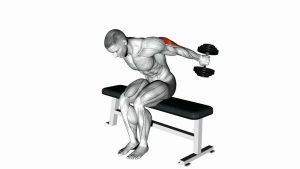
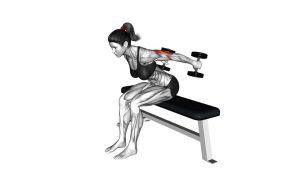
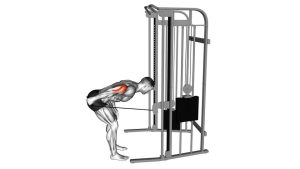
- Choose your stance: Stand in a staggered stance and hinge forward at the hips until your torso is angled roughly 45–60 degrees.
- Create support: Place your non-working hand on your front thigh or a bench for balance and posture control.
- Hold the dumbbell: Grip one dumbbell with a neutral grip, palm facing inward.
- Set the upper arm: Bring your working elbow up so the upper arm is close to the torso and roughly parallel to the floor or slightly below.
- Start bent: Begin with the elbow flexed around 90 degrees and the dumbbell hanging beneath the elbow.
- Brace posture: Keep your chest open, spine neutral, neck relaxed, and core lightly braced.
Tip: The more stable your torso is, the better you can isolate the triceps and avoid turning the exercise into a swinging rear-delt movement.
Execution (Step-by-Step)
- Lock in the elbow position: Keep your upper arm still and tucked close to your body.
- Extend the elbow: Drive the dumbbell backward by straightening your arm until it is nearly fully extended.
- Squeeze at the top: Pause briefly when the arm is straight and the triceps are fully contracted.
- Stay controlled: Do not let the shoulder roll forward or the elbow drop during the rep.
- Lower slowly: Bend the elbow under control and return the dumbbell to the start position without letting it swing.
- Repeat evenly: Complete all reps on one arm, then switch sides and match the same quality and tempo.
Pro Tips & Common Mistakes
- Keep the upper arm still: The elbow is the hinge. Too much shoulder movement reduces triceps tension.
- Use moderate weight: Kickbacks usually work better with lighter loads and stricter form than with heavy dumbbells.
- Pause at full extension: A brief squeeze at the top improves mind-muscle connection and makes lighter weights more effective.
- Avoid torso swinging: Momentum takes tension off the triceps and puts stress on the lower back.
- Don’t drop the dumbbell down: Control the eccentric phase to keep the muscle working.
- Keep the wrist neutral: Excessive wrist bending can reduce comfort and make the rep feel unstable.
- Train both sides evenly: Match reps and tempo to avoid side-to-side imbalances.
FAQ
What muscle does the dumbbell one-arm triceps kickback target most?
It primarily targets the triceps brachii, which is the muscle on the back of the upper arm responsible for elbow extension. It is especially useful as an isolation exercise at the end of an upper-body or arm workout.
Should my upper arm move during a triceps kickback?
Very little. Your upper arm should stay mostly fixed while the forearm moves. Excess shoulder motion usually means you are using momentum instead of isolating the triceps.
Is a lighter dumbbell better for kickbacks?
In many cases, yes. Kickbacks are a strict isolation exercise, so lighter weights often produce better triceps tension and cleaner full-range reps than using a heavy dumbbell with sloppy form.
Can beginners do one-arm triceps kickbacks?
Yes. Beginners can benefit from this exercise as long as they use a manageable weight, maintain a stable hip hinge, and focus on controlled elbow extension.
Where should I feel this exercise?
You should mainly feel it in the back of the upper arm. If you feel more strain in the shoulder, neck, or lower back, adjust your setup and reduce the load.
Recommended Equipment
- Adjustable Dumbbell — ideal for progressive overload and easy one-arm exercise loading
- Adjustable Weight Bench — useful for support during one-arm kickbacks and other upper-body movements
- Weightlifting Gloves — can improve grip comfort and hand protection during dumbbell training
- Resistance Bands Set — helpful for warm-ups, triceps activation, and accessory arm work
- Workout Gloves with Wrist Support — useful if you want extra wrist stability and grip security during arm sessions
Choose equipment that supports strict form, comfortable grip, and gradual progression rather than chasing heavy weight too soon.