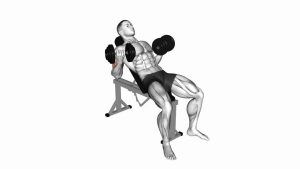
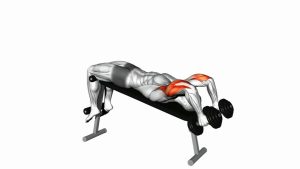
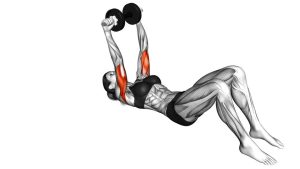
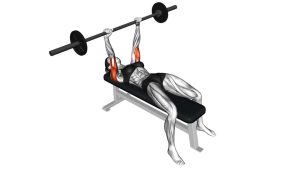
Dumbbell Lying Triceps Extension (Across Face): Form, Sets, Tips & FAQ
Learn the Dumbbell Lying Triceps Extension (Across Face) to build stronger triceps with a deeper stretch on the long head. Includes form tips, setup, execution, sets by goal, common mistakes, FAQ, and recommended equipment.
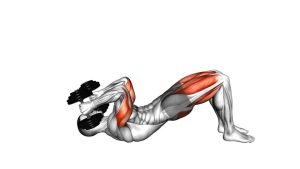
Dumbbell Lying Triceps Extension (Across Face)
This exercise works best with moderate weight, clean control, and a full but safe range of motion. The goal is to keep tension on the triceps from the stretched bottom position all the way to full elbow extension. You should feel the effort mainly in the back of the upper arm, not in the shoulders, wrists, or lower back. If your elbows flare too much or your upper arms drift around, reduce the load and focus on precision.
Quick Overview
| Body Part | Triceps |
|---|---|
| Primary Muscle | Triceps brachii (especially the long head) |
| Secondary Muscle | Anconeus, forearm stabilizers, anterior deltoids (light stabilization only) |
| Equipment | Two dumbbells and a flat bench |
| Difficulty | Beginner to Intermediate |
Sets & Reps (By Goal)
- Muscle growth: 3–4 sets × 8–12 reps with 60–90 seconds rest
- Strength-focused arm work: 4–5 sets × 6–8 reps with 90–120 seconds rest
- Technique and joint-friendly control: 2–3 sets × 10–15 reps with slow lowering and 45–75 seconds rest
- Finisher after pressing day: 2–3 sets × 12–15 reps with moderate weight and constant tension
Progression rule: Add reps before increasing weight. Only load heavier when you can keep the elbows steady, maintain the same range of motion, and finish each rep without swinging the dumbbells.
Setup / Starting Position
- Lie flat on a bench: Keep your head, upper back, and glutes supported while planting both feet firmly on the floor.
- Hold two dumbbells: Use a neutral grip with palms facing each other and press the dumbbells above your chest.
- Set your upper arms: Keep them mostly fixed and slightly angled back rather than perfectly straight up.
- Brace lightly: Keep your ribs down and core engaged so the torso stays stable throughout the set.
- Prepare the elbows: Keep them tucked in naturally rather than flaring wide.
Tip: A slight backward arm angle often makes it easier to keep tension on the long head of the triceps.
Execution (Step-by-Step)
- Start at the top: Hold the dumbbells above the chest with elbows extended but not aggressively locked out.
- Bend at the elbows: Lower the dumbbells in a controlled arc toward the face or just behind the forehead area.
- Keep the upper arms steady: Let the forearms move while the elbows stay in nearly the same position.
- Reach the stretch: Pause briefly in the bottom when the triceps feel loaded and stretched without losing control.
- Extend the elbows: Reverse the movement smoothly and drive the dumbbells back to the start position.
- Repeat without momentum: Keep the tempo controlled and avoid turning the rep into a chest press.
Pro Tips & Common Mistakes
- Use control on the way down: The eccentric phase is where you build stability and tension.
- Do not flare the elbows hard: Excessive flare shifts tension away from the triceps and can stress the joints.
- Keep wrists neutral: Avoid letting the dumbbells bend the wrists backward.
- Do not turn it into a press: The movement should come mainly from elbow extension, not shoulder pressing.
- Choose the right load: Too much weight usually causes sloppy reps, shortened range, and elbow drift.
- Use full but comfortable range: Lower until you feel a strong stretch, but never force the dumbbells into a painful bottom position.
- Stay symmetrical: Move both dumbbells evenly so one arm does not dominate the rep.
FAQ
What muscles does the dumbbell lying triceps extension work?
It mainly targets the triceps brachii, especially the long head. The forearms and shoulders help stabilize the dumbbells, but the triceps are the main drivers of the exercise.
Why use the across-face variation?
The across-face path usually creates a slightly deeper stretch and keeps more tension on the long head of the triceps. Many lifters also find it more natural on the elbows than a straight-up-and-down skull crusher path.
Is this better than using an EZ-bar for skull crushers?
Not always better, but different. Dumbbells allow each arm to move more freely, help reduce side-to-side imbalances, and often feel more comfortable on the wrists and elbows.
How heavy should I go?
Use a weight you can control for the full set without elbow flare, bouncing, or shoulder compensation. This exercise usually responds better to strict moderate loading than to maximal weight.
Can beginners do this exercise?
Yes. Beginners can use light dumbbells and focus on clean elbow motion, a stable upper arm position, and a slow tempo. Start conservatively until the pattern feels natural.
Recommended Equipment
- Adjustable Dumbbells — versatile for progressive overload and ideal for home triceps training
- Flat Weight Bench — provides stable body support for lying triceps extensions
- Lifting Gloves — can improve grip comfort and reduce palm fatigue during higher-rep sets
- Dumbbell Storage Rack — helps organize multiple dumbbell pairs for efficient training space setup
- Elbow Sleeves — optional support for lifters who want extra warmth and comfort around the elbows
Tip: The best setup for this exercise is simple: a stable flat bench, dumbbells you can progress gradually, and enough space to lower the weights safely with full control.