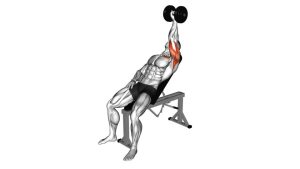
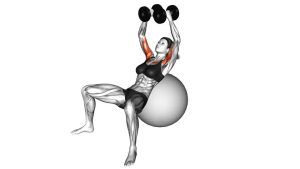
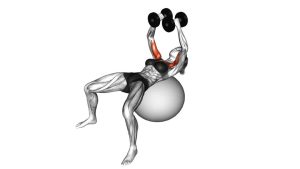
Dumbbell Incline One-Arm Press on Exercise Ball: Form, Sets, Tips & FAQ
Master the Dumbbell Incline One-Arm Press on an exercise ball to build upper-chest strength, improve shoulder stability, and train anti-rotation core control. Step-by-step form, sets by goal, mistakes, FAQs, and recommended gear.
Dumbbell Incline One-Arm Press on Exercise Ball
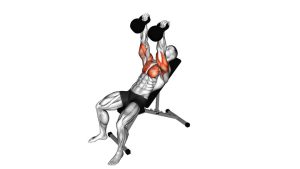
This movement combines an incline dumbbell press angle with a single-arm load, which naturally tries to rotate your torso. Your job is to resist that rotation while keeping the dumbbell path smooth and repeatable. If the ball feels too unstable, reduce the incline angle, widen your stance, or lighten the weight.
Quick Overview
| Body Part | Chest |
|---|---|
| Primary Muscle | Upper chest (Pectoralis major — clavicular fibers) |
| Secondary Muscle | Anterior deltoid, triceps, serratus anterior; core (anti-rotation) and scapular stabilizers |
| Equipment | Dumbbell + exercise ball (stability ball) |
| Difficulty | Intermediate (requires balance, trunk control, and shoulder stability) |
Sets & Reps (By Goal)
- Hypertrophy (upper chest focus): 3–4 sets × 8–12 reps/side (60–90 sec rest)
- Strength + control: 4–5 sets × 4–8 reps/side (90–150 sec rest)
- Stability & shoulder health: 2–4 sets × 10–15 reps/side (45–75 sec rest, slow tempo)
- Finisher / pump: 2–3 sets × 12–20 reps/side (30–60 sec rest, lighter load)
Progression rule: First improve stability (less wobble, no torso twist), then add reps, then add load. If your hips drop or your torso rotates, you’ve progressed too far.
Setup / Starting Position
- Choose your dumbbell: Start lighter than your normal incline press—the ball adds instability.
- Get on the ball: Sit tall on the exercise ball with the dumbbell resting safely on your thigh.
- Walk out to incline: Step your feet forward and roll your upper back onto the ball until your torso is at a comfortable incline (about 30–45°).
- Set your base: Feet wide, heels planted, knees bent. Lift hips so you form a straight line from knees to shoulders.
- Brace & square up: Ribs down, glutes tight, abs braced. Keep shoulders level—don’t rotate toward the dumbbell side.
- Start position: Dumbbell at upper-chest line with wrist stacked over elbow. Keep the elbow slightly tucked (about 30–45° from the torso).
Tip: If balance is tough, widen your stance and reduce the incline angle by rolling slightly higher on the ball (more upper back support).
Execution (Step-by-Step)
- Lock in your brace: Squeeze glutes, brace abs, and keep your torso square to the ceiling.
- Press up and slightly inward: Drive the dumbbell up in a smooth arc so it finishes above the upper chest/shoulder line.
- Keep shoulder packed: Avoid shrugging. Think “shoulder down and stable” as you press.
- Control the top: Reach near full extension without aggressive lockout. Keep wrist neutral and steady.
- Lower with control: Bring the dumbbell down slowly to chest level. Maintain tension—no bouncing.
- Repeat clean reps: Each rep should look the same: stable hips, stable ribs, smooth press path.
Pro Tips & Common Mistakes
- Press with a “quiet” torso: Resist rotation—imagine your ribcage and hips stay square the entire set.
- Don’t over-arch: If your lower back arches hard, lower your hips slightly, brace more, or go lighter.
- Elbow angle matters: Too flared can irritate shoulders; keep a gentle tuck (about 30–45°).
- Keep wrists stacked: Don’t let the dumbbell bend your wrist backward—neutral wrist improves force transfer.
- Control the eccentric: A slower lowering phase increases upper-chest tension and reduces shoulder stress.
- Stability first, load second: If the ball turns the set into a balancing act, your chest stimulus drops—regress the setup.
FAQ
What does this exercise target the most?
The incline angle emphasizes the upper chest, while the single-arm load forces your core and shoulder stabilizers to work harder to keep you from rotating.
Should I go heavy on this movement?
Usually no. This variation is best for moderate loads with excellent control. If the weight causes wobbling, twisting, or shoulder discomfort, it’s too heavy for the purpose.
How do I make it more stable?
Widen your stance, keep heels planted, lower the incline angle, and reduce the dumbbell weight. You can also slow the tempo and pause briefly at the bottom to reset position.
Is this better than a normal incline dumbbell press?
It’s not “better,” just different. A bench press allows heavier loading for pure strength. The ball version adds stability and anti-rotation demand, which can be useful for control and unilateral development.
What are the most common mistakes?
The big ones are torso rotation, hips dropping, over-arching, and flaring the elbow. Clean reps come from a strong brace and controlled tempo.
Recommended Equipment
- Anti-Burst Exercise Ball — stable, durable ball for pressing and full-body training
- Adjustable Dumbbells — quick load changes for progressive overload and home workouts
- Dumbbell Set (with Rack) — convenient for unilateral training and volume work
- Exercise Ball Pump — keeps the ball properly inflated for better stability and safety
- Non-Slip Training Mat — improves footing traction and comfort while setting up on the ball
Tip: Keep the ball properly inflated—an under-inflated ball increases wobble and reduces pressing consistency.