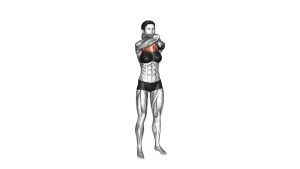
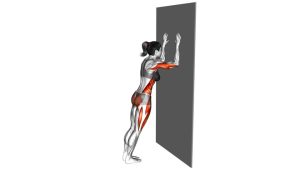
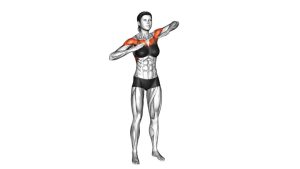
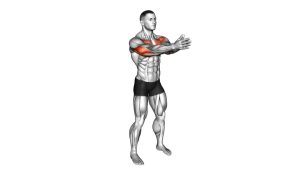
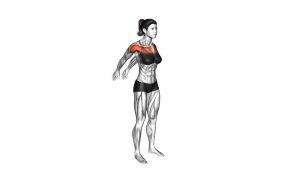
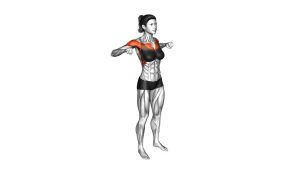
Dumbbell Svend Press: Form, Sets & Reps, Tips, Mistakes, and FAQ
Learn how to do the Dumbbell Svend Press with perfect form to target the chest and improve mind-muscle connection. Includes setup, step-by-step execution, sets & reps by goal, common mistakes, FAQ, and recommended equipment.
Dumbbell Svend Press
This lift rewards tension more than heavy weight. If you lose the squeeze, your shoulders and triceps can take over. Keep your ribs stacked, shoulder blades gently set, and think: “crush the dumbbell, then press.”
Quick Overview
| Body Part | Chest |
|---|---|
| Primary Muscle | Pectoralis major (mid/inner emphasis via squeeze) |
| Secondary Muscle | Anterior deltoids, triceps, serratus anterior (stability) |
| Equipment | 1 dumbbell (optional: flat wall for posture feedback) |
| Difficulty | Beginner → Intermediate (simple technique, challenging tension control) |
Sets & Reps (By Goal)
- Chest activation (warm-up): 2–3 sets × 10–15 reps (light/moderate, 45–60 sec rest)
- Hypertrophy (main accessory): 3–4 sets × 8–12 reps (2–3 sec controlled eccentric, 60–90 sec rest)
- Finisher / pump: 2–3 sets × 12–20 reps (short rest 30–60 sec, constant squeeze)
- Joint-friendly chest day add-on: 2–3 sets × 8–15 reps (smooth tempo, no lockout slam)
Progression rule: First increase squeeze quality and control (slower reps, longer peak hold), then add small weight jumps. If the shoulders take over, the load is too heavy.
Setup / Starting Position
- Stand tall: Feet about shoulder-width, knees soft, glutes and core lightly braced.
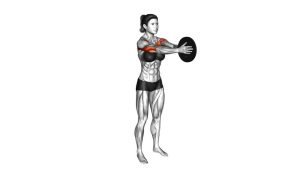
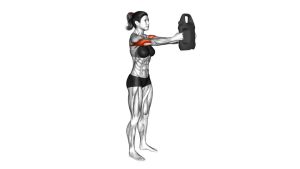
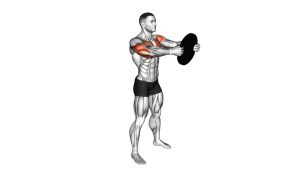
- Hold one dumbbell vertically: Place it between both palms at mid-chest height.
- Set the shoulders: Think “down and back,” chest proud, neck neutral.
- Elbows slightly forward: Keep them in front of your ribs (not flared straight out).
- Pre-squeeze: Start pressing your palms inward before the first rep—this is the whole point.
Tip: If you struggle to stay upright, do it with your back near a wall for feedback (no leaning).
Execution (Step-by-Step)
- Crush the dumbbell: Squeeze your palms inward to create chest tension (you should feel pecs engage).
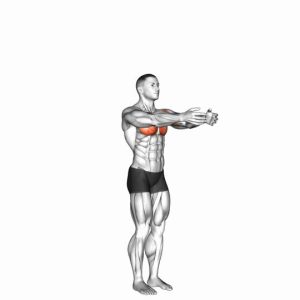
- Press forward: Push the dumbbell straight out from your chest while maintaining the squeeze.
- Soft lockout: Stop just short of a hard elbow lock; keep tension in the chest, not the joints.
- Peak contraction: Hold 1–2 seconds at full reach while still “crushing” the dumbbell.
- Return slowly: Bring it back to the chest under control (2–3 seconds), keep the squeeze the entire time.
Pro Tips & Common Mistakes
Pro Tips
- Use “tension weight,” not ego weight: Choose a dumbbell you can squeeze hard without compensating.
- Slow the eccentric: 2–3 seconds back to the chest keeps the pecs loaded.
- Add a peak hold: 1–2 seconds at full reach builds a strong contraction.
- Keep ribs stacked: Brace your core so you don’t lean back to “cheat” the press.
- Think “in + out”: Squeeze inward while pressing outward for maximum pec recruitment.
Common Mistakes
- Losing the squeeze: If palms relax, the exercise becomes a shoulder/triceps press.
- Leaning back: Turns it into a standing incline-style press with less chest isolation.
- Elbows flaring high: Can irritate shoulders and reduces stable pressing mechanics.
- Hard lockout: Slamming elbows can shift tension off the pecs and into the joints.
- Too much load: Heavy weight often kills the contraction—go lighter and stricter.
FAQ
Where should I feel the Dumbbell Svend Press?
You should feel a strong contraction in the chest, especially mid/inner fibers. If you feel mostly shoulders, lighten the weight and increase the inward squeeze.
Is this better for inner chest?
The “inner chest” isn’t a separate muscle, but the Svend Press can emphasize a strong adduction squeeze, which many lifters feel more in the inner/mid pec area. It’s excellent for tension and pump.
Should I do it standing or lying?
Standing is great for core stability and convenience. Lying on a bench can reduce body sway and help you focus purely on pressing. Use the version that lets you keep the squeeze and control every rep.
How heavy should I go?
Moderate. Pick a weight you can squeeze hard for the entire set without leaning back or shrugging. If the squeeze disappears, the dumbbell is too heavy.
When should I program it?
Use it as a warm-up/activation before presses, as an accessory after heavy compounds, or as a finisher to end chest training with a pump.
Recommended Equipment (Optional)
- Adjustable Dumbbells Set — easy load changes for strict squeeze-based work
- Dumbbell Set with Rack — convenient for progressive overload and supersets
- Flat Weight Bench — optional support if you prefer a lying Svend press variation
- Push-Up Handles — great for pairing with chest finishers (push-ups after Svend press)
- Resistance Bands Set — ideal for chest activation/pump combos (band fly + Svend press)
Tip: If your wrists feel uncomfortable holding the dumbbell, switch to a different dumbbell shape or do the classic plate Svend press (two hands squeezing a plate).