Arm Crossover : Form, Sets, Tips & FAQ
Learn the Arm Crossover to activate and pump the chest with a simple standing “hug” motion. Step-by-step form, sets by goal, common mistakes, FAQs, and optional equipment.
Arm Crossover
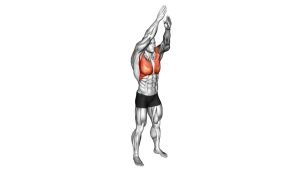
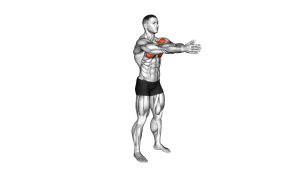
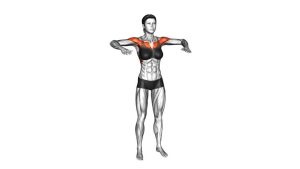
This movement works best when you treat it like a chest isolation drill, not a shoulder swing. Your torso stays tall and quiet while the arms move in a controlled arc. You should feel the squeeze across the middle chest (and sometimes the inner chest line), with the shoulders staying down and relaxed.
Quick Overview
| Body Part | Chest |
|---|---|
| Primary Muscle | Pectoralis major (chest) |
| Secondary Muscle | Anterior deltoids, serratus anterior (stability), biceps (light) |
| Equipment | None (optional: resistance band + door anchor) |
| Difficulty | Beginner (great for activation, warm-ups, and pump finishers) |
Sets & Reps (By Goal)
- Warm-up / activation: 2–3 sets × 12–20 reps (easy burn, 30–45 sec rest)
- Hypertrophy (pump work): 3–4 sets × 15–25 reps (1–2 sec squeeze, 45–75 sec rest)
- Finisher after presses: 2–3 sets × 20–30 reps (slow tempo, minimal rest)
- Band-resisted strength focus: 3–5 sets × 10–15 reps (controlled, 60–90 sec rest)
Progression rule: First add a longer squeeze (1–3 sec) and slower reps. Then add reps. Only increase resistance when your shoulders stay down and the movement stays smooth.
Setup / Starting Position
- Stand tall: Feet about shoulder-width, knees soft, glutes lightly engaged.
- Set your ribs: Keep your chest proud but avoid flaring the ribs or arching the lower back.
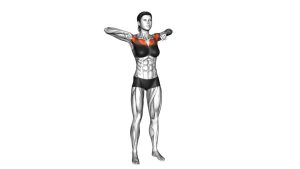
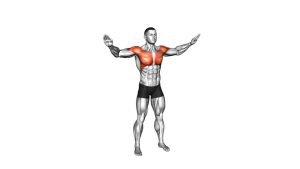
- Arms out: Raise arms to about chest height with a soft elbow bend.
- Shoulders down: Think “shoulders in back pockets” (no shrugging).
- Optional band setup: Place a band behind you (around a post or with a door anchor) and hold handles/ends at chest height.
Tip: If you feel mostly shoulders, slightly bend the elbows more and focus on “hugging” with the chest—slow down.
Execution (Step-by-Step)
- Open with control: Start with arms out to the sides (comfortable stretch, not forced).
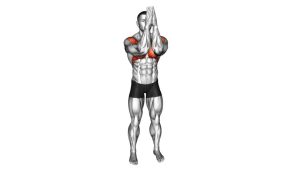
- Bring arms forward: Sweep the arms in a wide arc as if you’re wrapping a barrel.
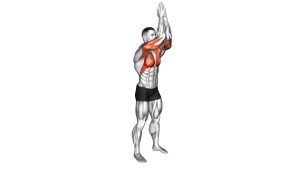
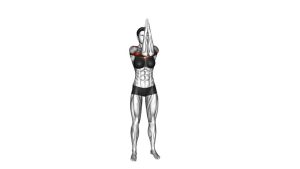
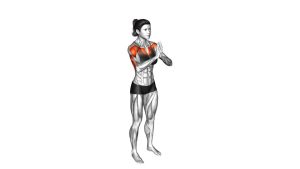
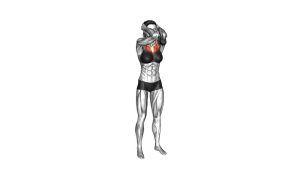
- Cross at midline: Let one forearm pass slightly over the other; keep elbows softly bent.
- Squeeze the chest: Pause 1–2 seconds and focus on pec contraction (not shoulder tension).
- Return slowly: Open back out under control—no bouncing, no swinging.
Pro Tips & Common Mistakes
- Think “hug + squeeze”: Chest initiates; arms are just the lever.
- Keep elbows soft: Locked elbows turn it into a jointy swing and reduce chest feel.
- Don’t shrug: Traps up = chest down. Keep shoulders relaxed.
- Control the return: The eccentric (opening) builds control and keeps shoulders happy.
- Use tempo for intensity: Try 2 sec in, 2 sec squeeze, 3 sec out.
- Band option: Light band resistance makes it a true “crossover” pattern—great for home training.
FAQ
Where should I feel the Arm Crossover?
Mostly across the pecs (mid-chest). A little front-shoulder involvement is normal, but if shoulders dominate, slow down, keep elbows bent, and focus on squeezing at the midline.
Is this an “inner chest” exercise?
You can’t isolate the “inner chest” as a separate muscle, but the midline squeeze can strongly emphasize pec contraction and mind-muscle connection, which many people describe as an inner-chest feel.
Should my hands touch or overlap?
Overlap slightly (crossing forearms) is fine if it’s comfortable. Don’t force extra range—prioritize a smooth squeeze without shoulder pinching.
How do I make it harder without weights?
Add a light resistance band, slow the tempo, increase the squeeze time (1–3 seconds), or perform higher-rep sets (15–30 reps).
Who should be cautious with this movement?
If you have shoulder impingement-like pain, recent shoulder injury, or sharp discomfort when opening the arms, keep the range smaller and consider professional guidance.
Recommended Equipment (Optional)
- Resistance Bands Set (with Handles) — easiest way to add progressive resistance for crossovers
- Door Anchor for Resistance Bands — lets you mimic cable crossovers at home safely
- Chest Expander / Tube Bands — great for chest fly-style movements and quick pump sets
- Band Handles (Extra Grip) — improves comfort and control during higher-rep crossovers
- Loop Resistance Bands — useful for warm-ups plus pairing with push-ups or pressing variations
Tip: Choose lighter resistance than you think—this drill shines with control, not max load. If your shoulders feel stressed, reduce range and slow the tempo.