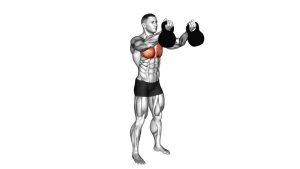
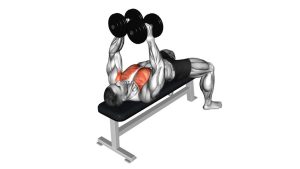
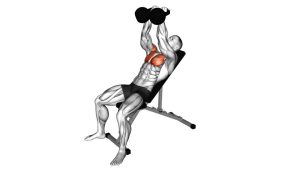
Kettlebell Fly: Proper Form, Sets, Tips & FAQ
Learn how to do the Kettlebell Fly with perfect form to build your chest safely. Step-by-step setup, sets & reps by goal, pro tips, common mistakes, FAQs, and recommended equipment.
Kettlebell Fly
This fly variation rewards tempo and precision more than heavy loading. Your elbows should stay slightly bent, your ribs should stay down, and your shoulder blades should remain retracted and lightly depressed to protect the shoulders. Stop the descent when you feel a strong chest stretch but can still keep your shoulders stable.
Quick Overview
| Body Part | Chest |
|---|---|
| Primary Muscle | Pectoralis major (chest) |
| Secondary Muscle | Anterior deltoids, biceps (support), serratus anterior, rotator cuff (stability) |
| Equipment | Two kettlebells + flat bench (or floor) |
| Difficulty | Intermediate (requires shoulder control and smooth tempo) |
Sets & Reps (By Goal)
- Hypertrophy (most people): 3–4 sets × 8–12 reps (60–90 sec rest)
- Technique + control: 2–4 sets × 10–15 reps (45–75 sec rest, slow eccentric)
- Finisher / pump: 2–3 sets × 12–20 reps (30–60 sec rest, lighter load)
- Strength accessory (after pressing): 2–3 sets × 6–10 reps (keep perfect form)
Progression rule: Add reps first, then add a small amount of load. Only increase weight if you can keep the same elbow bend, stable shoulders, and controlled bottom position.
Setup / Starting Position
- Choose your base: Use a flat bench for more range, or the floor to limit depth and reduce shoulder stress.
- Set the upper back: Pull shoulder blades slightly back and down (don’t shrug).
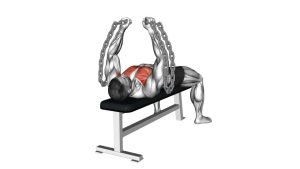
- Start above the chest: Hold a kettlebell in each hand with arms up, palms facing in or slightly angled.
- Soft elbows: Keep a small bend (about 15–30°) and maintain it throughout the rep.
- Brace: Feet planted, ribs down, core tight so you don’t over-arch your lower back.
Tip: If grip or wrist stability limits you, start with lighter kettlebells and slow tempo—control matters more than load.
Execution (Step-by-Step)
- Inhale and open: Lower both arms out to the sides in a wide arc, keeping elbows slightly bent.
- Stay “chest up,” ribs down: Keep shoulders packed—avoid letting them roll forward at the bottom.
- Stop at a safe stretch: Descend until you feel a strong chest stretch while maintaining control (no bouncing).
- Exhale and squeeze: Bring the arms back up by “hugging” the chest together (horizontal adduction).
- Finish over mid-chest: Return to the top with control—don’t clank the bells together.
Pro Tips & Common Mistakes
- Use a 2–3 second lowering phase: Most of the chest stimulus comes from the controlled eccentric.
- Keep elbows fixed: Changing elbow bend mid-rep shifts stress and turns it into a press.
- Don’t over-stretch: Stop when you feel chest tension—depth is not the goal.
- Shoulders stay back: Avoid letting shoulders dump forward at the bottom.
- Neutral wrists: Don’t let wrists collapse—stack knuckles over forearms.
- Pair smart: Great after bench press/push-ups as an isolation finisher.
FAQ
Where should I feel the kettlebell fly?
You should feel it mainly in the chest, especially during the stretch and squeeze. If you feel it mostly in the front of the shoulders, reduce range, slow down, and re-pack the shoulders.
Bench or floor: which is better?
A bench allows a larger range of motion and stretch, but demands more shoulder control. The floor limits depth and can be more shoulder-friendly for beginners or sensitive shoulders.
Can I go heavy on flyes?
Flyes generally work best with moderate loads and controlled tempo. Going too heavy often causes elbow bending (turning it into a press) or shoulder stress.
What’s the best tempo?
Try 2–3 seconds down, a brief pause at the bottom, then a smooth lift up. If your shoulders feel unstable, slow down even more and shorten range.
Who should avoid this exercise?
If you have acute shoulder pain, instability, or a history of painful fly motions, choose a safer option like a floor fly, cable fly with lighter load, or consult a professional.
Recommended Equipment
- Kettlebell Set (Cast Iron or Competition) — scalable loads for flyes, presses, and full-body training
- Flat Weight Bench — stable base to increase range of motion and control
- Thick Exercise Mat — comfortable floor fly option and joint-friendly support
- Lifting Straps (Optional) — helpful if grip limits your set before the chest does
- Resistance Bands Set — great for warm-ups (band pull-aparts) and shoulder stability work
Tip: Choose equipment that improves stability and control—the kettlebell fly is most effective when the reps are smooth and consistent.