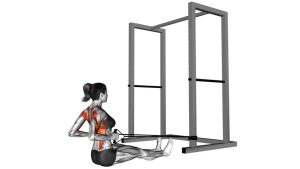
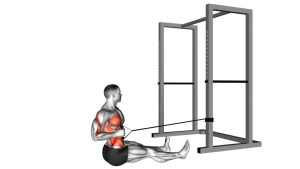
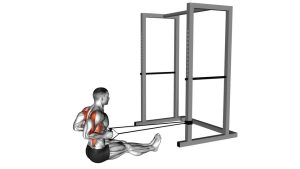
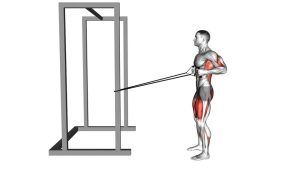
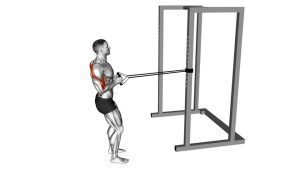
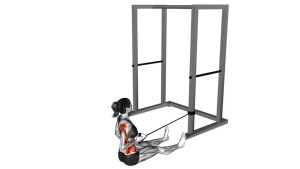
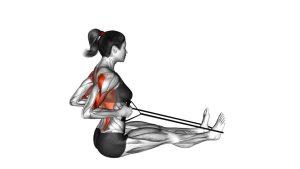
Band Bent-Over Row: Proper Form, Muscles Worked, Sets, Tips & FAQ
Learn how to perform the Band Bent-Over Row with proper form to build a stronger back, improve posture, and train lats, rhomboids, and rear delts. Includes setup, execution, sets and reps, common mistakes, FAQ, and recommended equipment.
Band Bent-Over Row
This movement is especially useful for home workouts, travel training, and back-focused programs that need efficient pulling volume with minimal equipment. Because band tension increases as you pull, the top portion of the row can create a strong contraction in the back muscles while still being joint-friendly for many lifters. Done correctly, the exercise should feel smooth and controlled, with the torso stable and the shoulder blades moving naturally as the elbows travel back.
Quick Overview
| Body Part | Back |
|---|---|
| Primary Muscle | Latissimus dorsi, rhomboids, middle trapezius |
| Secondary Muscle | Rear deltoids, biceps, forearms, spinal erectors, core |
| Equipment | Resistance band with handles or loop band |
| Difficulty | Beginner to Intermediate |
Sets & Reps (By Goal)
- Muscle building: 3–4 sets × 10–15 reps with a controlled squeeze and 45–75 seconds rest
- General strength: 3–5 sets × 8–12 reps using a stronger band and 60–90 seconds rest
- Posture and activation: 2–3 sets × 12–20 reps with lighter resistance and slower tempo
- Warm-up or movement prep: 1–2 sets × 12–15 reps focusing on clean scapular retraction
Progression rule: Increase band tension only after you can keep the torso fixed, maintain full control, and finish each rep with a clean back contraction instead of shrugging or swinging.
Setup / Starting Position
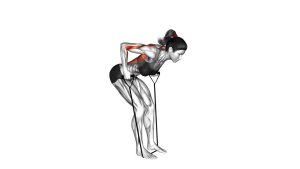
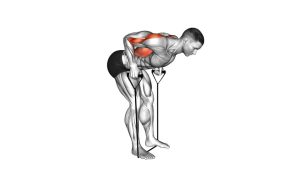
- Anchor the band: Stand on the center of the resistance band with feet about hip-width apart. Hold one handle in each hand or grip the ends evenly.
- Hinge at the hips: Push the hips back and lean the torso forward until you reach roughly a 45–70 degree angle, depending on mobility and control.
- Soften the knees: Keep a slight bend in the knees so the lower back is not overloaded.
- Set a neutral spine: Keep the chest open, core braced, and neck aligned with the torso. Avoid rounding the upper or lower back.
- Start with long arms: Let the arms hang straight down under the shoulders while maintaining tension in the band.
Tip: Think of the setup like a light Romanian deadlift position. The hips stay back and the torso stays steady while the arms do the rowing.
Execution (Step-by-Step)
- Brace first: Before pulling, tighten your core and lock in your torso angle so the body does not rise and fall during the rep.
- Initiate from the back: Begin by drawing the shoulder blades slightly together instead of yanking with the hands.
- Drive the elbows back: Pull the handles toward the lower ribs or waistline while keeping the elbows close to the body.
- Squeeze at the top: Pause briefly when the elbows pass the torso and the upper back is fully engaged.
- Lower with control: Slowly extend the arms back to the start without losing spinal position or letting the band snap downward.
- Repeat smoothly: Keep each rep consistent and controlled from start to finish.
Pro Tips & Common Mistakes
- Keep the hinge position fixed: Don’t stand up as you row. The torso angle should stay consistent.
- Lead with the elbows: This helps shift emphasis to the back instead of turning the exercise into a biceps-dominant pull.
- Don’t shrug at the top: Keep the shoulders away from the ears to maintain better lat and mid-back involvement.
- Use full control on the way down: The eccentric phase is valuable for muscle growth and shoulder stability.
- Avoid rounding the spine: Keep the chest proud and core braced throughout the set.
- Match resistance to your form: Bands that are too heavy often cause jerking, shortened range, and poor scapular mechanics.
- Pause briefly at peak contraction: A short squeeze improves mind-muscle connection and back engagement.
FAQ
What muscles does the Band Bent-Over Row work the most?
The exercise primarily targets the lats, rhomboids, and middle traps. The rear delts, biceps, forearms, and spinal stabilizers also contribute during the movement.
Is the Band Bent-Over Row good for beginners?
Yes. It is beginner-friendly because the resistance can be adjusted easily and the exercise teaches an important pulling pattern without requiring large machines or heavy free weights.
Where should I pull the band to?
Most lifters should pull toward the lower ribs or waist area. This usually creates a more natural elbow path and better back engagement than pulling too high toward the chest.
Can this replace cable rows or dumbbell rows?
It can be an excellent alternative, especially for home training or travel workouts. While the resistance profile is different from cables or dumbbells, it still builds the back effectively when performed with enough tension and control.
Why do I feel this more in my arms than my back?
That usually happens when the elbows are not leading the movement, the shoulders are shrugging, or the band is too heavy. Reduce resistance, stabilize your torso, and focus on pulling from the upper and mid-back first.
Recommended Equipment
- Resistance Bands Set with Handles — the most direct tool for this exercise and useful for a wide range of home pulling movements
- Door Anchor for Resistance Bands — expands your training options by allowing more row, pulldown, and press variations
- Lifting Straps — helpful if grip fatigue limits your back work during higher-volume pulling sessions
- Adjustable Workout Bench — useful for pairing this row with chest-supported, incline, and full upper-body home training
- Exercise Mat — improves comfort and traction during home workouts, especially on slippery floors
Tip: For most people, the best first purchase is a quality band set with handles plus a door anchor. That combination gives you the most exercise variety for the lowest cost and smallest space requirement.