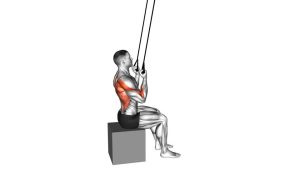
Band Kneeling One-Arm Pulldown: Form, Muscles Worked, Sets & Tips
Learn how to do the Band Kneeling One-Arm Pulldown with proper form. Discover muscles worked, setup tips, sets and reps by goal, common mistakes, FAQs, and recommended equipment.
Band Kneeling One-Arm Pulldown
This exercise is especially useful for home workouts, back activation sessions, and lifters who want a band-based alternative to a machine lat pulldown. The kneeling stance helps reduce cheating and makes it easier to focus on a smooth pull, a full lat contraction, and a controlled return to the overhead stretch.
Quick Overview
| Body Part | Back |
|---|---|
| Primary Muscle | Latissimus dorsi |
| Secondary Muscle | Teres major, rhomboids, rear deltoid, biceps, lower traps, and core stabilizers |
| Equipment | Resistance band and a secure overhead anchor point |
| Difficulty | Beginner to Intermediate |
Sets & Reps (By Goal)
- Muscle building: 3–4 sets × 8–15 reps per side
- Back activation / warm-up: 2–3 sets × 10–15 reps per side with slower tempo
- Strength-focused band work: 3–5 sets × 6–10 reps per side using a heavier band
- Posture and control practice: 2–3 sets × 12–15 smooth reps per side
Progression rule: First improve control, range, and tempo. Then increase band tension or add reps while keeping the torso steady and the elbow path clean.
Setup / Starting Position
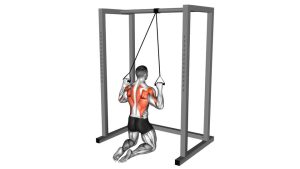
- Anchor the band overhead: Attach the resistance band high enough to create a downward pulling angle similar to a pulldown machine.
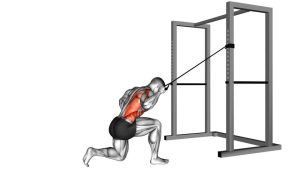
- Get into a half-kneeling stance: Place one knee on the floor and the opposite foot flat in front for balance and support.
- Grab the band with one hand: Start with the working arm extended overhead and slightly in front of the body.
- Brace your torso: Keep your chest tall, ribs down, and core tight so you do not lean back or rotate during the rep.
- Set the shoulder: Let the shoulder blade rise naturally at the top, but avoid shrugging excessively before you begin the pull.
Tip: The non-working hand can rest on the front thigh to help you stay balanced and reduce unnecessary torso movement.
Execution (Step-by-Step)
- Start from a full stretch: Reach the working arm overhead while keeping the spine neutral and the band under tension.
- Initiate with the back: Begin the movement by pulling the shoulder blade down and slightly back instead of bending the elbow first.
- Drive the elbow down: Pull the elbow toward your side and slightly toward your hip while keeping it close to the body.
- Pause at the bottom: Briefly squeeze the lat when the hand reaches about shoulder or upper-rib level and the elbow is near the torso.
- Return under control: Slowly extend the arm back overhead, allowing the lat to lengthen without letting the band snap you upward.
- Repeat smoothly: Perform all reps on one side, then switch arms and match the same tempo and range of motion.
Pro Tips & Common Mistakes
- Keep the elbow path tight: Let the elbow travel down close to your side instead of flaring outward.
- Do not lean back to cheat: Excessive torso swing turns the exercise into a momentum-based pull and reduces lat isolation.
- Control the eccentric: The upward return is where many lifters lose tension. Fight the band all the way back up.
- Avoid shrugging: Keep the shoulder from creeping toward the ear as you pull.
- Use full but comfortable range: Reach overhead for a stretch, then finish with a strong but natural contraction.
- Brace the core: The unilateral setup challenges anti-rotation, so keep your torso quiet throughout the set.
- Match both sides: Use the weaker side to set the standard for reps and tempo.
FAQ
What muscles does the Band Kneeling One-Arm Pulldown work?
The main target is the latissimus dorsi. Secondary muscles include the teres major, rhomboids, rear deltoid, biceps, and smaller scapular stabilizers. Your core also works to resist twisting.
Is this a good alternative to machine lat pulldowns?
Yes. It is a strong band-based alternative for home training, especially when you want to train the lats through a similar overhead pulling angle without access to a cable machine.
Should I feel this more in my lat or my arm?
You should mainly feel it in the lat area along the side of the back. A little biceps involvement is normal, but if the arm dominates, use a lighter band and focus on leading with the elbow.
Can beginners do this exercise?
Yes. Beginners can use a lighter band and a slower pace to learn the movement pattern. The half-kneeling position also helps create a stable setup for cleaner reps.
What is the biggest mistake to avoid?
The most common mistake is using momentum by leaning backward and yanking the band down. Keep your torso stable and make the lat do the work.
Recommended Equipment (Optional)
- Resistance Bands Set with Handles — useful for changing resistance levels and training back exercises at home
- Door Anchor for Resistance Bands — creates a secure overhead anchor point for pulldown-style movements
- Heavy-Duty Resistance Tube Bands — a good option for lifters who want smoother tension and stronger resistance
- Exercise Knee Pad — adds comfort and stability during half-kneeling setups on hard floors
- Adjustable Workout Bench — helpful for expanding your home back training options beyond band pulldowns
Tip: Prioritize a secure anchor and the right band tension first. Better setup quality almost always leads to better reps.