Prone T Raise: Proper Form, Benefits, Sets, Tips & FAQ
Learn how to perform the Prone T Raise with proper form to strengthen the upper back, rear delts, and scapular stabilizers. Includes setup, step-by-step execution, sets by goal, mistakes to avoid, FAQ, and recommended equipment.
Prone T Raise
This exercise looks easy, but it works best when done with patience and precision. A strong rep comes from lifting the arms with the upper back rather than forcing range through the lower back or neck. You should feel the muscles around the shoulder blades and the back of the shoulders doing the work. When performed well, the Prone T Raise is excellent for improving posture, supporting shoulder health, and reinforcing better control of the upper posterior chain.
Quick Overview
| Body Part | Upper Back |
|---|---|
| Primary Muscle | Middle trapezius and rhomboids |
| Secondary Muscle | Rear deltoids, lower trapezius, rotator cuff stabilizers |
| Equipment | None required (optional: exercise mat, light weights, resistance tools) |
| Difficulty | Beginner |
Sets & Reps (By Goal)
- Posture improvement: 2–3 sets × 10–15 reps with slow, controlled lifting and lowering
- Upper-back activation in a warm-up: 2–3 sets × 8–12 reps with a 1–2 second squeeze at the top
- Muscular endurance: 3–4 sets × 12–20 reps with strict form and short rest periods
- Technique practice / rehab-style control: 2–3 sets × 6–10 reps with very slow tempo and small range if needed
Progression rule: First improve control, pause quality, and rep consistency. After that, increase reps or add very light resistance only if you can keep the neck relaxed and the shoulders away from the ears.
Setup / Starting Position
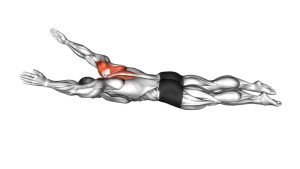
- Lie face down: Get into a prone position on the floor, bench, or mat with the legs extended comfortably behind you.
- Extend the arms out to the sides: Raise the arms into a straight “T” position so they line up roughly with the shoulders.
- Set the head and neck: Keep your gaze down and your neck neutral instead of craning your head upward.
- Brace lightly through the trunk: Tighten the abs gently so the lower back does not overarch during the lift.
- Relax the shoulders: Let the shoulder blades sit naturally before each rep so you can actively pull them back during the movement.
Tip: A folded towel under the forehead can help you keep a neutral neck position if lying flat feels awkward.
Execution (Step-by-Step)
- Start in the T position: Arms extended out to the sides, thumbs pointing slightly upward or palms facing down based on comfort.
- Lift the arms off the floor: Raise both arms slowly by squeezing the shoulder blades together rather than jerking the hands upward.
- Pause at the top: Hold the top position for 1–2 seconds while keeping the shoulders down and the neck relaxed.
- Lower with control: Bring the arms back down slowly until they lightly return to the floor or starting position.
- Repeat with the same path: Each rep should look smooth, symmetrical, and controlled without swinging or twisting.
Pro Tips & Common Mistakes
- Keep the chin tucked naturally: Avoid looking forward, which can create unnecessary neck tension.
- Move through the shoulder blades: The main action should feel like drawing the shoulder blades together.
- Do not lift too high: More height is not always better. A smaller lift with clean control is more effective.
- Avoid shrugging: If your upper traps dominate, keep the shoulders farther from the ears and slow the rep down.
- Do not swing the arms: Momentum reduces the training effect on the target muscles.
- Keep the torso quiet: The chest may rise slightly, but the lower back should not take over the movement.
- Use a pause: A brief squeeze at the top improves awareness of the mid-back muscles.
- Pair it well: This exercise works great alongside Y raises, face pulls, rows, and rotator cuff stability drills.
FAQ
What muscles does the Prone T Raise work most?
It primarily targets the middle traps and rhomboids, while the rear delts and other shoulder stabilizers assist during the lift.
Is the Prone T Raise good for posture?
Yes. It helps strengthen muscles that support better shoulder blade positioning and can be useful for people who spend a lot of time sitting or rounding forward.
Should I use weights for this exercise?
Beginners usually do best with bodyweight only. Once your form is consistent, you can add very light weights in small increments, but strict control matters more than load.
Why do I feel this more in my neck than my upper back?
That usually happens when the shoulders shrug upward or the head lifts too much. Keep your gaze down, relax the neck, reduce the lifting height, and focus on squeezing the shoulder blades together.
Can I include this in a shoulder rehab or warm-up routine?
In many cases, yes. It is commonly used for low-load activation and scapular control. Keep the movement pain-free and conservative, especially if you have a history of shoulder irritation.
Recommended Equipment (Optional)
- Extra Thick Exercise Mat — adds comfort for prone floor work and helps reduce pressure on the hips, ribs, and chest
- Resistance Bands Set — useful for pairing with rows, pull-aparts, and shoulder stability drills that complement the Prone T Raise
- Light Neoprene Dumbbells — a gentle progression option once bodyweight reps become easy and your scapular control is solid
- Foam Roller — helpful for upper-back mobility work before or after posture-focused training sessions
- Light Posture Corrector — can serve as a temporary awareness tool, but should support training habits rather than replace them
Tip: Keep equipment simple. The best progress with this exercise usually comes from cleaner reps, better pauses, and more consistent upper-back activation rather than heavy loading.