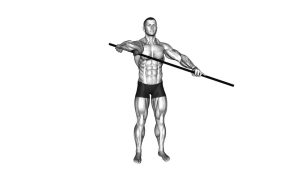
Resistance Band Assisted Front Rack Stretch: Form, Benefits, Sets & FAQ
Improve your front rack mobility with the Resistance Band Assisted Front Rack Stretch. Learn proper setup, execution, coaching tips, common mistakes, FAQs, and recommended equipment.
Resistance Band Assisted Front Rack Stretch
This stretch works best when you stay relaxed and let the band assist the position instead of fighting it. You should feel a broad stretch through the front of the shoulders, upper arms, wrists, and sometimes the upper back. Done well, it can make front rack work feel smoother and less cramped, especially if your elbows tend to drop or your wrists feel tight when the bar rests on the shoulders.
Quick Overview
| Body Part | Shoulders |
|---|---|
| Primary Muscle | Anterior deltoids and shoulder external rotation structures |
| Secondary Muscle | Wrists, forearms, triceps, and upper back stabilizers |
| Equipment | Resistance band and a secure anchor point |
| Difficulty | Beginner (easy to scale with band tension and body position) |
Sets & Reps (By Goal)
- Pre-workout mobility: 2–3 sets × 20–30 seconds
- Front rack improvement: 3–4 sets × 30–45 seconds
- Post-training recovery: 2–3 sets × 30–60 seconds
- Technique warm-up before cleans/front squats: 1–2 sets × 15–25 seconds with light band tension
Progression rule: First improve comfort, elbow height, and breathing quality. Then increase hold time or use slightly more tension if needed. Avoid turning the stretch into a forced position.
Setup / Starting Position
- Anchor the band securely: Attach a resistance band to a stable rack, post, or similar support at an appropriate height.
- Position your arms: Loop the band around your wrists or forearms, depending on the variation and comfort.
- Step back into tension: Walk back until the band applies a gentle forward pull on the arms.
- Raise the elbows: Bring the arms into a front rack-style position with elbows lifted in front of the body.
- Stand tall: Keep your chest up, ribs controlled, and spine neutral. Avoid leaning back to fake more range.
Tip: Start with a lighter band so you can hold the position without shoulder shrugging or wrist irritation.
Execution (Step-by-Step)
- Set the rack position: Lift the elbows forward and slightly up so the arms resemble your front rack setup.
- Let the band assist: Allow the band to gently guide the shoulders and arms deeper into the stretch.
- Stay upright: Maintain a tall torso and neutral neck while keeping the chest open.
- Breathe and relax: Take slow breaths and let the shoulders, wrists, and upper back gradually adapt.
- Make small adjustments: Slightly change elbow height, stance, or wrist angle to find the most effective stretch without pain.
- Exit under control: Step forward carefully to reduce band tension before fully relaxing the arms.
Pro Tips & Common Mistakes
- Keep the elbows as high as you can manage comfortably: This makes the stretch more specific to the front rack.
- Do not overarch the low back: Mobility should come from better shoulder, wrist, and upper-back positioning, not compensation.
- Use the lightest effective band tension: Too much pull usually creates tension instead of improving movement quality.
- Relax your grip and hands: Excess gripping can increase wrist and forearm tightness.
- Pair it with thoracic and lat mobility: Many front rack issues improve faster when upper-back and lat stiffness are also addressed.
- Use it before front squats or cleans: It works especially well as a short warm-up drill before rack-dependent lifts.
- Avoid forcing painful wrist extension: Mild stretch is fine, but sharp wrist discomfort means you need to back off.
FAQ
What should I feel during the Resistance Band Assisted Front Rack Stretch?
You should usually feel a controlled stretch across the front of the shoulders, upper arms, wrists, and sometimes the upper back. It should feel productive, not aggressive.
Is this exercise good before front squats or cleans?
Yes. It is especially useful before movements that require a strong front rack position, because it helps prepare the shoulders, wrists, and upper back for the posture needed under the bar.
How long should I hold the stretch?
Most people do well with 20 to 45 seconds per set. If you are using it as part of a warm-up, shorter holds usually work well. Longer holds can be useful after training or during a mobility session.
What if my wrists hurt in the front rack?
Reduce band tension, shorten the hold, and focus on lifting the elbows while staying relaxed. Wrist discomfort often improves when shoulder mobility and upper-back positioning improve too.
Can beginners use this stretch?
Yes. It is beginner-friendly because the difficulty can be adjusted easily with lighter bands, shorter holds, and less tension.
Recommended Equipment
- Functional Fitness Pull Up Assist Resistance Bands — loop-style bands suited for mobility, stretching, and assisted positioning drills like this one
- 4 Pcs Workout Band Resistance Pull Up Assist Bands Set — multiple band strengths make it easier to scale the stretch based on shoulder and wrist mobility
- LEEKEY Resistance Bands with Handles — useful if you want a broader band kit for warm-ups, mobility circuits, and general training
- Sports Wrist Brace Support Wrap — can help reduce irritation during front rack practice if your wrists are sensitive
- Amazon Best Sellers: Resistance Bands — a useful page for comparing current popular band options before choosing a set
Choose bands based on control, not maximum tension. Loop-style resistance bands are commonly recommended for mobility use, and Amazon currently lists several options specifically marketed for stretching, mobility, and assisted exercise.