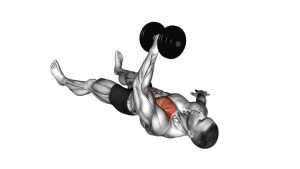
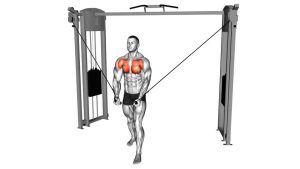
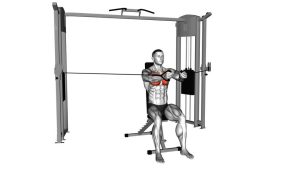
Cable Lying Fly: Proper Form, Sets & Reps, Tips, and FAQ (Chest Fly on Cables)
Learn the Cable Lying Fly (flat bench cable fly) for stronger, fuller chest development with constant cable tension. Includes setup, step-by-step form cues, sets & reps by goal, common mistakes, FAQs, and recommended equipment.
Cable Lying Fly
This movement is all about control. Use a load you can move smoothly without losing shoulder position. You should feel the work primarily in the chest, with your shoulders staying “packed” and your ribs not flaring. If you feel pinching in the front of the shoulder, shorten the range, lower the load, and slow down.
Quick Overview
| Body Part | Chest |
|---|---|
| Primary Muscle | Pectoralis major (mid/sternal fibers emphasized) |
| Secondary Muscle | Anterior deltoids (assist), biceps (stabilize), serratus anterior/scapular stabilizers (control) |
| Equipment | Dual cable station + flat bench + D-handles |
| Difficulty | Intermediate (best once you can keep shoulders stable and control the stretch) |
Sets & Reps (By Goal)
- Muscle growth (hypertrophy): 3–5 sets × 8–15 reps (60–90 sec rest)
- Chest pump / finisher: 2–4 sets × 12–20 reps (45–75 sec rest)
- Strength-biased accessory: 3–4 sets × 6–10 reps (90–120 sec rest)
- Technique/control focus: 2–3 sets × 10–12 reps (slow 3-sec lowering)
Progression rule: Add reps first (top of the range), then add a small amount of weight. Keep the same elbow bend and shoulder position—if form changes, the weight is too heavy.
Setup / Starting Position
- Bench placement: Put a flat bench centered between the cable columns. Make sure you have room to open your arms without hitting the uprights.
- Pulley height: Start with pulleys set low-to-mid (around bench height or slightly below). Adjust so the cables stay taut at the top and bottom.
- Handles: Attach D-handles. Sit on the bench, grab both handles, and carefully lie back while keeping control of the cables.
- Body position: Feet planted, glutes and upper back on the bench, ribs down. Keep a small natural arch—don’t overextend the lower back.
- Arm position: Hands start above the chest with soft elbows (about 10–20° bend). Shoulders down and back—no shrugging.
Tip: If you struggle with shoulder stability, reduce the range and use a slower lowering phase. Smooth reps beat deep reps.
Execution (Step-by-Step)
- Brace and set shoulders: Inhale, lock your upper back into the bench, and keep shoulders gently “packed” (down/back).
- Open the arms in an arc: Lower both handles outward and down in a wide “hug opening” motion. Keep the same elbow angle—don’t turn it into a press.
- Control the stretch: Stop when you feel a strong chest stretch while the shoulders remain stable (no anterior shoulder pinch).
- Squeeze back to center: Exhale and bring the handles back together above the chest using the pecs. Think “wrap the arms around the ribcage.”
- Finish strong: Pause 0.5–1 second at the top, keeping tension (don’t let the cables go slack), then repeat.
Pro Tips & Common Mistakes
- Keep elbows “locked” in position: Maintain a consistent soft bend—changing elbow angle shifts the movement toward a press.
- Let the chest stretch, not the shoulder joint: Stop the descent before the shoulders roll forward or pinch.
- Use a slow eccentric: 2–4 seconds down builds control and makes lighter weights more effective.
- Don’t bang reps together: Smooth arcs. No bouncing out of the bottom.
- Keep shoulders down: Shrugging turns it into a trap/shoulder-dominant pattern and often causes irritation.
- Set pulley height for your body: If tension disappears at the top, raise the pulleys slightly; if it feels awkward at the bottom, lower them a bit.
FAQ
Where should I feel the cable lying fly?
Mostly in the chest, especially the mid-pec area, with a controlled stretch at the bottom and a strong squeeze at the top. If you feel it mostly in the front of the shoulders, reduce range, lighten the load, and re-pack the shoulders.
What’s better: cable lying fly or dumbbell fly?
Cables often feel smoother because they provide constant tension through the whole rep and let you fine-tune the line of pull. Dumbbells are great too, but they can lose tension at the top depending on arm angle.
How low should I go at the bottom?
Go only as low as you can while keeping your shoulders stable and pain-free. A big stretch is not required—your best range is the range you can control.
Should I do these heavy?
Usually, moderate loads work best. Think 8–15 reps with perfect control. Going too heavy often turns the fly into a press and increases shoulder stress.
Where does this fit in a chest workout?
It’s excellent after presses (bench/incline) as a chest isolation lift, or as a finisher for a strong pump. Many lifters do it as the 2nd or 3rd chest movement.
Recommended Equipment (Optional)
- Cable D-Handles (Pair) — comfortable grip and smoother fly path
- Cable Straps / Multi-Purpose Attachments — useful alternatives for grip variety and joint comfort
- Lifting Straps — helps if grip fatigue limits your chest work
- Flat Weight Bench — stable base for consistent fly mechanics
- Foam Roller — great for thoracic mobility to improve chest training positions
Tip: Equipment should improve comfort and consistency—not increase strain. If something causes shoulder irritation, simplify the setup and reduce range/load.