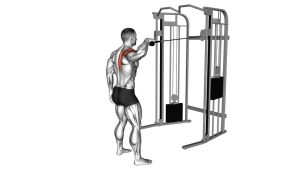
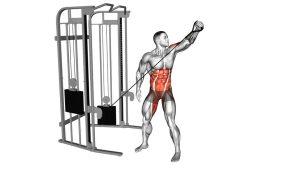
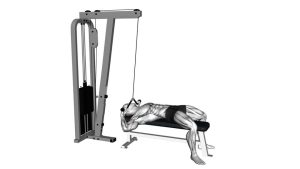
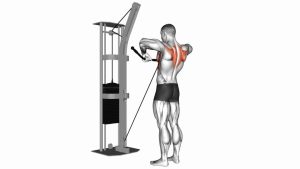
Cable One-Arm Bent-Over Lateral Raise: Form, Muscles, Sets & Tips
Learn how to do the Cable One-Arm Bent-Over Lateral Raise with perfect form to target the rear delts. Step-by-step technique, sets & reps by goal, common mistakes, FAQs, and recommended equipment.
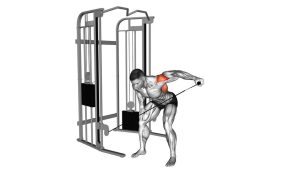
Cable One-Arm Bent-Over Lateral Raise
This exercise rewards light-to-moderate load and precision. If you feel your upper traps taking over, your torso twisting, or the movement turning into a “row,” lower the weight and focus on the rear delt doing the work. Your reps should look almost identical from start to finish.
Quick Overview
| Body Part | Shoulders (Rear) |
|---|---|
| Primary Muscle | Rear deltoid (posterior deltoid) |
| Secondary Muscle | Middle deltoid (assist), rotator cuff, mid/lower traps (stabilization) |
| Equipment | Cable machine (low pulley) + single handle |
| Difficulty | Beginner–Intermediate (easy to learn, hard to master with perfect control) |
Sets & Reps (By Goal)
- Hypertrophy (rear delts): 3–5 sets × 10–20 reps (45–75 sec rest)
- Strength focus (strict form): 3–5 sets × 6–10 reps (75–120 sec rest)
- Endurance / pump finisher: 2–4 sets × 15–30 reps (30–60 sec rest)
- Warm-up / activation: 2–3 sets × 12–20 reps (light load, slow tempo)
Progression rule: Add reps first. When you can hit the top of your rep range with clean, no-swing reps, increase the weight slightly (small jumps).
Setup / Starting Position
- Set the cable low: Attach a single handle to the low pulley.
- Stand side-on: The working arm is usually the one farther from the stack to keep a clean line of pull.
- Hip hinge: Push hips back and lean forward (about 45–70°). Keep a neutral spine.
- Brace lightly: Slight knee bend. Keep ribs down and torso stable—no twisting.
- Start position: Working arm hangs down with a soft elbow and the shoulder “set” (not shrugged).
Tip: Step slightly away from the cable to maintain tension at the bottom—avoid letting the stack go slack.
Execution (Step-by-Step)
- Lock in your hinge: Keep your torso angle steady and shoulders level.
- Lead with the elbow: Raise the arm out to the side in a controlled arc. Keep a slight bend—don’t straighten or curl.
- Stop at the right height: Lift until the upper arm is roughly in line with your torso (about shoulder height relative to your body).
- Pause and squeeze: Hold 1 second and feel the rear delt working—not the traps.
- Lower slowly: Return with control for 2–3 seconds, keeping tension on the cable.
Pro Tips & Common Mistakes
Pro Tips
- Use a “rear-delt” arc: Lift out to the side, not backward into a row.
- Stay stable: Keep ribs down and hips square—no twisting for extra range.
- Tempo wins: Try 1–2 seconds up, 1 second squeeze, 2–3 seconds down.
- Keep traps quiet: Shoulder stays away from the ear; think “wide shoulder.”
- Best placement: Works great after presses/rows or as a shoulder-finisher.
Common Mistakes
- Too heavy → swinging: Momentum steals tension from the rear delt.
- Shrugging up: Turns it into a trap-dominant rep.
- Turning it into a row: Elbow pulls behind the body instead of lifting out.
- Letting tension disappear: Stepping too close and losing cable tension at the bottom.
- Overextending the neck: Keep head aligned with spine—don’t crank upward.
FAQ
Where should I feel this exercise?
Mainly in the rear delts (back of the shoulder). A small amount of upper-back stabilization is normal, but if your upper traps dominate, reduce weight and keep the shoulder down.
Should my arm go higher than shoulder level?
Usually no. Lifting much higher often causes shrugging and shifts tension away from the rear delt. Aim for a strong squeeze with clean mechanics instead of chasing height.
Why do I feel it in my traps?
Common reasons include going too heavy, shrugging, or losing torso stability. Keep the shoulder “set,” slow down the tempo, and lead with the elbow without hiking the shoulder.
Is this better than dumbbell rear delt raises?
The cable version often feels smoother because it provides more consistent tension through the range. Dumbbells can still be great—use both across your program.
How often should I train rear delts?
Many lifters do well with 2–4 sessions per week (moderate volume), since rear delts recover fairly quickly. Keep quality high and avoid sloppy swinging reps.
Recommended Equipment
- Single D-Handle Cable Attachment — improves grip comfort and keeps your wrist neutral
- Cable Strap Attachment (Multi-purpose) — versatile strap for different angles and joint-friendly setups
- Lifting Straps — reduces grip limitation so you can focus on rear delt tension
- Resistance Bands Set — great for rear-delt warm-ups (pull-aparts, face-pull patterns)
- Adjustable Workout Bench — helps you brace for strict rear-delt work and accessory shoulder training
Tip: For the cleanest reps, keep the load modest and prioritize control + consistent tension. Rear delts grow best with high-quality volume.