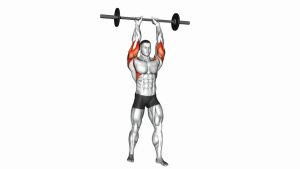
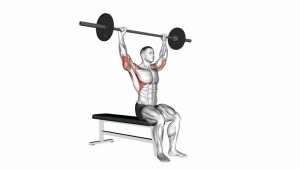
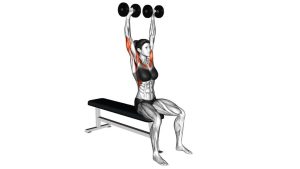
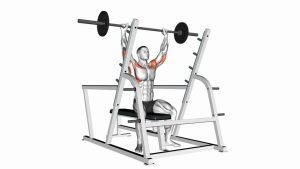
Smith Machine Standing Military Press: Form, Muscles Worked, Sets, Tips & FAQ
Learn how to perform the Smith Machine Standing Military Press with proper form. Discover muscles worked, setup, step-by-step execution, sets and reps by goal, common mistakes, FAQs, and recommended equipment.
Smith Machine Standing Military Press
This exercise is excellent for lifters who want to build stronger shoulders with more stability than a free-weight overhead press. The Smith machine reduces balance demands, which makes it easier to focus on bar path, shoulder engagement, and repetition quality. It works well for both muscle-building phases and shoulder-focused upper-body sessions.
Quick Overview
| Body Part | Shoulders |
|---|---|
| Primary Muscle | Anterior deltoids |
| Secondary Muscle | Lateral deltoids, triceps, upper chest, upper traps, core stabilizers |
| Equipment | Smith machine |
| Difficulty | Intermediate |
Sets & Reps (By Goal)
- Muscle growth: 3–5 sets × 6–12 reps with 60–90 seconds rest
- Strength focus: 4–6 sets × 4–6 reps with 2–3 minutes rest
- Technique / control: 2–4 sets × 8–10 reps with a slower lowering phase
- Shoulder accessory work: 2–4 sets × 10–15 reps with moderate weight and strict form
Progression rule: Add load only when you can press through a full, controlled range without leaning back, bouncing at the bottom, or losing shoulder position.
Setup / Starting Position
- Set the bar height: Position the Smith bar around upper-chest or collarbone height so you can unrack it safely.
- Choose your stance: Stand with feet about shoulder-width apart for a stable base.
- Grip the bar: Use a pronated grip slightly wider than shoulder width.
- Align your body: Stand so the bar starts near the upper chest with your head slightly clear of its path.
- Brace hard: Tighten your core, squeeze your glutes, lift the chest slightly, and keep the spine neutral.
- Set your elbows: Keep them slightly under or just in front of the bar rather than flaring them too wide.
Tip: A narrow stance can make balance harder, while an overly split stance can reduce pressing efficiency. Stay rooted and symmetrical.
Execution (Step-by-Step)
- Unrack the bar: Rotate the bar out of the hooks and settle it at upper-chest level.
- Press upward: Drive the bar vertically overhead while keeping your torso tall and your core braced.
- Move your head naturally: Let the head shift slightly back so the bar can travel in a clean line.
- Reach full lockout: Finish with elbows extended overhead without shrugging excessively or forcing the lower back into extension.
- Lower with control: Bring the bar back down to the upper chest in a smooth, deliberate descent.
- Repeat clean reps: Maintain the same stance, shoulder position, and bar path on every rep.
Pro Tips & Common Mistakes
- Keep ribs down: Prevent excessive arching by bracing your abs before every rep.
- Press through the shoulders: Do not turn the movement into a standing incline press by leaning back too much.
- Use a controlled bottom position: Lower to the upper chest, not deep into an uncomfortable range.
- Do not flare excessively: Very wide elbows can make the lift less efficient and more stressful on the shoulders.
- Avoid bouncing: Do not rebound the bar off the bottom to create momentum.
- Stay smooth at lockout: Finish strongly without slamming the elbows straight.
- Match the machine path: Stand in the right position so the fixed bar path feels natural rather than awkward.
FAQ
What muscles does the Smith Machine Standing Military Press work?
It primarily targets the anterior deltoids while also training the lateral deltoids, triceps, and upper-body stabilizers. Your core and glutes also help keep your body rigid during the press.
Is this better than a barbell overhead press?
It is not automatically better, but it is often easier to control. The Smith machine provides a fixed bar path, which can help lifters focus on shoulder tension, technique, and hypertrophy without as much balance demand.
How low should I lower the bar?
Lower the bar to around the upper chest or collarbone area if that feels strong and pain-free. You do not need to force extra depth if it causes shoulder discomfort or makes you lose position.
Should I use heavy weight on this exercise?
You can train it heavy, but only if you can keep a stable torso and a clean press path. If the rep turns into a back bend, reduce the weight and rebuild the pattern.
Can beginners use this movement?
Yes, many beginners find it easier than free-weight overhead pressing because the machine adds stability. Still, start light and learn proper shoulder alignment before pushing the load.
Recommended Equipment
- Gymreapers Wrist Wraps — useful for extra wrist support during heavier overhead pressing
- Harbinger 4-Inch Padded Leather Lifting Belt — helps improve trunk bracing and support on heavy working sets
- Fit Simplify Resistance Loop Exercise Bands — great for shoulder warm-ups, activation drills, and post-workout accessory work
- Foam Roller — helpful for thoracic mobility work before pressing sessions
- Liquid Chalk — improves grip security if your hands get slick during training
Tip: Accessories should support better pressing mechanics, not hide poor technique. Prioritize bar path, shoulder position, and core control first.