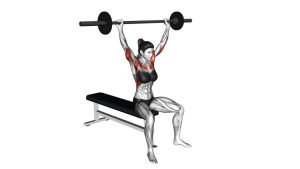
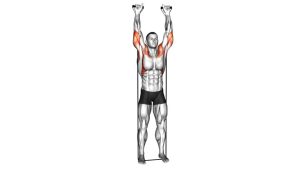
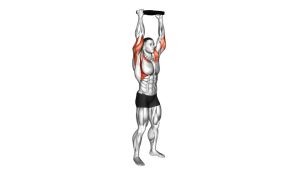
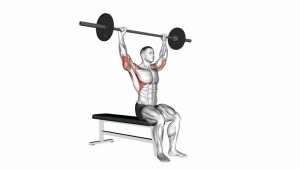
Standing Behind-the-Neck Press: Proper Form, Sets, Mistakes & FAQ
Learn how to perform the Standing Behind-the-Neck Press with proper form. Discover muscles worked, setup, execution steps, sets and reps by goal, common mistakes, FAQs, and recommended equipment.
Standing Behind-the-Neck Press
This exercise can be highly effective for building shoulder strength and size, but it is also less forgiving than a standard front overhead press. Because the bar starts behind the neck, your shoulders must move well and your upper back must stay tall. The best reps look smooth, balanced, and controlled from the bottom position to full lockout overhead.
Quick Overview
| Body Part | Shoulders |
|---|---|
| Primary Muscle | Deltoids (especially side delts, with strong overall shoulder involvement) |
| Secondary Muscle | Triceps, upper traps, upper back stabilizers, rotator cuff |
| Equipment | Barbell, weight plates, optional squat rack |
| Difficulty | Intermediate to Advanced |
Sets & Reps (By Goal)
- Muscle building: 3-4 sets × 6-10 reps
- Strength focus: 4-5 sets × 3-6 reps
- Technique practice: 2-4 sets × 5-8 reps with light to moderate weight
- Shoulder accessory work: 2-3 sets × 8-12 reps after main pressing work
Progression tip: Increase load only when you can press smoothly from the bottom without leaning back, flaring the ribcage, or cutting the range short.
Setup / Starting Position
- Set the bar at upper-chest to shoulder height in a rack so you can unrack it safely behind the neck.
- Take a slightly wider-than-shoulder-width grip so the shoulders can move more naturally through the press.
- Position the bar across the upper traps, not pressing hard into the neck.
- Stand tall with feet about shoulder-width apart and keep your weight evenly distributed through the floor.
- Brace your core and glutes to prevent excessive lower-back arching.
- Keep the chest up and elbows under the bar as much as your mobility allows.
A stable starting position matters here. If your setup is loose, the rep usually turns into a risky grind instead of a clean press.
Execution (Step-by-Step)
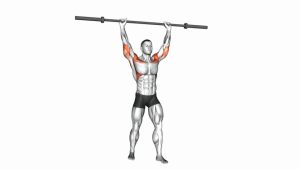
- Start from a tall, braced stance: Keep your ribs down, neck neutral, and upper back active.
- Press the bar straight upward: Drive the bar from behind the neck toward a strong overhead position.
- Move your head slightly forward under the bar once the bar clears the back of the head so it can stack over the shoulders.
- Lock out overhead with control: Finish with straight arms, active shoulders, and the bar balanced over your mid-foot.
- Lower the bar slowly: Bring it back down to the upper traps under control instead of dropping or bouncing it.
- Repeat for smooth, even reps: Every repetition should follow the same vertical path.
Pro Tips & Common Mistakes
- Use a controlled range: Lower only as far as your shoulders can handle without pain or compensation.
- Keep the torso upright: Too much backward lean shifts the work away from the shoulders and stresses the lower back.
- Do not slam the bar onto the traps: Lower it gently and stay tight between reps.
- Avoid excessive ego loading: This lift punishes poor mobility and rushed progression.
- Warm up the shoulders first: Band work, light presses, and upper-back activation can improve the quality of your sets.
- Use a rack whenever possible: It makes the setup safer and more repeatable than trying to muscle the bar into place.
- Do not force the bottom position: If mobility is limited, shorten the range instead of pushing through joint discomfort.
FAQ
What muscles does the Standing Behind-the-Neck Press work most?
It primarily targets the shoulders, especially the deltoids. The triceps, upper traps, and upper-back stabilizers also help support the movement.
Is the behind-the-neck press bad for shoulders?
Not automatically, but it can be a poor choice for lifters with limited mobility, previous shoulder issues, or poor overhead mechanics. It needs good control and should never feel forced.
Should beginners do this exercise?
Most beginners are better off learning the standard overhead press first. The behind-the-neck version is more demanding and usually fits better for experienced lifters with solid mobility.
How low should I bring the bar?
Lower the bar only as far as you can while maintaining good posture, shoulder comfort, and bar control. Full depth is not worth it if the bottom position causes pain or compensation.
Can I use this for shoulder size?
Yes. When programmed intelligently, it can be an effective shoulder hypertrophy exercise. Moderate reps with strict form usually work better than chasing maximal weight.
Recommended Equipment (Optional)
- Olympic Barbell — the main tool for performing the exercise with stable loading and consistent grip spacing
- Bumper Plates — useful for progressive loading and safer training in home or garage gyms
- Power Rack — makes unracking and reracking the bar much safer for standing press variations
- Weightlifting Belt — optional support for bracing during heavier strength-focused sets
- Resistance Bands Set — helpful for shoulder warm-ups, rotator cuff activation, and upper-back prep before pressing
Choose equipment that improves setup quality and control. Better positioning usually leads to better reps.