Dumbbell Arnold Press : Proper Form, Sets, Tips & FAQ
Learn how to perform the Dumbbell Arnold Press with proper form to build stronger, fuller shoulders. Includes setup, step-by-step execution, sets and reps by goal, common mistakes, FAQs, and recommended equipment.
Dumbbell Arnold Press
This exercise is excellent for lifters who want more complete shoulder development while improving pressing control. Compared with a standard dumbbell shoulder press, the Arnold Press adds a rotational component that increases time under tension and requires better shoulder coordination. Keep the movement smooth from bottom to top, avoid leaning back, and choose a load you can rotate and press without losing posture.
Quick Overview
| Body Part | Shoulders |
|---|---|
| Primary Muscle | Front deltoids (anterior shoulders) |
| Secondary Muscle | Side deltoids, triceps, upper chest, rotator cuff stabilizers |
| Equipment | Dumbbells; optional adjustable bench for seated variation |
| Difficulty | Beginner to Intermediate |
Sets & Reps (By Goal)
- Muscle growth: 3-4 sets × 8-12 reps with 60-90 sec rest
- Strength focus: 4-5 sets × 5-8 reps with 90-120 sec rest
- Shoulder control / technique: 2-3 sets × 10-15 reps with light-to-moderate weight
- Accessory after main pressing: 2-4 sets × 8-12 reps with strict form
Progression tip: Increase reps first, then add weight once you can complete every rep with a smooth rotation, a full press, and no torso lean.
Setup / Starting Position
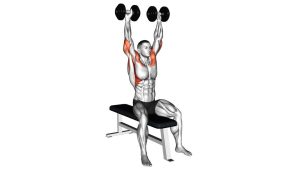
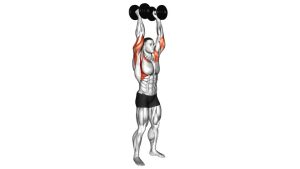
- Choose your stance: Sit upright on a bench with back support or stand tall with feet about hip-width apart.
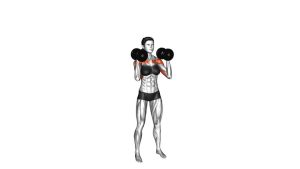
- Bring the dumbbells up: Hold a dumbbell in each hand at shoulder level.
- Start palms in: Palms face your body with elbows bent and slightly in front of the torso.
- Brace your core: Keep ribs down, glutes lightly engaged, and spine neutral.
- Set the shoulders: Keep shoulders down and back without shrugging.
Tip: A seated setup makes it easier to reduce momentum and focus on shoulder-driven movement.
Execution (Step-by-Step)
- Start from the bottom: Dumbbells are close to the front of the shoulders with palms facing inward.
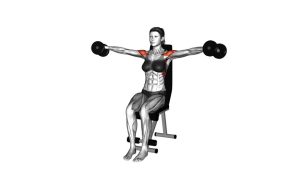
- Press and rotate together: Drive the dumbbells upward while rotating the palms outward.
- Finish overhead: At the top, arms are extended above the shoulders and palms face forward.
- Pause briefly: Lock in the top position without shrugging or overextending the lower back.
- Lower with control: Reverse the motion by lowering the dumbbells and rotating the palms back toward the body.
- Return to the start: Finish in the same front-rack position and repeat smoothly.
Pro Tips & Common Mistakes
- Use controlled rotation: Don’t rush the wrist turn; make it smooth from bottom to top.
- Keep elbows slightly forward at the bottom: This helps the shoulders move through the intended path.
- Press overhead, not forward: Finish with the dumbbells stacked over the shoulders.
- Don’t lean back: Excessive torso lean turns the movement into a standing incline press.
- Avoid shrugging: Let the delts do the work instead of lifting the shoulders toward the ears.
- Choose the right load: Too much weight usually ruins the rotation before it builds the shoulders.
- Control the lowering phase: The eccentric matters for shoulder growth and joint control.
FAQ
What muscles does the Dumbbell Arnold Press work most?
The main target is the front deltoid, while the side delts and triceps assist. The rotational path also increases shoulder-control demands.
Is the Arnold Press better than a regular dumbbell shoulder press?
It is not automatically better, but it does provide a different stimulus. The Arnold Press increases range of motion and time under tension, while a standard shoulder press is often easier to load heavier.
Should I do it seated or standing?
Both work well. Seated is usually better for strict form and shoulder isolation. Standing adds more core demand and overall stability.
Why do my shoulders or wrists feel uncomfortable?
The load may be too heavy, your wrists may be bending backward, or the rotation may be too forced. Reduce the weight and keep the wrists stacked over the forearms.
Can beginners use the Arnold Press?
Yes, but beginners should start light and master the rotation first. If the movement feels awkward, build confidence with a standard dumbbell shoulder press before progressing.
Recommended Equipment
- BowFlex SelectTech 552 Adjustable Dumbbells — adjustable dumbbells that replace multiple fixed weights, making them ideal for progressive shoulder training
- Adjustable Dumbbells — a practical option for home workouts when you want several loading options without buying many separate pairs
- FLYBIRD Adjustable Weight Bench — useful for seated Arnold Press variations and other upper-body dumbbell work
- Harbinger Pro WristWrap Weightlifting Gloves — adds grip comfort and wrist support if pressing volume irritates the wrists
- Harbinger 18-Inch Wrist Wraps — a simple support option for lifters who want extra wrist stability during pressing sessions
Choose equipment that supports clean technique first. For most people, a solid pair of adjustable dumbbells and a stable bench provide the best return for shoulder-focused training.