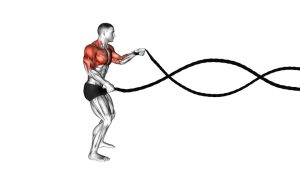
Battling Ropes High Waves (Plyometric): Form, Sets, Benefits & FAQ
Learn how to perform Battling Ropes High Waves (Plyometric) with proper form for explosive conditioning, shoulder endurance, and full-body power. Includes setup, execution, sets by goal, mistakes, FAQs, and recommended equipment.
Battling Ropes High Waves (Plyometric)
This variation is best performed with an aggressive but controlled tempo. The arms generate the waves, but the legs and core help absorb force and transfer power. You should feel the exercise in the shoulders, arms, upper back, and trunk, along with a strong cardiovascular demand as the set continues. Focus on producing crisp, repeatable waves rather than simply moving as fast as possible with sloppy mechanics.
Quick Overview
| Body Part | Plyometrics |
|---|---|
| Primary Muscle | Shoulders (especially anterior delts) |
| Secondary Muscle | Upper back, forearms, core, quads, calves |
| Equipment | Battle ropes anchored securely to a fixed point |
| Difficulty | Intermediate (high-intensity conditioning and power output) |
Sets & Reps (By Goal)
- Power development: 4–6 sets × 10–20 seconds, full effort, 60–90 seconds rest
- Conditioning / HIIT: 6–10 rounds × 20–30 seconds work, 30–60 seconds rest
- Athletic finisher: 3–5 sets × 15–25 seconds, 45–75 seconds rest
- General fitness: 3–4 sets × 20–40 seconds at a sustainable but challenging pace
Progression rule: Increase wave quality, work time, or density before dramatically increasing total volume. The best sets keep the waves high, even, and explosive from start to finish.
Setup / Starting Position
- Anchor the ropes securely: Make sure the rope setup is stable and the anchor point can handle repeated explosive waves.
- Choose your distance: Stand far enough back to create slight rope tension without pulling the ropes completely off the floor.
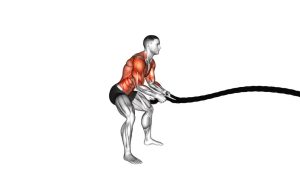
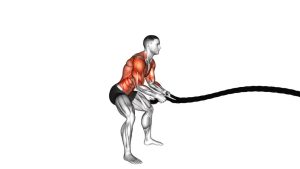
- Take an athletic stance: Feet about shoulder-width apart, knees soft, hips slightly back, chest tall.
- Brace your trunk: Keep your ribs stacked over your pelvis and your core tight so the torso does not collapse or overextend.
- Set the arms forward: Hold the rope ends firmly with neutral wrists and relaxed but active shoulders.
Tip: A slight forward torso lean usually helps keep the body in a strong athletic position without turning the movement into a back-driven swing.
Execution (Step-by-Step)
- Load the stance: Stay springy through the knees and ankles with the core braced.
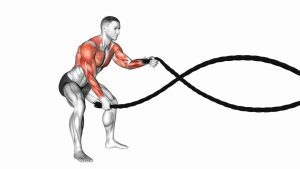
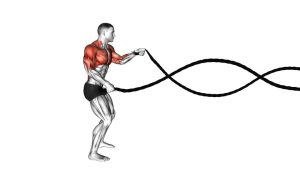
- Drive both arms upward: Lift the rope ends powerfully to create tall, synchronized waves.
- Slam the arms downward: Reverse direction quickly and snap the ropes down to send force through the entire rope length.
- Use rhythmic rebound: Let the lower body absorb and recycle force so each repetition flows into the next.
- Repeat explosively: Maintain consistent wave height, tempo, and posture until the set ends.
Pro Tips & Common Mistakes
- Create waves from the whole body: The arms lead, but the legs and core help drive the rhythm.
- Keep the wrists neutral: Avoid excessive bending or flopping at the hands.
- Do not shrug excessively: Let the shoulders move freely, but do not let the traps dominate every rep.
- Stay on balance: Avoid rocking too far backward or letting the heels become heavy.
- Don’t turn it into random flailing: Big, controlled waves beat fast, sloppy movement.
- Cut sets before technique collapses: Rope conditioning is most effective when power and wave height stay high.
FAQ
What muscles do battling ropes high waves work most?
This variation primarily challenges the shoulders, especially the front delts, while also training the upper back, forearms, core, and lower body as stabilizers and force transmitters.
Are high waves better for power or cardio?
They can do both. Short, all-out sets are great for power output, while repeated intervals with limited rest are highly effective for conditioning and calorie-burning work.
How long should each set last?
Most lifters do well with 10 to 30 seconds per set depending on the goal. Explosive power sets are usually shorter, while conditioning intervals can be slightly longer.
Should I use a squat with every wave?
Not necessarily. A small athletic bounce is normal, but you do not need a deep squat. The goal is to stay springy and powerful, not to turn the exercise into a full squat pattern.
Is this exercise beginner-friendly?
It can be learned by beginners, but the plyometric version is usually better once you can already control basic rope waves with good posture and rhythm.
Recommended Equipment
- Battle Ropes — the main tool for high-wave training; choose a rope length and diameter that matches your strength level and training space
- Battle Rope Anchor Kit — helps secure the rope to a stable point and protects the rope during repeated explosive use
- Gymboss Interval Timer — useful for timed work/rest intervals during HIIT, conditioning circuits, and power rounds
- Gym Interval Timer — a larger-format timer option for garage gyms, studios, or group conditioning sessions
- 2-Inch 30-Foot Battle Rope Options — a popular heavy-duty size range for challenging wave training and strong conditioning sessions
Tip: Prioritize a secure anchor and enough floor space before increasing rope size. Better setup usually improves wave quality more than simply choosing heavier equipment.