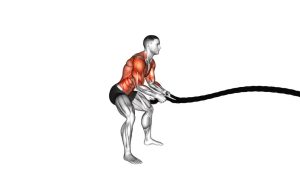
Battling Ropes Alternating Waves: Form, Sets, Benefits, Tips & FAQ
Learn how to perform battling ropes alternating waves with proper form. Discover muscles worked, setup, sets and reps by goal, common mistakes, FAQs, and recommended equipment.
Battling Ropes Alternating Waves
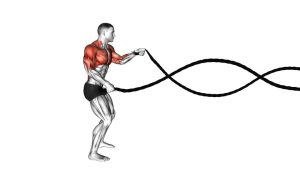
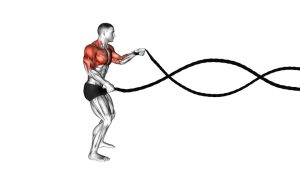
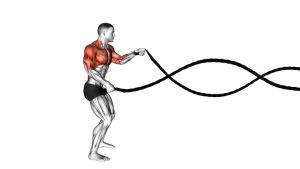
Battling ropes alternating waves look simple, but they demand full-body coordination. The arms generate the wave pattern, while the legs and core stabilize the body so power can travel efficiently into the ropes. When done well, this movement challenges the shoulders, arms, upper back, and trunk without requiring complicated technique or heavy external loading.
Quick Overview
| Body Part | Cardio |
|---|---|
| Primary Muscle | Shoulders (Deltoids) |
| Secondary Muscle | Biceps, Triceps, Forearms, Trapezius, Core, Glutes, Quadriceps |
| Equipment | Battle ropes with a secure anchor point |
| Difficulty | Beginner to Intermediate |
Sets & Reps (By Goal)
- General conditioning: 3–5 sets of 20–30 seconds, 45–75 seconds rest
- Fat-loss circuits: 3–6 rounds of 15–25 seconds, 20–40 seconds rest
- Power endurance: 4–6 sets of 30–45 seconds, 60–90 seconds rest
- Beginner skill practice: 2–4 sets of 10–20 seconds, full recovery between rounds
Progression rule: Increase work time, wave consistency, or intensity gradually. Do not progress by simply going faster if posture, breathing, and rhythm start to collapse.
Setup / Starting Position
- Anchor the ropes securely: Make sure the ropes are attached to a stable anchor that can handle explosive movement.
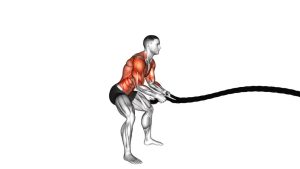
- Stand in an athletic stance: Place your feet about shoulder-width apart with knees softly bent.
- Set the hips and torso: Hinge slightly at the hips, keep the chest up, and brace your core.
- Grip each rope end firmly: Hold one rope end in each hand with your arms in front of the body.
- Create light rope tension: Step back until the ropes are off the floor but not fully stretched tight.
Tip: A slight forward lean helps you stay balanced and produce stronger, cleaner waves.
Execution (Step-by-Step)
- Brace before you move: Tighten your midsection and keep your neck neutral.
- Start the wave pattern: Lift one arm while driving the other arm down.
- Alternate rapidly: Switch sides in a steady rhythm so one arm rises as the other falls.
- Send the wave down the ropes: Aim to create visible, even ripples that travel all the way toward the anchor.
- Keep the lower body stable: Let the arms move fast while the torso stays controlled.
- Finish with posture intact: End the set before the shoulders shrug, the back rounds, or the waves become sloppy.
Pro Tips & Common Mistakes
- Stay athletic: Keep a soft bend in the knees instead of standing tall and stiff.
- Brace the core: Your trunk should resist excessive twisting and bouncing.
- Make the waves even: Consistent left-right rhythm creates better training quality.
- Do not shrug the shoulders: Keep tension out of the neck and upper traps as much as possible.
- Use the arms, not wild body swing: The torso should support the motion, not replace it.
- Breathe naturally: Avoid holding your breath during longer intervals.
- Stop before technique falls apart: Quality intervals beat messy exhaustion.
FAQ
What muscles do battling ropes alternating waves work?
This exercise mainly targets the shoulders, while also training the arms, forearms, upper back, core, glutes, and legs as stabilizers. It is a full-body conditioning movement even though the ropes are driven by the arms.
Is this exercise good for fat loss?
Yes. Battling ropes alternating waves can raise heart rate quickly, making them useful for calorie-burning circuits, HIIT sessions, and general conditioning workouts.
Should I go as fast as possible?
Not right away. Focus first on producing clean, repeatable waves. Once the rhythm is solid and posture stays stable, you can gradually increase speed and intensity.
How long should one set last?
Most lifters do well with sets lasting 15 to 45 seconds, depending on the goal. Shorter bursts work well for power and intervals, while longer bouts build endurance.
Can beginners use battling ropes?
Yes. Beginners can start with shorter intervals, lighter rope demands, and a focus on posture and rhythm. It is a scalable exercise when intensity is controlled properly.
Recommended Equipment
- Battle Ropes — the main tool for alternating waves, intervals, and conditioning work
- Battle Rope Anchor Kit — helps create a stable, secure anchor point for safer training
- Workout Grip Gloves — useful for grip comfort, callus reduction, and longer high-volume sessions
- Rubber Gym Flooring — improves traction and protects the training surface in home gym setups
- Interval Gym Timer — makes it easier to structure work-rest intervals for HIIT and conditioning sessions
Tip: Choose rope length and thickness based on your training level and available space. A secure anchor and stable floor matter just as much as the ropes themselves.