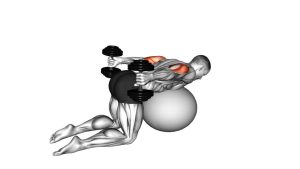
Dumbbell Biceps Curl with Overhead Triceps Extension on Stability Ball: Form, Sets, Tips & FAQ
Learn how to perform the Dumbbell Biceps Curl with Overhead Triceps Extension on a Stability Ball with proper form. Includes setup, step-by-step execution, sets and reps by goal, mistakes to avoid, FAQs, and recommended equipment.
Dumbbell Biceps Curl with Overhead Triceps Extension on Stability Ball
This exercise demands more than arm strength. Because you are balancing with one foot on a stability ball while moving each arm through a different pattern, you need strong postural control, core bracing, and shoulder stability. The goal is to perform both arm actions smoothly without twisting the torso, leaning excessively, or losing balance.
Quick Overview
| Body Part | Arms |
|---|---|
| Primary Muscle | Biceps brachii and triceps brachii |
| Secondary Muscle | Deltoids, forearms, core stabilizers, glutes, and ankle stabilizers |
| Equipment | Two dumbbells and one stability ball |
| Difficulty | Advanced |
Sets & Reps (By Goal)
- Muscle endurance and control: 2–3 sets × 8–12 reps per side using light dumbbells
- Coordination and stability training: 2–4 sets × 6–8 slow reps per side with full control
- Light hypertrophy finisher: 2–3 sets × 10–12 reps per side with strict form and moderate tempo
- Athletic balance challenge: 2–3 sets × 5–8 reps per side focusing on posture and precision
Progression rule: Increase control and balance quality before increasing load. This exercise is most effective when the movement stays smooth, upright, and stable from start to finish.
Setup / Starting Position
- Pick up two light dumbbells: Start lighter than you would for regular curls or overhead extensions.
- Set your stance: Stand tall with one foot firmly planted on the floor and the other foot resting lightly on top of a stability ball behind or slightly beside you.
- Bring one dumbbell overhead: Hold one dumbbell above the shoulder with the elbow bent so the weight lowers behind the head.
- Let the other arm hang naturally: The opposite arm starts down by your side, ready for the curl.
- Brace your core: Keep your ribs down, chest lifted, and hips square. Avoid leaning into the planted leg.
Tip: Before adding the arm movement, practice standing in position with one foot on the ball until your balance feels steady.
Execution (Step-by-Step)
- Start from the split position: One arm is bent overhead in the triceps stretch position, and the other arm is fully extended at your side.
- Extend the overhead arm: Press the overhead dumbbell upward by straightening the elbow without flaring the ribcage or arching the lower back.
- Begin the curl with the opposite arm: As the overhead arm reaches lockout, curl the other dumbbell upward toward the shoulder.
- Reach the top under control: The overhead arm finishes straight above the head while the curling arm reaches peak contraction near the chest or shoulder.
- Lower both dumbbells slowly: Bend the overhead elbow to return behind the head while lowering the curl back down to the starting position.
- Reset and repeat: Maintain steady posture throughout the rep, then continue for the target number of reps before switching sides if needed.
Pro Tips & Common Mistakes
- Use light dumbbells: The stability demand makes this much harder than a normal curl or extension.
- Move slowly: Quick reps make balance harder and reduce muscular control.
- Keep the core braced: Don’t let the lower back arch during the overhead extension.
- Control the ball-side leg: The foot on the ball is for balance challenge, not for pushing hard into the ball.
- Don’t swing the curl: Use elbow flexion, not momentum from the hips or torso.
- Keep the overhead elbow stable: Avoid letting it drift too far out to the side.
- Master simpler versions first: Practice standing overhead extensions and curls separately before combining them on an unstable base.
FAQ
Is this exercise good for beginners?
No. This is better suited for intermediate to advanced trainees because it combines arm isolation, balance, coordination, and core stabilization in one movement.
What weight should I use?
Use lighter dumbbells than you normally would for standard curls or overhead extensions. The instability and coordination demands make even light weights feel much harder.
What if I can’t balance on the stability ball?
Start by removing the ball and performing the arm pattern from a stable standing stance. Then progress to placing one foot lightly on the ball only after you can control the movement safely.
What muscles does this exercise target most?
The main muscles are the biceps brachii and triceps brachii. Your shoulders, core, glutes, and ankle stabilizers also work hard to keep your body steady.
Is this exercise for strength or coordination?
It is more useful as a coordination, stability, and muscular-control exercise than as a pure strength movement. Most lifters should keep the load moderate and prioritize form.
Recommended Equipment
- Adjustable Dumbbells — versatile for progressing curls, extensions, and other arm exercises without needing multiple fixed weights
- Exercise Stability Ball — essential for adding the balance and coordination challenge used in this variation
- Exercise Mat — helps create a more secure training area and can improve comfort and traction around your setup
- Wrist Wraps — useful for lifters who want extra wrist support during curls and overhead work
- Adjustable Weight Bench — helpful for regressing to seated or supported arm work before progressing to unstable standing variations
Tip: For most people, a stable standing version of this movement is safer and easier to load properly than the stability-ball variation.