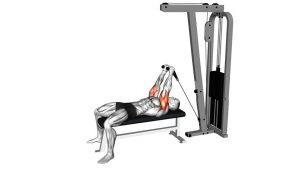
Dumbbell Lying One-Arm Supinated Triceps Extension: Form, Sets, Tips & FAQ
Learn the Dumbbell Lying One-Arm Supinated Triceps Extension with proper form, setup, execution steps, sets by goal, common mistakes, FAQs, and recommended Amazon equipment for stronger triceps training.
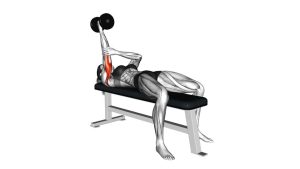
Dumbbell Lying One-Arm Supinated Triceps Extension
This exercise works best when the movement stays strict and the shoulder stays quiet. The elbow should act as the main hinge while the dumbbell travels in a controlled arc. You should feel the triceps doing most of the work, especially near the stretch at the bottom and the final third of the lift on the way up. Because this is a single-arm variation, it is also useful for identifying left-to-right strength differences.
Quick Overview
| Body Part | Triceps |
|---|---|
| Primary Muscle | Triceps brachii |
| Secondary Muscle | Anconeus, forearm stabilizers, shoulder stabilizers |
| Equipment | One dumbbell, flat bench |
| Difficulty | Intermediate |
Sets & Reps (By Goal)
- Muscle growth: 3–4 sets × 8–12 reps per arm, 60–90 sec rest
- Strength-focused accessory work: 3–5 sets × 6–8 reps per arm, 90–120 sec rest
- Technique and control: 2–3 sets × 10–15 reps per arm, slow tempo, 45–75 sec rest
- Finisher / pump work: 2–3 sets × 12–15 reps per arm, shorter rest, strict form
Progression rule: Increase reps first, then load. Only go heavier when you can keep the upper arm stable, the wrist neutral, and the lowering phase smooth and controlled.
Setup / Starting Position
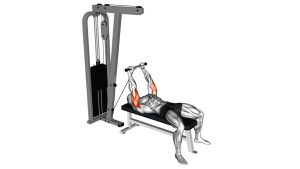
- Lie flat on a bench: Keep your head, upper back, and glutes supported, with feet planted firmly on the floor.
- Hold one dumbbell in one hand: Use a supinated grip so the palm faces toward your face or head.
- Press the dumbbell above the shoulder: Start with the working arm nearly straight and the elbow pointing upward.
- Stabilize the upper arm: Keep the shoulder packed and avoid letting the elbow drift too far forward or backward.
- Brace lightly: Keep the ribcage down and torso quiet so the movement stays isolated at the elbow.
Tip: Start with your weaker arm first and match the same reps on the stronger side to keep your training balanced.
Execution (Step-by-Step)
- Begin at the top: Hold the dumbbell above the shoulder with the palm turned inward toward your face and the elbow nearly locked.
- Lower under control: Bend the elbow slowly and bring the dumbbell down beside the head in a smooth arc.
- Keep the upper arm steady: Let the forearm move while the upper arm stays mostly fixed in position.
- Reach a comfortable stretch: Lower until you feel solid triceps tension without collapsing the shoulder or forcing range.
- Extend the elbow: Drive the dumbbell back up by squeezing the triceps and returning to the start position.
- Finish with control: Stop just short of an aggressive lockout and maintain tension before starting the next rep.
Pro Tips & Common Mistakes
- Keep the elbow as the hinge: Avoid turning the rep into a press or pullover.
- Use a slow eccentric: Lowering under control improves tension and protects the elbow.
- Don’t overreach the bottom: Go only as deep as you can while keeping the shoulder stable.
- Keep the wrist neutral: Don’t let the dumbbell fold the wrist backward.
- Don’t flare excessively: A little natural movement is fine, but too much flare reduces control.
- Train both sides evenly: This unilateral variation is excellent for correcting arm imbalances.
- Use moderate loads: This exercise rewards precision more than ego lifting.
FAQ
What does the supinated grip change in this exercise?
The supinated grip changes wrist and arm position slightly, which can improve comfort and help some lifters feel a cleaner triceps contraction. It also adds a different stimulus compared with a neutral-grip extension.
Is this better than doing triceps extensions with both arms at once?
Not necessarily better for everyone, but very useful for fixing side-to-side imbalances, improving coordination, and getting more focused control on each arm.
Where should I feel this movement?
Mostly in the triceps, especially through the lower portion of the rep and during the extension back to the top. You should not feel the shoulder doing most of the work.
Can beginners use this exercise?
Yes, but beginners should start light. The single-arm setup and supinated grip demand more control than standard two-arm dumbbell extensions.
What if my elbow feels uncomfortable?
Reduce the load, shorten the range slightly, and slow the lowering phase. If discomfort continues, switch to a variation that feels smoother on your joints.
Recommended Equipment
- FEIERDUN Adjustable Dumbbells — versatile adjustable dumbbells for progressive loading in single-arm triceps work
- YOLEO Adjustable Weight Bench — a practical bench option for stable lying extensions and other dumbbell movements
- DMoose Fitness Elbow Wraps for Weightlifting — helpful for lifters who want extra elbow support during pressing and extension sessions
- HERAON Gym Gloves / Grip Pads — can improve comfort and grip security when dumbbell handles feel slippery
- Rehband X-RX Elbow Support — adjustable elbow support for added compression during arm-focused training
Tip: For this exercise, the most important equipment choices are a stable bench, a controllable dumbbell, and optional elbow support if higher-volume triceps work irritates your joints.