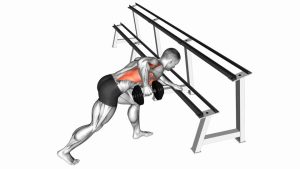
Dumbbell One-Arm Bent-Over Row : Form, Muscles Worked, Sets & Tips
Learn how to do the Dumbbell One-Arm Bent-Over Row with proper form. Discover muscles worked, setup, step-by-step execution, sets and reps by goal, common mistakes, FAQs, and recommended equipment.
Dumbbell One-Arm Bent-Over Row
This row variation is especially useful for improving left-to-right strength balance, refining mind-muscle connection, and training the back through a controlled range of motion. Because you work one side at a time, it also challenges the core and shoulder stabilizers to keep the body steady while the upper back and lats do the pulling.
Quick Overview
| Body Part | Back |
|---|---|
| Primary Muscle | Latissimus dorsi |
| Secondary Muscle | Rhomboids, middle trapezius, rear deltoids, biceps, core stabilizers |
| Equipment | Dumbbell and flat bench or another sturdy support surface |
| Difficulty | Beginner to Intermediate |
Sets & Reps (By Goal)
- Muscle building: 3–4 sets × 8–12 reps per side
- Strength focus: 4–5 sets × 5–8 reps per side
- Technique and control: 2–3 sets × 10–15 reps per side with a slower tempo
- General fitness: 2–4 sets × 8–12 reps per side
Progression rule: Increase the load only when you can keep the torso still, reach a full stretch at the bottom, and finish each rep without shrugging or twisting.
Setup / Starting Position
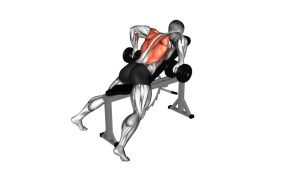
- Set your support: Place one knee and the same-side hand on a bench. The opposite foot stays planted firmly on the floor.
- Hold the dumbbell: Grip the dumbbell in the free hand with your palm facing inward.
- Align your torso: Hinge forward so your chest faces the floor and your back stays flat.
- Brace the core: Tighten your midsection to keep the spine stable and prevent rotation.
- Let the arm hang naturally: Start with the working arm extended toward the floor and the shoulder relaxed.
Tip: Think about making a long line from the back of your head to your tailbone. A neutral spine helps you row with the back instead of overloading the lower back.
Execution (Step-by-Step)
- Start from a dead hang: Let the dumbbell hang directly below your shoulder without rounding your upper back.
- Initiate with the back: Begin the pull by drawing the shoulder blade slightly back and down.
- Drive the elbow upward: Pull the elbow close to your torso and aim it toward your hip or lower rib area.
- Pause at the top: Briefly squeeze the lats and upper back when the elbow passes the torso.
- Lower under control: Slowly return the dumbbell to the starting position and allow a full stretch at the bottom.
- Repeat evenly: Complete all reps on one side, then switch sides and match the same quality of movement.
Pro Tips & Common Mistakes
- Pull with the elbow: Think “elbow back” instead of “hand up” to better target the lats.
- Keep the torso quiet: Avoid twisting or opening the chest during the row.
- Do not shrug: Keep the neck relaxed and the shoulder away from the ear.
- Use full range: Stretch at the bottom and squeeze at the top without losing spinal position.
- Do not rush the lowering phase: The eccentric portion helps build control and muscle tension.
- Avoid curling the weight: This is a back exercise, not a biceps lift.
- Choose the right load: Heavy enough to challenge the back, light enough to keep the motion clean.
FAQ
What muscles does the Dumbbell One-Arm Bent-Over Row work?
The main target is the latissimus dorsi. It also works the rhomboids, middle traps, rear delts, and biceps, while the core helps stabilize the torso.
Should I pull the dumbbell to my chest or hip?
For more lat emphasis, pull the elbow toward the hip with the arm kept close to the body. Pulling higher toward the chest can shift more work to the upper back and rear shoulder.
Is this exercise good for beginners?
Yes. It is one of the best beginner-friendly dumbbell back exercises because it trains one side at a time and makes it easier to focus on form, control, and muscle activation.
How heavy should I go?
Use a weight that lets you keep a flat back, steady torso, and smooth tempo for all reps. If you need to twist or yank the dumbbell, reduce the load.
Can I do this without a bench?
Yes. You can support your free hand on a rack, sturdy chair, or another stable surface. The most important thing is maintaining balance and a neutral spine.
Recommended Equipment
- Adjustable Weight Bench — helpful for supported one-arm rows and other dumbbell strength work
- Hex Dumbbell — a stable and simple option for unilateral rowing exercises
- Lifting Straps — useful when grip fatigue limits your back training on heavier sets
- Weightlifting Gloves — can improve comfort and grip for higher-volume training
- Resistance Bands Set — great for warm-ups, shoulder activation, and pairing with row-focused back sessions
Tip: For this exercise, prioritize a sturdy bench, a well-balanced dumbbell, and accessories that improve grip and control rather than trying to row the heaviest weight possible.