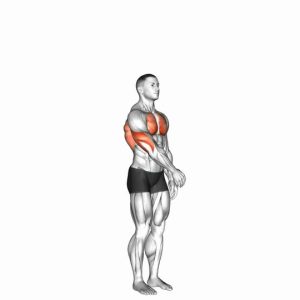
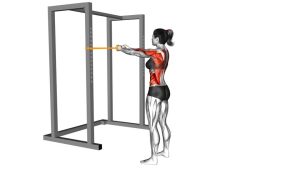
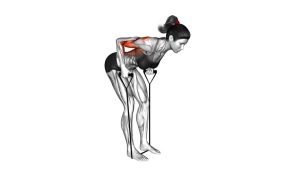
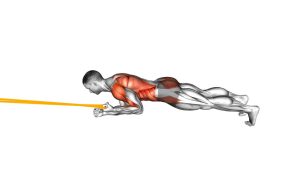
Resistance Band Shoulder Adduction: Form, Muscles Worked, Sets, Tips & FAQ
Learn how to do the Resistance Band Shoulder Adduction with proper form. Discover muscles worked, step-by-step setup, sets by goal, common mistakes, FAQs, and recommended equipment.
Resistance Band Shoulder Adduction
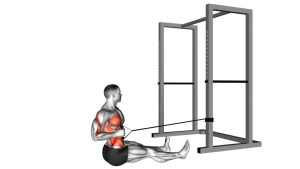
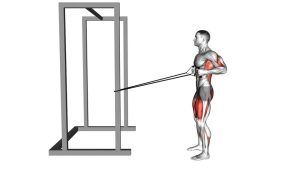
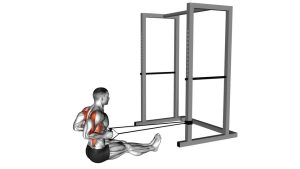
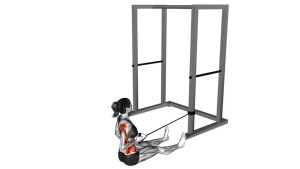
This movement is best performed with control, tension awareness, and consistent posture. The arm stays nearly straight while the shoulder does the work, which helps shift emphasis away from the elbow flexors and into the lats. You should feel the contraction along the side of the upper back and under the armpit area rather than in the neck or upper traps.
Quick Overview
| Body Part | Back |
|---|---|
| Primary Muscle | Latissimus dorsi |
| Secondary Muscle | Teres major, posterior deltoid, pectoralis major (assisting), rotator cuff stabilizers |
| Equipment | Resistance band with a high anchor point |
| Difficulty | Beginner to intermediate |
Sets & Reps (By Goal)
- Lat activation / warm-up: 2–3 sets × 12–15 reps per arm with light band tension
- Muscle growth: 3–4 sets × 10–15 reps per arm with controlled tempo and full tension
- Technique / shoulder control: 2–3 sets × 8–12 reps per arm with slower reps and lighter resistance
- Posture-focused accessory work: 2–4 sets × 12–20 reps per arm with strict form
Progression rule: Increase resistance only after you can keep the torso still, the shoulder down, and the arm path smooth from start to finish.
Setup / Starting Position
- Anchor the band high: Secure the resistance band above shoulder level so it pulls the arm up and outward.
- Stand tall: Position yourself with feet about hip-width apart and your torso upright.
- Grab the band with one hand: Use a neutral grip and keep a slight bend in the elbow.
- Raise the working arm out to the side: Start with the arm abducted so the band creates clear tension.
- Brace lightly: Keep the ribs down, chest tall, and shoulders level before beginning the pull.
Tip: Step slightly farther from the anchor if you need more tension, but do not let the band pull you into leaning or twisting.
Execution (Step-by-Step)
- Start in the stretched position: Let the arm begin out to the side with tension already on the band.
- Pull the arm down toward your side: Drive the movement from the shoulder, not the hand or elbow.
- Keep the elbow softly bent: Maintain that angle instead of turning the movement into a row or pulldown.
- Finish near the hip: Bring the arm down in a controlled arc until it reaches your side.
- Squeeze briefly: Pause for a moment and feel the lat contract without shrugging the shoulder.
- Return slowly: Let the arm travel back up under control to maintain tension through the eccentric phase.
Pro Tips & Common Mistakes
- Lead with the upper arm: This helps keep the lats as the main driver of the movement.
- Do not shrug the shoulder: Keep the trap from taking over by staying long through the neck.
- Avoid torso rotation: Twisting the body reduces lat isolation and turns the exercise into a whole-body pull.
- Use a controlled return: The eccentric phase is valuable for both muscle development and shoulder control.
- Do not over-bend the elbow: Too much elbow flexion changes the movement pattern and shifts work away from shoulder adduction.
- Choose the right band tension: A band that is too heavy often causes momentum, shrugging, and shortened range.
FAQ
What muscle does the Resistance Band Shoulder Adduction work the most?
The main target is the latissimus dorsi. It also recruits the teres major, parts of the posterior deltoid, and smaller stabilizers around the shoulder joint.
Is this the same as a straight-arm pulldown?
It is very similar, but the resistance path in this variation emphasizes shoulder adduction more clearly. Depending on the anchor angle, it may blend shoulder adduction with a small amount of shoulder extension.
Should I keep my arm completely straight?
Keep a slight bend in the elbow and hold that angle throughout the set. Locking the elbow hard is not necessary, but bending it too much changes the exercise.
Where should I feel this exercise?
You should mostly feel it along the side of the back and around the lat area under the armpit. If you mainly feel your neck or upper traps, reduce resistance and improve shoulder position.
Is this exercise good for beginners?
Yes. It is a strong beginner-friendly choice because resistance bands are easy to adjust and the movement teaches cleaner shoulder control without requiring heavy loads.
Recommended Equipment (Optional)
- Resistance Bands Set — useful for adjusting tension levels as you improve strength and control
- Resistance Band Door Anchor — helps create a secure high anchor point for shoulder adduction work at home
- Single D-Handle Attachment — can improve grip comfort during single-arm band exercises
- Exercise Mat — useful for comfort and stability if you include this in a full band workout routine
- Adjustable Resistance Band System — a practical option for progressive overload and more exercise variety
Tip: A secure anchor setup matters just as much as band quality. Always check the band and anchor before starting each set.