Battling Ropes High Waves: Proper Form, Sets, Benefits & FAQ
Learn how to perform Battling Ropes High Waves with proper form for power, conditioning, and upper-body endurance. Includes setup, step-by-step execution, sets by goal, mistakes, FAQs, and recommended equipment.
Battling Ropes High Waves
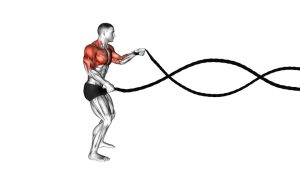
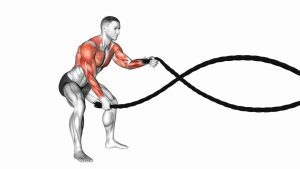
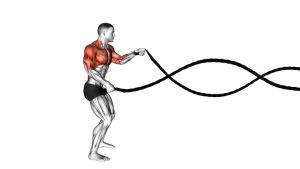
Battling Ropes High Waves challenge the shoulders, arms, upper back, grip, and core while also raising heart rate quickly. This makes the movement useful for conditioning circuits, athletic finishers, and total-body training sessions that need a low-skill but high-output exercise. Even though the arms are visibly active, the lower body still plays an important role by keeping the stance stable and helping the athlete absorb and transfer force.
Quick Overview
| Body Part | Plyometrics |
|---|---|
| Primary Muscle | Shoulders (deltoids), upper back, and arms |
| Secondary Muscle | Core, forearms, quads, glutes, and calves for stability and force transfer |
| Equipment | Battle ropes anchored securely to a fixed point |
| Difficulty | Intermediate |
Sets & Reps (By Goal)
- Conditioning: 3–5 sets of 20–40 seconds with 30–60 seconds of rest
- Power output: 4–6 sets of 10–20 seconds with 60–90 seconds of rest and maximal wave quality
- Muscular endurance: 2–4 sets of 30–60 seconds with controlled, repeatable effort
- Finisher work: 2–3 rounds of 15–30 seconds near the end of the workout
Progression rule: Increase time, wave height, or consistency one variable at a time. Do not progress by simply moving faster if your stance, posture, and wave quality break down.
Setup / Starting Position
- Face the anchor point: Stand far enough away that the ropes have light tension with no excessive slack.
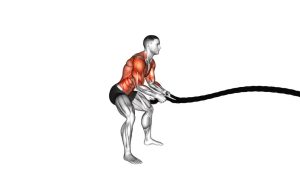
- Set your stance: Place your feet about shoulder-width apart and bend the knees slightly into an athletic quarter squat.
- Brace the trunk: Tighten the core, keep the chest lifted, and maintain a neutral spine.
- Grip the rope ends firmly: Use a neutral grip and keep the wrists aligned instead of excessively bent.
- Prepare to move explosively: Relax the neck and shoulders just enough to stay fluid while keeping the body ready to generate force.
Tip: Your stance should feel stable enough to handle repeated rope recoil without rocking backward or rising out of position.
Execution (Step-by-Step)
- Start with tension: Begin with the ropes slightly off the floor or under light tension so the first wave is clean.
- Drive the arms forcefully: Lift and slam the rope ends in a strong, rhythmic pattern to produce tall waves.
- Create high-amplitude movement: Focus on sending large, visible waves all the way toward the anchor rather than making short, choppy motions.
- Stay athletic through the legs: Keep the knees bent and use subtle lower-body support to stay balanced and powerful.
- Maintain posture under fatigue: Keep the core tight, shoulders active, and head neutral as the set continues.
- Finish with control: End the set before form breaks down, then lower the ropes safely and reset.
Pro Tips & Common Mistakes
- Think “big waves,” not random speed: Quality matters more than frantic arm motion.
- Stay slightly low: A soft knee bend improves balance, force transfer, and repeatable rhythm.
- Keep the core engaged: A loose midsection wastes energy and reduces wave efficiency.
- Avoid shrugging the shoulders up: Let the shoulders move powerfully, but do not jam them toward the ears.
- Do not lean too far back: Maintain a centered base instead of using body swing to fake the movement.
- Cut the set before mechanics fall apart: High-quality short intervals usually work better than sloppy long ones.
FAQ
What muscles do Battling Ropes High Waves work the most?
They primarily target the shoulders, arms, upper back, and grip, while the core and lower body help stabilize your body and support repeated force production.
Are high waves better for cardio or strength?
They are used mostly for conditioning, power endurance, and athletic output rather than pure strength. You can bias them toward power with short, explosive sets or toward cardio with longer intervals.
How high should the waves be?
The waves should be high enough to travel clearly toward the anchor while you still maintain posture and rhythm. If wave height drops sharply, reduce duration or rest more between sets.
Should I move both arms together or alternate them?
Both patterns can work, but many athletes use a strong alternating rhythm for continuous high waves. The best option is the one that lets you generate powerful waves consistently without losing control.
Can beginners do Battling Ropes High Waves?
Beginners can use battle ropes, but this specific high-wave style is usually best once basic rope control, stance stability, and shoulder endurance are already in place.
Recommended Equipment (Optional)
- Battle Ropes — the main training tool for high waves, conditioning intervals, and upper-body endurance work
- Battle Rope Anchor Kit — helps secure the rope properly for safer and smoother training sessions
- Exercise Floor Mat — useful for protecting flooring and improving traction in home training spaces
- Training Gloves for Grip — optional support if long rope sessions irritate the hands or reduce grip quality
- Interval Gym Timer — great for structured work-rest intervals during conditioning and power rounds
Tip: Choose a rope length and thickness that match your training level. A setup that is too heavy can ruin rhythm, shorten sets unnecessarily, and make clean wave production harder.