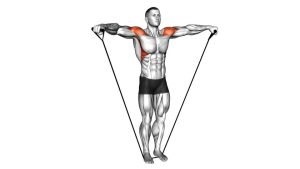
Resistance Band Standing Single-Arm Lateral Raise: Form, Sets, Tips & FAQ
Learn the Resistance Band Standing Single-Arm Lateral Raise for stronger side delts and better shoulder control. Includes setup, step-by-step form, sets by goal, common mistakes, FAQs, and recommended equipment.
Resistance Band Standing Single-Arm Lateral Raise
This exercise works best when you use a moderate range of motion, a slight bend in the elbow, and a steady tempo. The goal is to make the side deltoid do the work instead of turning the rep into a full-body swing. You should feel the outer shoulder working hard near the top without excessive trap shrugging, neck tension, or leaning.
Quick Overview
| Body Part | Shoulders |
|---|---|
| Primary Muscle | Lateral deltoid |
| Secondary Muscle | Anterior deltoid, supraspinatus, upper traps (minimal if form is correct), core stabilizers |
| Equipment | Resistance band with handle or grip point; optional door anchor or foot anchor setup |
| Difficulty | Beginner to Intermediate |
Sets & Reps (By Goal)
- Muscle growth: 3–4 sets × 10–18 reps per arm with 45–75 sec rest
- Shoulder endurance / control: 2–4 sets × 12–20 reps per arm with 30–60 sec rest
- Warm-up activation: 1–3 sets × 10–15 light, smooth reps per arm
- Home shoulder workout finisher: 2–3 sets × 15–25 reps per arm with controlled tempo
Progression rule: First increase rep quality, then reps, then band tension. If your torso starts swaying or your traps take over, the resistance is probably too high.
Setup / Starting Position
- Secure the band: Stand on the band or anchor it low so the working arm starts with tension near hip level.
- Grip with one hand: Hold the band firmly with the working hand while keeping the other arm relaxed.
- Stand tall: Place feet about hip- to shoulder-width apart and brace the core lightly.
- Set the arm: Keep a slight bend in the elbow and position the hand near the outside of the thigh or slightly in front of the hip.
- Find shoulder position: Keep the shoulder down and away from the ear before you begin the raise.
Tip: A slight forward arm angle often feels more natural and shoulder-friendly than trying to raise perfectly straight out to the side.
Execution (Step-by-Step)
- Brace and stabilize: Keep your chest up, ribs stacked, and torso still.
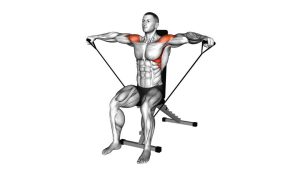
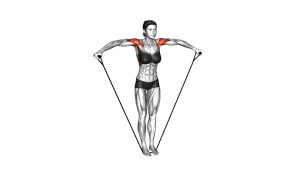
- Raise the arm outward: Lift the working arm out to the side with a slight bend in the elbow.
- Stay in control: Continue until the hand reaches about shoulder height or slightly below.
- Pause briefly: Hold the top for a moment while keeping the neck relaxed and the shoulder from shrugging.
- Lower slowly: Return the arm to the starting position under control without letting the band snap back.
- Repeat evenly: Complete all reps on one side, then switch arms.
Pro Tips & Common Mistakes
- Lead with the elbow: Think about lifting the elbow outward rather than flicking the hand upward.
- Keep a soft elbow: Slight bend is ideal; avoid locking the arm rigidly.
- Do not shrug: The side delt should work harder than the upper traps.
- Avoid swinging: Momentum turns an isolation exercise into a sloppy full-body rep.
- Stop near shoulder height: Going much higher often shifts tension away from the target muscle.
- Use controlled lowering: The eccentric phase is one of the biggest benefits of the band variation.
- Train both sides evenly: Single-arm work is excellent for correcting side-to-side differences.
FAQ
What muscle does the resistance band standing single-arm lateral raise target most?
The main target is the lateral deltoid, which helps build shoulder width and improves the look of the side shoulder.
Should I raise my arm above shoulder height?
Usually no. Stopping around shoulder height keeps the movement cleaner and helps maintain tension on the side delt without excessive shrugging.
Is this better than a dumbbell lateral raise?
It is not automatically better, but it is different. Bands provide more tension near the top, are easier to use at home, and can feel more joint-friendly for some people.
Why do I feel my traps more than my shoulders?
That usually happens when the band is too heavy, the shoulder shrugs upward, or the arm travels too high. Use lighter tension and focus on keeping the shoulder down.
Can beginners use this exercise?
Yes. It is beginner-friendly as long as the resistance is light enough to keep the torso stable and the movement controlled.
Recommended Equipment (Optional)
- WHATAFIT Resistance Bands Set with Handles — versatile for single-arm raises, presses, rows, and full home shoulder workouts
- Resistance Band Handles — useful if you want a more comfortable grip or need replacement handles for your band setup
- BOSS Fitness Products Door Anchor — helps create consistent low-anchor angles for unilateral band shoulder work
- THERABAND Professional Resistance Bands — good choice if you prefer therapy-style band resistance and progressive shoulder control work
- Gaiam Non-Slip Exercise Mat — adds traction and comfort for home training, especially when anchoring bands underfoot
Tip: For this exercise, the best upgrade is usually a quality band set with handles plus a secure door anchor. That combination gives you more setup options and smoother resistance.