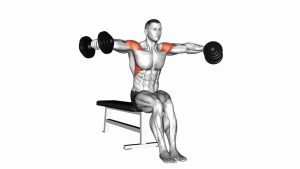
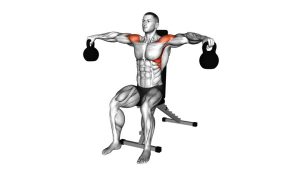
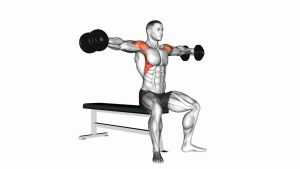
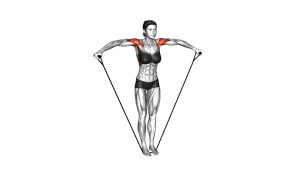
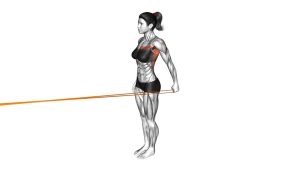
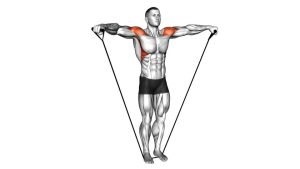
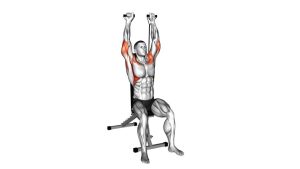
Band Seated Lateral Raise: Form, Sets, Benefits, Tips & FAQ
Learn how to perform the Band Seated Lateral Raise with proper form to build side delts and shoulder width. Includes setup, step-by-step execution, sets by goal, common mistakes, FAQs, and recommended equipment.
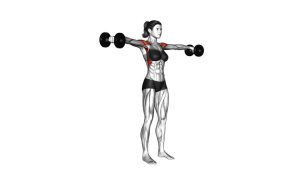
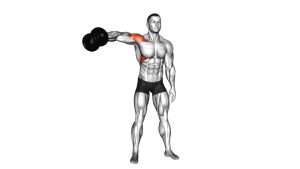
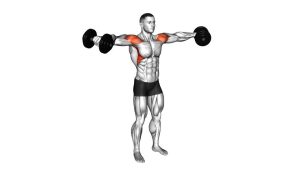
Band Seated Lateral Raise
This exercise is ideal for lifters who want to build broader-looking shoulders without needing dumbbells or machines. Because the band provides increasing resistance as it stretches, the movement becomes especially challenging near the top range. The seated position also makes it easier to stay strict, control the tempo, and keep the work on the delts instead of turning the exercise into a swinging full-body raise.
Quick Overview
| Body Part | Side Shoulders |
|---|---|
| Primary Muscle | Lateral deltoids (side delts) |
| Secondary Muscle | Anterior deltoids, supraspinatus, upper traps (light stabilization) |
| Equipment | Resistance band, flat bench or sturdy seat |
| Difficulty | Beginner to Intermediate |
Sets & Reps (By Goal)
- Muscle growth: 3–4 sets × 10–15 reps with 45–75 seconds rest
- Shoulder endurance: 2–4 sets × 15–20 reps with 30–45 seconds rest
- Warm-up / activation: 2–3 sets × 12–15 controlled reps using a lighter band
- Finisher / pump work: 2–3 sets × 15–25 reps with strict form and short rest
Progression rule: First improve control, range, and rep quality. Then increase band tension or add reps while keeping the shoulders down and the torso stable.
Setup / Starting Position
- Sit upright: Sit tall on a bench or sturdy chair with your feet flat on the floor.
- Anchor the band: Place the middle of the resistance band securely under your feet.
- Grip the ends: Hold one end of the band in each hand with your arms down by your sides.
- Set the elbows: Keep a slight bend in the elbows and maintain that angle throughout the rep.
- Brace your posture: Keep the chest up, core lightly engaged, and shoulders relaxed—not shrugged.
Tip: Adjust the difficulty by widening or narrowing foot placement on the band, or by choking up slightly on the band handles.
Execution (Step-by-Step)
- Start from the sides: Begin with the hands near thigh level and the band already under light tension.
- Raise outward: Lift both arms out to the sides in a wide arc, leading with the elbows.
- Stop near shoulder height: Bring the arms up until the hands and elbows reach about shoulder level.
- Pause briefly: Hold the top position for a moment while keeping tension on the side delts.
- Lower with control: Slowly return to the starting position without letting the band snap downward.
- Repeat smoothly: Perform each rep with the same path, posture, and tempo.
Pro Tips & Common Mistakes
- Lead with the elbows: This helps keep the emphasis on the side delts instead of the hands.
- Keep the shoulders down: Avoid shrugging at the top or turning it into an upper-trap raise.
- Use strict reps: Sitting helps remove momentum, so take advantage of the controlled setup.
- Do not raise too high: Going far above shoulder height often shifts tension away from the lateral delts.
- Control the lowering phase: The eccentric part builds more tension and helps improve shoulder stability.
- Pick the right band: Too much resistance usually causes bent-wrist cheating, torso movement, and shortened range.
FAQ
What muscles does the Band Seated Lateral Raise work?
The main target is the lateral deltoid, which helps build shoulder width. The front delts, supraspinatus, and upper traps may assist slightly depending on form and resistance level.
Is this better than dumbbell lateral raises?
It is not necessarily better, but it offers a different resistance profile. Bands provide constant and increasing tension, especially near the top, and are excellent for home training, warm-ups, or higher-rep delt work.
Should I sit all the way upright or lean forward?
Stay mostly upright with a tall torso. A slight natural torso angle is fine, but avoid turning the lift into a swing or leaning back to force the reps up.
Why do I feel my traps more than my side delts?
That usually happens when the band is too heavy, the shoulders shrug upward, or the arms go too high. Use lighter resistance, keep the shoulders down, and stop around shoulder height.
Can beginners use this exercise?
Yes. It is beginner-friendly as long as you choose a manageable band and focus on smooth, controlled reps. It is also useful for experienced lifters as a delt isolation movement or burnout finisher.
Recommended Equipment
- Resistance Bands Set — multiple tension levels for progressive shoulder training
- Fabric Loop Bands — useful for lighter shoulder activation and accessory work
- Adjustable Workout Bench — provides a stable seated setup for stricter reps
- Foam Exercise Mat — adds grip and comfort under the feet and bench area
- Workout Gloves — can improve grip comfort during longer band shoulder sessions
Tip: For better side-delt isolation, choose a resistance level that lets you reach shoulder height without shrugging or swinging.