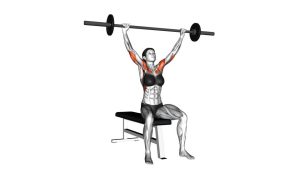
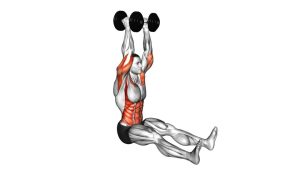
Standing Dumbbell Overhead Press: Proper Form, Sets, Tips & FAQ
Learn how to perform the Standing Dumbbell Overhead Press with proper form. Discover muscles worked, setup, execution steps, sets and reps by goal, common mistakes, FAQs, and recommended equipment.
Standing Dumbbell Overhead Press
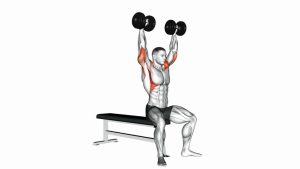
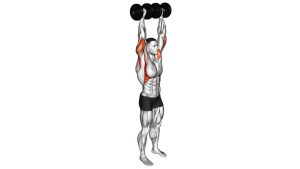
This exercise is most effective when each rep starts from a stable base and finishes with the dumbbells stacked over the shoulders. The front and side delts do most of the work, while the triceps help extend the elbows and the core keeps the torso from overextending. A clean standing press should feel strong and smooth, not loose or rushed.
Quick Overview
| Body Part | Shoulders |
|---|---|
| Primary Muscle | Anterior deltoids and lateral deltoids |
| Secondary Muscle | Triceps, upper chest, upper traps, and core stabilizers |
| Equipment | Pair of dumbbells |
| Difficulty | Beginner to Intermediate |
Sets & Reps (By Goal)
- Muscle growth: 3-4 sets × 8-12 reps with 60-90 seconds rest
- Strength: 4-5 sets × 4-6 reps with 90-150 seconds rest
- General fitness: 2-4 sets × 8-10 reps with 45-75 seconds rest
- Shoulder endurance / conditioning: 2-3 sets × 12-15 reps with 30-60 seconds rest
Progression rule: Add weight only when you can press through the full range of motion without leaning back, shortening the top position, or rushing the lowering phase.
Setup / Starting Position
- Stand tall: Place your feet about shoulder-width apart for a stable base.
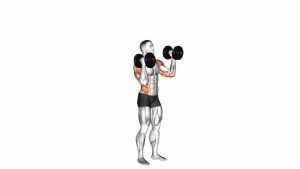
- Pick up the dumbbells safely: Bring them to shoulder level with control.
- Set the elbow position: Keep elbows slightly in front of the body rather than flared straight out.
- Brace your torso: Tighten your abs and glutes lightly to keep the ribs down and spine neutral.
- Align the wrists: Stack wrists over elbows so the dumbbells stay in a strong pressing line.
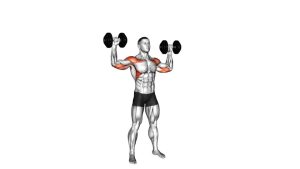
- Start at shoulder height: Hold the dumbbells near the shoulders with palms facing forward or slightly inward.
Tip: Before the first rep, think “tall posture, tight core, smooth press.”
Execution (Step-by-Step)
- Lock in your stance: Stand upright with your chest up, head neutral, and core braced.
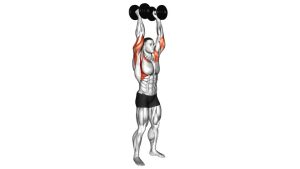
- Press upward: Drive both dumbbells overhead at the same time in a controlled path.
- Move slightly inward: Let the dumbbells travel naturally so they finish above the shoulders, not far out in front.
- Reach a strong top position: Arms should be nearly straight overhead without forcing an aggressive lockout.
- Lower with control: Bring the dumbbells back down to shoulder level slowly, following the same path.
- Repeat cleanly: Maintain balance and posture on every rep without using leg drive or torso swing.
Pro Tips & Common Mistakes
- Keep the core active: A strong brace protects your lower back and improves pressing power.
- Do not lean back excessively: Turning the press into an incline-style movement reduces shoulder focus.
- Use full control on the way down: The eccentric phase helps build muscle and keeps the shoulders safer.
- Do not flare the elbows too wide: Slightly forward elbows usually create a stronger, safer pressing line.
- Avoid bouncing at the bottom: Reset the dumbbells at shoulder level before starting the next rep.
- Choose realistic weights: Pressing too heavy too soon usually leads to back arching and shortened range of motion.
- Keep the head neutral: Let the arms move around your head naturally without craning the neck.
FAQ
What muscles does the standing dumbbell overhead press work?
It mainly targets the front delts and side delts. The triceps help extend the elbows, while the core and upper body stabilizers help keep you balanced during the standing position.
Is standing better than seated for dumbbell overhead press?
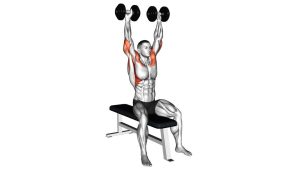
Standing is not always better, but it does add a bigger stability demand. It trains the shoulders while forcing the core and glutes to keep the torso steady. Seated versions usually reduce the balance challenge and may help isolate the shoulders more.
How low should I bring the dumbbells?
In most cases, lower them to about shoulder level with control. That range gives you a strong pressing position without turning the movement into a loose, overly stretched bottom position.
Should my palms face forward or inward?
Both can work. A forward-facing grip is common, while a slight inward angle may feel more comfortable for some lifters. Use the position that lets you press smoothly without shoulder irritation.
Why do I feel this more in my lower back than my shoulders?
That usually happens when the weight is too heavy or the core is not braced well enough. Reduce the load, tighten your abs and glutes, and keep your ribs from flaring upward during the press.
Recommended Equipment
- Adjustable Dumbbells — ideal for progressive overload without needing multiple fixed-weight pairs
- Fixed Dumbbell Set — useful if you want quick weight changes and a traditional gym feel
- Weightlifting Wrist Wraps — helpful for extra wrist support during heavier pressing sets
- Tribe Lifting Heavy Duty Wrist Wraps — a press-friendly wrist support option for strength training sessions
- Exercise Mat / Home Gym Mat — protects flooring and improves grip and stability for standing dumbbell work
Tip: For most lifters, the best first investment is a solid pair of adjustable dumbbells plus simple wrist support if heavy pressing bothers the wrists.