Dumbbell One-Arm Triceps Extension (On Bench): Form, Sets, Tips & FAQ
Learn the Dumbbell One-Arm Triceps Extension on Bench for stronger, more defined triceps. Includes proper form, setup, execution, sets by goal, common mistakes, FAQs, and recommended equipment.
Dumbbell One-Arm Triceps Extension (On Bench)
This movement is most effective when performed with a controlled tempo and a full but comfortable range of motion. The dumbbell should lower behind the head without pulling the torso out of position, and the elbow should extend smoothly to the top without snapping into lockout. Since this is a single-arm exercise, it is excellent for identifying left-to-right strength differences and improving symmetry in triceps development.
Quick Overview
| Body Part | Triceps |
|---|---|
| Primary Muscle | Triceps brachii (long head emphasis) |
| Secondary Muscle | Medial and lateral heads of the triceps, shoulder stabilizers, core stabilizers |
| Equipment | One dumbbell and a flat bench |
| Difficulty | Beginner to Intermediate |
Sets & Reps (By Goal)
- Muscle growth: 3–4 sets × 8–12 reps per arm, 60–90 seconds rest
- Muscular endurance: 2–3 sets × 12–20 reps per arm, 45–60 seconds rest
- Technique and control: 2–3 sets × 10–15 reps per arm using a slow eccentric, 45–75 seconds rest
- Accessory work after pressing: 2–4 sets × 8–15 reps per arm, moderate load, controlled tempo
Progression rule: Add reps before adding weight. Once you can complete all target reps with clean elbow tracking and no torso movement, increase the dumbbell slightly.
Setup / Starting Position
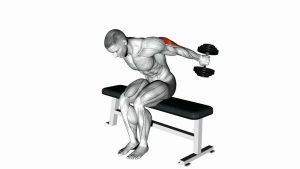
- Sit tall on a flat bench: Keep your feet planted firmly on the floor and your torso upright.
- Hold one dumbbell overhead: Grip the dumbbell with one hand and press it above the shoulder of the working arm.
- Set the upper arm: Keep the working upper arm close to the head and as vertical as possible.
- Brace your core: Keep the ribs down and avoid leaning back as the dumbbell lowers.
- Start the rep: Bend the elbow and lower the dumbbell behind your head under control to reach the stretch position.
Tip: Use your non-working hand on your hip or bench for balance, and keep your shoulder packed instead of shrugging upward.
Execution (Step-by-Step)
- Begin from the stretched position: With the dumbbell behind your head, keep the elbow pointing mostly upward.
- Extend the elbow: Press the dumbbell upward by straightening the arm while keeping the upper arm stable.
- Reach the top with control: Finish near full elbow extension without slamming into lockout.
- Squeeze the triceps: Pause briefly at the top to reinforce peak contraction.
- Lower slowly: Bend the elbow and return the dumbbell behind the head in a smooth, controlled eccentric.
- Repeat evenly: Complete all reps on one side, then switch arms while keeping the same form and tempo.
Pro Tips & Common Mistakes
- Keep the upper arm fixed: Too much shoulder movement reduces triceps isolation.
- Lower under control: The eccentric phase is where a lot of muscle-building tension happens.
- Do not flare the elbow too wide: Keep it close enough to maintain a strong overhead line.
- Avoid arching your lower back: Stay braced so the ribcage does not lift excessively.
- Use a full stretch that feels safe: Lower the dumbbell behind the head, but only as far as you can control comfortably.
- Do not rush lockout: Smooth extension creates better tension than throwing the dumbbell up.
- Train both sides evenly: Start with your weaker arm if one side lags behind.
FAQ
What part of the triceps does this exercise emphasize most?
Because the arm is overhead, this variation strongly emphasizes the long head of the triceps, which is placed under a deeper stretch than in many pushdown-style movements.
Is this better with one arm or two arms?
The one-arm version is great for improving unilateral strength, fixing side-to-side imbalances, and creating a stronger mind-muscle connection. The two-arm version may allow heavier loading, but the single-arm version offers better control for many lifters.
Should I sit on a bench or stand?
Sitting on a bench usually makes it easier to stay stable and focus on elbow extension without using extra body movement. It is often the better choice for strict form and hypertrophy work.
How heavy should the dumbbell be?
Choose a weight that allows you to move through a full controlled range without elbow flare, shoulder shifting, or momentum. For most people, moderate weight with strict technique works better than going too heavy.
Can beginners do this exercise?
Yes. Beginners can use a lighter dumbbell and focus on slow reps, stable posture, and consistent elbow positioning. It is a very effective triceps isolation movement when form is kept strict.
Recommended Equipment
- Adjustable Dumbbell — versatile option for progressive overload without needing multiple fixed dumbbells
- Rubber Hex Dumbbell — stable, durable, and easy to handle for single-arm extension work
- Flat Weight Bench — provides a stable seated base for better posture and isolation
- Weightlifting Gloves — can improve grip comfort and reduce hand fatigue during dumbbell work
- Exercise Mat — useful under the bench for floor protection, grip, and a cleaner training setup
Tip: For this exercise, a secure grip and a stable bench matter more than using maximum weight. Prioritize control and comfort.