Cable Single-Arm Triceps Pushdown (Rope Attachment): Form, Sets, Tips & FAQ
Learn the Cable Single-Arm Triceps Pushdown with rope attachment to isolate the triceps through a controlled unilateral pressing path. Includes setup, step-by-step execution, sets by goal, mistakes, FAQs, and recommended equipment.
Cable Single-Arm Triceps Pushdown (Rope Attachment)
This variation is excellent for lifters who want more focused triceps work than a two-arm pushdown can sometimes provide. Because you train one arm at a time, it becomes easier to clean up compensations, reduce dominance from the stronger side, and feel a sharper contraction through the working triceps. The rope also allows a natural wrist path that many people find more comfortable than a rigid straight bar.
Quick Overview
| Body Part | Triceps |
|---|---|
| Primary Muscle | Triceps brachii (all three heads, with strong emphasis on elbow extension) |
| Secondary Muscle | Anconeus, forearm stabilizers, shoulder stabilizers, core bracing muscles |
| Equipment | Cable machine, rope attachment, single-hand grip on rope end |
| Difficulty | Beginner to Intermediate |
Sets & Reps (By Goal)
- Muscle growth: 3–4 sets × 10–15 reps per arm, 45–75 sec rest
- Strength-focused accessory work: 3–5 sets × 6–10 reps per arm, 60–90 sec rest
- Technique and mind-muscle connection: 2–3 sets × 12–15 reps per arm with slower tempo
- Joint-friendly pump finisher: 2–3 sets × 15–20 reps per arm with moderate load and strict form
Progression rule: Add reps first, then increase load in small steps only when you can keep the elbow pinned, fully control the eccentric, and reach a clean lockout without torso movement.
Setup / Starting Position
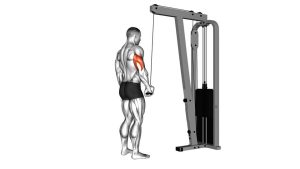
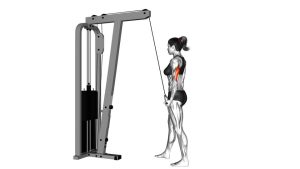
- Attach the rope: Set a rope attachment to a high pulley on a cable machine.
- Choose one rope end: Grip one side of the rope with your working hand using a neutral grip.
- Set your stance: Stand tall with feet about hip-width apart and a slight bend in the knees.
- Pin the elbow: Bring your upper arm close to your torso with the elbow bent around 90 degrees.
- Brace lightly: Keep ribs down, chest tall, shoulders relaxed, and wrist neutral before starting.
Tip: Take a half-step back from the machine so the cable stays loaded at the top without yanking your arm forward.
Execution (Step-by-Step)
- Lock in posture: Stand upright and keep your working elbow tucked close to your side.
- Start the press: Extend the elbow and push the rope handle downward in a controlled path.
- Keep the shoulder quiet: Do not let the upper arm drift forward or the torso lean over the movement.
- Reach full extension: At the bottom, straighten the arm without aggressively hyperextending the elbow.
- Squeeze briefly: Pause for a moment to contract the triceps hard at full lockout.
- Return slowly: Let the handle rise back up under control until the elbow returns to the starting bend.
- Repeat smoothly: Maintain constant tension and perform all reps on one arm before switching sides.
Pro Tips & Common Mistakes
- Keep the elbow fixed: The elbow should act like a hinge. Too much upper-arm movement turns it into a shoulder exercise.
- Use full but controlled range: Don’t cut off the bottom squeeze or rush the return phase.
- Stay tall: Avoid folding forward to finish reps. A stable torso keeps tension where it belongs.
- Don’t overload too soon: Heavy weight often leads to momentum, elbow flare, and sloppy lockout.
- Let the rope work for you: The rope allows a natural line of force and can feel easier on the wrists than rigid attachments.
- Train both sides evenly: Start with your weaker arm if you’re trying to reduce imbalances.
- Control the eccentric: The upward return is where many lifters lose tension and technique.
FAQ
What muscles does the cable single-arm triceps pushdown work?
It primarily targets the triceps brachii, whose main job is elbow extension. Your forearm and shoulder stabilizers also help keep the arm path controlled during the rep.
Why use a single-arm version instead of a two-arm pushdown?
The unilateral version helps expose and correct side-to-side imbalances, improves mind-muscle connection, and often makes it easier to keep the elbow path strict.
Should I use heavy weight on this exercise?
Usually no. This movement works best with controlled moderate loads that let you feel the triceps through the full range rather than forcing momentum or torso sway.
Where should I feel it?
You should feel the strongest tension in the back of the upper arm. If you mainly feel your shoulder, wrist, or traps, check your setup, reduce the weight, and keep your elbow tighter to your side.
Can beginners use this exercise?
Yes. It is beginner-friendly because the cable provides smooth resistance and the single-arm setup makes it easier to focus on clean mechanics one side at a time.
Recommended Equipment
- Yes4All Deluxe Tricep Rope Cable Attachment — a classic rope attachment option for smooth pushdowns and comfortable one-arm cable work
- 360° Rotating Single D-Handle Cable Attachment — useful if you want to alternate between rope work and a more fixed one-hand cable grip
- Cable Machine Attachment Set — practical for home gym users who want rope, handle, bar, and multiple cable options in one bundle
- Ergonomic Non-Slip D-Handle Cable Attachment — a more grip-friendly handle style that can reduce hand fatigue during unilateral cable training
- Resistance Bands Set — a good backup for triceps pump work, warm-ups, and travel sessions when no cable machine is available
Tip: For this exercise, prioritize attachments with a secure grip, smooth swivel, and durable end caps or stitching. Stable equipment makes it much easier to keep reps strict and elbow-friendly.