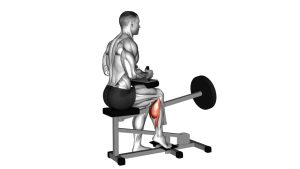
Dumbbell Single-Leg Calf Raise: Form, Muscles, Sets & Tips
Learn the Dumbbell Single-Leg Calf Raise with proper balance, heel control, and calf activation. Get step-by-step technique, sets, common mistakes, and FAQs.
Dumbbell Single-Leg Calf Raise
This exercise is especially useful for developing unilateral calf strength because each leg must independently lift and control the body’s weight. Additionally, the dumbbell provides external resistance, allowing progressive overload as strength improves. The supported position helps reduce unnecessary balancing demands while maintaining concentration on the working calf.
Unlike a traditional bilateral calf raise, this variation places greater relative demand on one ankle. Consequently, it can help identify strength differences between the left and right calves. Strong calf muscles also contribute to walking, running, jumping, stair climbing, and controlled ankle movement during everyday activities. However, proper technique remains more important than the amount of weight lifted.
Quick Overview
| Body Part | Calves |
|---|---|
| Primary Muscle | Gastrocnemius (medial and lateral heads) and soleus |
| Secondary Muscle | Tibialis posterior, fibularis muscles, intrinsic foot stabilizers, and supporting hip and core stabilizers |
| Equipment | One dumbbell and a stable support bar, railing, or fixed exercise station. Optional: non-slip calf raise block. |
| Difficulty | Intermediate, depending on dumbbell weight, single-leg balance, ankle mobility, and movement control |
Sets & Reps (By Goal)
- Strength: Perform 3–4 sets × 6–10 repetitions per leg using challenging but manageable resistance. Rest 90–120 seconds between sets. Prioritize full control without bouncing or pulling upward with the supporting hand.
- Hypertrophy (muscle growth): Complete 3–4 sets × 10–15 repetitions per leg. Use a controlled lifting phase, briefly contract the calf at the top, and lower for approximately 2–3 seconds. Rest 60–90 seconds between sets.
- Muscular endurance: Perform 2–3 sets × 15–25 repetitions per leg with light-to-moderate resistance. Maintain consistent repetition quality while resting approximately 30–60 seconds between sets.
- Mobility and movement control: Complete 2 sets × 8–12 slow repetitions per leg using bodyweight or very light resistance. Focus on smooth ankle movement and controlled heel lowering within a comfortable range.
- Rehab-style strengthening: When cleared by a healthcare professional, begin with 2–3 sets × 6–10 controlled repetitions per leg. Use appropriate support and minimal resistance. Progress only according to individual tolerance and rehabilitation guidance.
Progression rule: First master consistent bodyweight single-leg calf raises. Next, increase repetitions or improve control during the lowering phase. Finally, increase the dumbbell weight gradually while preserving balance and ankle alignment. Allow adequate recovery between challenging loaded calf-training sessions.
Setup / Starting Position
- Choose a stable support: Stand beside a secure exercise station, fixed railing, or sturdy support bar. The support should remain completely stationary when you lightly grip it.
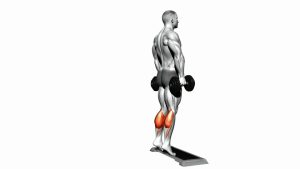
- Select an appropriate dumbbell: Hold one dumbbell in the hand opposite the supporting hand. Allow the weight to hang naturally beside your thigh with a neutral wrist. Initially, select a load that does not disturb your balance.
- Position the working foot: Place one foot firmly on a flat, non-slip surface. Distribute your weight across the forefoot without allowing the ankle to roll inward or outward.
- Lift the non-working leg: Slightly bend the opposite knee and raise that foot away from the floor. Keep the free leg relaxed and positioned so it cannot assist the calf raise.
- Establish upright posture: Keep your chest lifted, shoulders relaxed, and spine in a neutral position. Gently brace your abdominal muscles without leaning toward the support.
- Set the working knee: Maintain a nearly straight knee with a comfortable, slight degree of softness. Avoid aggressively locking the joint or bending it to initiate the lift.
- Prepare for the movement: Begin with the working heel lowered to a comfortable starting position. Take a steady breath and focus on lifting through the ankle rather than moving the entire body.
Tip: The demonstrated variation uses a dumbbell and stationary hand support. A raised calf block is not required. Therefore, beginners can practice on level ground before progressing to an elevated surface.
Execution (Step-by-Step)
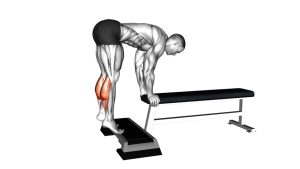
- Establish single-leg balance: Transfer your weight onto the working foot while keeping the opposite foot lifted. Maintain a light grip on the support and stabilize your torso before moving.
- Initiate ankle plantarflexion: Press through the ball of the working foot. Then contract the calf muscles to lift your heel away from the floor. Keep the movement centered at the ankle.
- Raise the body vertically: Continue elevating the heel as high as your comfortable ankle range permits. Meanwhile, maintain an upright torso and prevent unnecessary hip movement.
- Maintain working-leg alignment: Keep the working knee nearly straight and the ankle aligned over the foot. Avoid rolling onto the inner or outer edge of the forefoot.
- Contract at the top: Briefly pause in the elevated position for approximately one second. Focus on deliberate calf contraction without bouncing or excessively gripping the support bar.
- Lower the heel slowly: Gradually reverse the movement and lower the heel over approximately 2–3 seconds. Continue controlling the dumbbell and keep the opposite foot elevated.
- Complete the repetition: Return to the original heel position without suddenly dropping or rebounding. Afterward, repeat the movement for the prescribed repetitions before switching to the opposite leg.
Pro Tips & Common Mistakes
- Prioritize controlled heel elevation: Raise the heel smoothly rather than bouncing through the movement. Consequently, the calf muscles must generate and control the lifting force without unnecessary momentum.
- Avoid bending the working knee: Excessive knee bending changes the movement mechanics and may introduce unwanted leg drive. Instead, maintain a nearly straight knee throughout each repetition.
- Use the support for balance only: Avoid pushing or pulling strongly through the supporting arm. Otherwise, the upper body may assist the lift and reduce the resistance experienced by the calf.
- Keep the ankle properly aligned: Maintain even pressure through the forefoot. Additionally, prevent the heel from excessively drifting inward or outward as you rise onto the ball of the foot.
- Control the eccentric phase: Lower the heel deliberately instead of allowing it to drop suddenly. A controlled descent maintains muscular tension and makes it easier to reproduce consistent repetitions.
- Avoid excessive dumbbell weight: Heavy resistance can encourage swaying, abbreviated repetitions, and compensatory movements. Therefore, increase the load only when your current repetitions remain stable and comfortable.
- Maintain a stable upper body: Keep your shoulders approximately level and avoid leaning toward the support. Meanwhile, allow the dumbbell to hang naturally without swinging it.
- Train both legs consistently: Complete controlled repetitions on each side. If one calf is weaker, consider beginning with that leg and matching its successful repetitions on the stronger side.
- Progress range of motion carefully: Level-ground calf raises are effective for establishing control. Later, a stable calf block may allow greater heel travel if ankle mobility and tendon tolerance permit. However, never force a painful stretch.
FAQ
What muscles does the Dumbbell Single-Leg Calf Raise work?
The Dumbbell Single-Leg Calf Raise primarily strengthens the gastrocnemius and soleus. Both muscles contribute to ankle plantarflexion. However, the nearly straight-knee position particularly emphasizes the gastrocnemius. Additionally, smaller ankle and foot muscles help stabilize the working leg.
Is the Dumbbell Single-Leg Calf Raise suitable for beginners?
Beginners can learn the movement by starting with supported bodyweight calf raises. First, practice bilateral raises and then progress to supported single-leg repetitions. Once balance and ankle control improve, introduce a light dumbbell. Therefore, the weighted single-leg variation is generally more appropriate after mastering the basic movement.
Should I perform this exercise on a step or flat floor?
You can perform this exercise on a flat, non-slip floor, as demonstrated in the basic supported variation. An elevated calf block is optional. Although a secure step may permit greater ankle range of motion, it also increases balance demands and potential tendon loading. Choose the version that allows safe, controlled repetitions.
Why do I lose balance during single-leg calf raises?
Balance problems may result from excessive dumbbell weight, insufficient ankle stability, fatigue, or uneven forefoot pressure. Additionally, swinging the free leg can disturb your center of gravity. To improve control, reduce resistance, use a stationary support, and slow each repetition before increasing difficulty.
How heavy should the dumbbell be for calf raises?
Select a weight that allows you to complete your target repetitions without bouncing, twisting, or losing balance. Initially, a light dumbbell may be sufficient because your working calf also supports your body weight. As strength improves, gradually increase resistance while maintaining the same movement quality.
Recommended Equipment
- Adjustable Dumbbell Set — provides adjustable resistance for progressive calf strengthening while accommodating different training levels
- Non-Slip Calf Raise Block — optional stable platform for increasing heel range of motion during more advanced calf raise variations
- Wall-Mounted Exercise Support Bar — offers a fixed balance point when properly installed and rated for use, helping maintain controlled single-leg positioning
- Fitness Resistance Bands Set — useful for complementary ankle strengthening, calf activation, and progressive lower-leg conditioning
- Non-Slip Exercise Mat — provides a stable training surface when suitable for standing exercise and helps reduce unwanted slipping during home workouts
Tip: Prioritize a secure support structure, appropriate dumbbell weight, and a firm, non-slip surface. Additionally, introduce elevated calf blocks only after mastering controlled repetitions on level ground. A thick or unstable mat should not be used if it compromises balance.