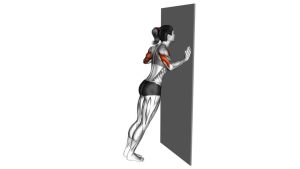
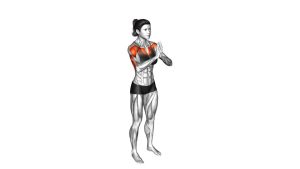
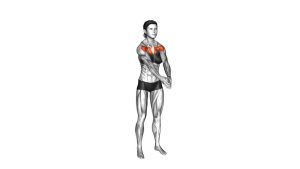
Arm Crossover Chest Out: Standing Chest Activation, Form, Sets & FAQ
Learn the Arm Crossover Chest Out exercise to activate and squeeze your chest using a standing bodyweight crossover. Step-by-step form, sets by goal, tips, common mistakes, FAQs, and recommended equipment.
Arm Crossover Chest Out
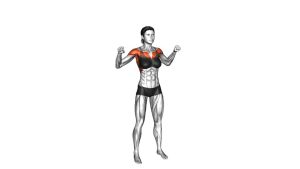
This movement is about control and tension, not heavy resistance. You’ll get the most from it by keeping the shoulders down and back, using a smooth tempo, and actively squeezing the pecs at the crossover point. If you feel mostly traps/neck or front shoulder discomfort, reduce range and slow down.
Quick Overview
| Body Part | Chest |
|---|---|
| Primary Muscle | Pectoralis major (chest) |
| Secondary Muscle | Anterior deltoids, serratus anterior, rhomboids & mid-traps (during the chest-out reset) |
| Equipment | None (optional: resistance band + door anchor for added tension) |
| Difficulty | Beginner (excellent for warm-ups, activation, and technique-focused chest work) |
Sets & Reps (By Goal)
- Warm-up / activation: 2–3 sets × 10–15 reps (easy–moderate effort, 30–45 sec rest)
- Mind–muscle connection: 2–4 sets × 12–20 reps (1–2 sec squeeze, 30–60 sec rest)
- Chest finisher / pump: 2–4 sets × 20–40 reps (continuous tension, short rests)
- Posture-friendly accessory: 2–3 sets × 12–18 reps (slow tempo, focus on “chest out” on the return)
Progression rule: Add reps or a longer squeeze first. If you want more challenge, add a light resistance band and keep the same smooth form.
Setup / Starting Position
- Stand tall: Feet about shoulder-width, knees soft, core gently braced.
- Set the shoulders: Pull shoulders down and back (no shrugging).
- Lift the chest: “Chest out” without leaning back or flaring ribs aggressively.
- Arms at chest height: Raise arms in front of you with a slight elbow bend.
- Neutral wrists: Hands relaxed; keep the movement smooth and controlled.
Tip: Imagine you’re about to hug a barrel. That cue helps keep the elbows softly bent and the motion chest-dominant.
Execution (Step-by-Step)
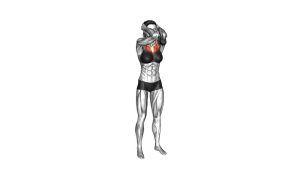
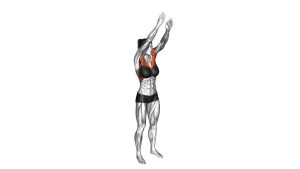
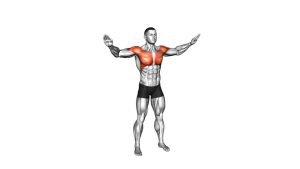
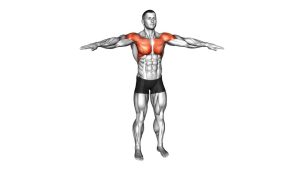
- Open position: Arms slightly out to the sides (not extreme), chest proud, shoulders down.
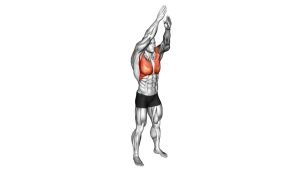
- Cross and squeeze: Bring arms across the body like a controlled hug. Let one forearm pass over the other.
- Peak contraction: At the crossover, squeeze the chest for 1–2 seconds while breathing calmly.
- Return with control: Open the arms back out slowly—don’t let them snap open.
- Chest-out reset: As you open, gently pull shoulder blades back to feel the chest “open” without arching your low back.
Pro Tips & Common Mistakes
- Use a soft elbow bend: Locked elbows usually shift stress to joints and shoulders.
- Don’t shrug: Keep shoulders down—shrugging turns it into a trap/neck drill.
- Squeeze, don’t swing: Momentum kills chest tension. Move like you’re resisting the air.
- Avoid rib flare: “Chest out” should not become a big lower-back arch.
- Control the return: The opening phase is where you build control and keep shoulders healthy.
- Make it harder safely: Add a light band or increase the squeeze hold—don’t force extreme range.
FAQ
Where should I feel the Arm Crossover Chest Out?
You should feel a strong chest squeeze when your arms cross, and a gentle chest opening as you return. If you mostly feel traps/neck or front shoulder pinching, reduce range and keep shoulders down and back.
Is this exercise good for “inner chest”?
It’s great for peak contraction and mind–muscle connection, which many people associate with “inner chest.” Anatomically, the pec works as a whole—but hard squeezes at the midline can improve how well you feel it.
Can I use this as a chest warm-up before pressing?
Yes. Do 1–3 light sets (10–15 reps) focusing on smooth control and a short squeeze. It can help you feel your chest better during bench press, push-ups, or machine pressing.
How can I make it more challenging without weights?
Slow the tempo, add a 2–3 second squeeze at the crossover, increase reps, or add a light resistance band anchored behind you. Keep the movement clean and shoulder-friendly.
Who should be cautious with this movement?
If you have current shoulder pain, impingement symptoms, or a history of painful cross-body movements, keep the range small and avoid forcing the crossover. If symptoms persist, seek professional guidance.
Recommended Equipment (Optional)
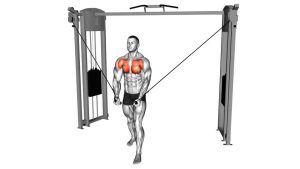
- Resistance Bands Set — add gentle resistance for banded crossovers and higher-tension squeezes
- Door Anchor for Resistance Bands — anchor bands safely to mimic cable-style standing crossovers
- Chest Expander — an easy home option for chest squeeze work and upper-body conditioning
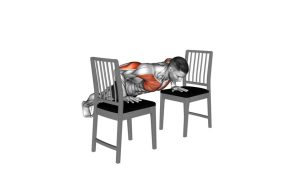
- Exercise Mat — helpful for warm-up circuits and comfort if pairing with floor push-ups
- Loop Bands (Mini Bands) — useful for posture pairing work (band pull-aparts, scapular control drills)
Tip: Keep resistance light enough to maintain smooth reps and shoulders down. This drill should feel chest-dominant and joint-friendly.