Roll Shoulder Blade Reach (Lying on Floor): Form, Sets, Benefits & FAQ
Learn how to perform the Roll Shoulder Blade Reach (Lying on Floor) with proper form. Improve scapular control, serratus activation, and upper-back mobility with setup tips, sets and reps, mistakes to avoid, FAQs, and recommended equipment.
Roll Shoulder Blade Reach (Lying on Floor)
This exercise works best as a precision-based upper-back drill rather than a heavy effort movement. You should feel the shoulder blades glide around the ribcage as you reach upward and then settle back down. The motion is small, but it can improve awareness, posture, and shoulder mechanics when performed with control.
Quick Overview
| Body Part | Upper Back |
|---|---|
| Primary Muscle | Serratus anterior |
| Secondary Muscle | Rhomboids, middle trapezius, lower trapezius, thoracic stabilizers |
| Equipment | Foam roller; optional exercise mat or towel for comfort |
| Difficulty | Beginner (excellent for mobility work, warm-ups, and posture-focused training) |
Sets & Reps (By Goal)
- Mobility warm-up: 2–3 sets × 8–12 reps with slow, smooth control
- Scapular activation: 2–4 sets × 10–15 reps with a brief pause at the top
- Posture / corrective work: 2–3 sets × 8–10 reps with 2–3 second holds
- Recovery day movement: 1–2 easy sets × 6–10 reps, focusing on range quality
Progression rule: Add control before adding volume. First improve the quality of the reach, then increase reps or pause time.
Setup / Starting Position
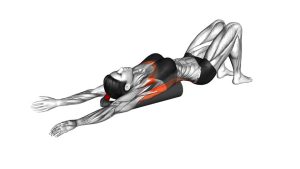
- Place the foam roller under your upper back: Position it around the mid-to-upper thoracic spine, near shoulder blade level.
- Lie on your back: Bend your knees and place your feet flat on the floor to create a stable base.
- Reach both arms straight up: Extend your hands toward the ceiling with elbows straight but not hyperextended.
- Keep the ribs controlled: Lightly brace the core so the lower back does not overarch.
- Relax the neck and shoulders: Avoid shrugging and keep the jaw soft.
Tip: A mat under your body can make the setup more comfortable and help you stay relaxed during the drill.
Execution (Step-by-Step)
- Start with your arms vertical: Hands stacked above the shoulders, shoulders relaxed, and neck neutral.
- Reach upward: Without bending the elbows, push your hands toward the ceiling so the shoulder blades glide away from the floor and around the ribcage.
- Pause briefly: Hold the top position for 1–2 seconds and feel the shoulder blades wrap forward smoothly.
- Return with control: Lower the shoulders back down slowly until the shoulder blades settle against the roller again.
- Repeat evenly: Keep the motion deliberate and small. Each rep should look smooth, quiet, and controlled.
Pro Tips & Common Mistakes
- Keep the arms long: Straight elbows help isolate scapular motion more effectively.
- Think “reach,” not “press”: This is not a chest press. The range is smaller and more precise.
- Do not shrug: Let the shoulder blades glide without hiking the shoulders up toward the ears.
- Control the ribs: Avoid flaring the ribcage or arching the low back to fake extra movement.
- Use a slow tempo: Smooth reps improve body awareness and make the drill more effective.
- Stay relaxed through the neck: If your neck starts doing the work, reduce the range and effort.
FAQ
What should I feel during the Roll Shoulder Blade Reach?
You should feel the shoulder blades moving smoothly around the ribcage, along with light activation around the upper ribs and side of the shoulder blade area. You should not feel pinching in the shoulder joint.
Is this exercise for mobility or strength?
It is mostly a mobility and control drill. It can improve activation and positioning, but it is not meant to be a heavy strength exercise.
Why is the foam roller used?
The roller provides support under the upper back and gives feedback for how the shoulder blades move as you reach and return. It can also encourage a more open thoracic position.
Can beginners use this exercise?
Yes. It is very beginner-friendly when done with a small range of motion and relaxed breathing. Start slow and focus on clean reps.
How can I include it in a workout?
Use it early in the session as part of a warm-up, shoulder prep routine, or upper-back mobility circuit before rows, presses, or overhead work.
Recommended Equipment
- High-Density Foam Roller — the main tool for supporting the upper back and giving scapular feedback during the movement
- Exercise Mat — adds comfort under the hips, feet, and head during floor-based mobility work
- Peanut Massage Ball — useful for additional upper-back soft tissue work around the shoulder blades
- Yoga Mat — a simple option if you want a lightweight surface for daily mobility practice
- Resistance Bands Set — useful for pairing this drill with rows, pull-aparts, and other scapular stability exercises
Tip: Use the foam roller for the drill itself, then add bands or massage tools only if they support your broader mobility and posture routine.