Medicine Ball Around Head Rotation: Form, Sets, Benefits & FAQ
Learn how to do the Medicine Ball Around Head Rotation with proper form. Discover shoulder-focused benefits, step-by-step execution, sets by goal, common mistakes, FAQs, and recommended equipment.
Medicine Ball Around Head Rotation
This exercise works best as a warm-up, movement prep drill, or light shoulder conditioning exercise. Instead of using heavy weight, the goal is to control the medicine ball as it travels around the head without excessive torso sway, neck strain, or lower-back arching. Done correctly, it can help improve shoulder awareness, upper-body rhythm, and overhead movement quality.
Quick Overview
| Body Part | Shoulders |
|---|---|
| Primary Muscle | Deltoids |
| Secondary Muscle | Rotator cuff, trapezius, serratus anterior, upper back, core stabilizers |
| Equipment | Medicine ball |
| Difficulty | Beginner |
Sets & Reps (By Goal)
- Warm-up / movement prep: 2–3 sets × 8–12 rotations each direction with a light ball
- Shoulder mobility & control: 2–4 sets × 10–15 rotations each direction at a smooth tempo
- Light conditioning / endurance: 2–3 sets × 20–30 total seconds per direction
- Rehab-style coordination work: 1–3 sets × 6–10 slow reps each direction with strict control
Progression rule: First improve smoothness, posture, and control. Then add a few reps, more time under tension, or a slightly heavier ball if form stays clean.
Setup / Starting Position
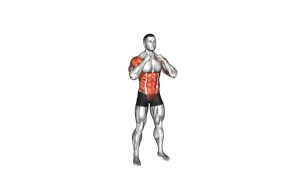
- Stand tall: Place your feet about shoulder-width apart and keep a soft bend in the knees.
- Brace the core: Tighten your midsection lightly to prevent leaning or arching.
- Hold the ball securely: Grip a light medicine ball with both hands near chest or face height.
- Lift the elbows naturally: Keep the elbows slightly bent and ready to guide the ball around the head.
- Start with posture: Keep the chest up, shoulders down, and neck relaxed before moving.
Tip: Start with a lighter medicine ball than you think you need. This exercise is about control, not max loading.
Execution (Step-by-Step)
- Bring the ball near one side of the head: Begin from the front and guide it toward one side in a controlled motion.
- Move around the back of the head: Carefully pass the ball behind the head while keeping the torso stable.
- Continue to the opposite side: Bring the ball around to the other side without jerking or rushing.
- Return to the front: Complete the full circle smoothly and maintain even rhythm.
- Repeat in one direction: Perform all reps with control, then reverse direction and repeat.
Pro Tips & Common Mistakes
- Use a light ball: Too much weight usually turns this into a sloppy grind instead of a quality mobility drill.
- Keep the motion smooth: Avoid throwing the ball around your head or using momentum.
- Stay tall: Don’t lean backward or flare the ribs to create extra room.
- Let the shoulders move naturally: Don’t force the elbows into an awkward path.
- Train both directions: Rotating clockwise and counterclockwise helps balance coordination.
- Protect the neck: Keep the head neutral and do not jut the chin forward during the circle.
- Keep reps controlled: Better circles beat faster circles every time.
FAQ
What is the main benefit of the Medicine Ball Around Head Rotation?
Its main benefit is improving shoulder mobility, control, and stability through a dynamic circular movement. It is especially useful before upper-body workouts or sports that require shoulder coordination.
Is this a strength exercise or a warm-up drill?
It is primarily a warm-up and mobility drill, although it can also build light muscular endurance and movement awareness in the shoulders and upper body.
How heavy should the medicine ball be?
Start light enough that you can move the ball smoothly around your head without leaning, shrugging, or losing control. For most people, lighter medicine balls work best for this drill.
Should I rotate in both directions?
Yes. Performing the movement in both directions helps develop balanced shoulder coordination and control.
Who should be careful with this exercise?
Anyone with current shoulder impingement, acute rotator cuff irritation, significant neck pain, or limited overhead mobility should use caution and stay within a pain-free range.
Recommended Equipment
- Medicine Ball — the main tool for performing controlled around-the-head rotations
- Lightweight Slam Ball — a solid alternative if you want a grippy weighted ball for shoulder drills
- Exercise Mat — useful for warm-up space, kneeling variations, or general training comfort
- Resistance Bands Set — great for pairing with shoulder activation and rotator cuff warm-up work
- Foam Roller — helpful for improving upper-back mobility before shoulder sessions
Tip: Choose equipment that supports control and comfort. For this drill, a lighter ball usually gives better results than a heavy one.