Band Twist Exercise: Proper Form, Core Benefits, Sets, Tips & FAQ
Learn the Band Twist to build stronger obliques, rotational core control, and torso stability with proper setup, steps, mistakes, FAQs, and equipment.
Band Twist
The Band Twist works best when the movement is smooth, braced, and controlled from start to finish. Your hands guide the band, but your core creates the rotation. Keep your ribs stacked over your pelvis, avoid twisting through the lower back aggressively, and move through a range that you can control without leaning or jerking.
This exercise is especially valuable for athletes, lifters, and home-training users because it builds strength in the transverse plane. That means it helps your body control twisting forces during daily movement, sports, and compound exercises. When performed correctly, the Band Twist teaches the core to rotate with power while also resisting unwanted pull from the band.
Quick Overview
| Body Part | Core |
|---|---|
| Primary Muscle | Obliques |
| Secondary Muscle | Transverse abdominis, rectus abdominis, spinal stabilizers, glutes, shoulders |
| Equipment | Resistance band and secure anchor point |
| Difficulty | Beginner to Intermediate |
Sets & Reps (By Goal)
- Core activation: 2–3 sets × 10–12 reps per side with light band tension.
- Oblique strength: 3–4 sets × 8–12 reps per side with moderate band tension.
- Rotational control: 3 sets × 10–15 slow reps per side using a 2–3 second return.
- Athletic core training: 3–5 sets × 6–10 powerful but controlled reps per side.
- Beginner practice: 2 sets × 8 reps per side with a short range and perfect posture.
Progression rule: Increase control first, range second, and band tension last. If you cannot pause at the end of the twist without losing balance, the resistance is too heavy.
Setup / Starting Position
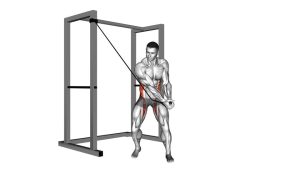
- Anchor the band securely: Attach the band to a stable rack, post, or door anchor around chest height. The anchor should not move during the exercise.
- Stand sideways to the anchor: Position your body so the band pulls from one side. Step far enough away to create light-to-moderate tension.
- Use a stable stance: Stand with feet about hip-to-shoulder width apart, or use a small split stance if you need more balance.
- Hold the band with both hands: Keep your hands together in front of your chest or slightly extended in front of the body.
- Brace your core: Keep your ribs down, pelvis controlled, and shoulders relaxed before starting the twist.
- Set your gaze: Look forward and keep your neck neutral. Avoid turning your head faster than your torso.
Your starting position should feel stable before you move. If the band pulls you off balance before the first rep, step closer to the anchor or use a lighter band.
Execution (Step-by-Step)
- Start with tension: Stand tall with the band slightly stretched. Keep your arms extended but not locked.
- Brace before rotating: Exhale gently, tighten your midsection, and keep your shoulders away from your ears.
- Rotate through the torso: Turn your chest away from or across the anchor direction, depending on the variation, while keeping the hands aligned with the center of your body.
- Keep the hips quiet: Let the trunk rotate, but do not allow the hips to spin wildly. Your lower body should support the movement.
- Reach the end position: Stop when you feel strong oblique tension without arching, leaning, or twisting the lower back aggressively.
- Pause briefly: Hold the end position for a short moment to reinforce control.
- Return slowly: Resist the band as you rotate back to the start. Do not let the band snap your torso back.
- Repeat with clean rhythm: Complete all reps on one side, then turn around and train the opposite side evenly.
Pro Tips & Common Mistakes
Pro Tips
- Move as one unit: Keep your hands, sternum, and core connected so the twist comes from the torso instead of the arms.
- Control the return: The eccentric phase is where a lot of core stability is built. Return slowly and resist the pull of the band.
- Use the right band tension: Choose a band that lets you rotate smoothly without leaning, shaking excessively, or losing posture.
- Keep the ribs down: Avoid flaring the ribs or arching the lower back as you rotate.
- Train both sides equally: Rotational exercises should be balanced to avoid one-sided strength or coordination gaps.
Common Mistakes
- Pulling with the arms: This turns the movement into an upper-body pull instead of a core rotation exercise.
- Using too much resistance: Heavy band tension often causes leaning, hip spinning, and poor trunk control.
- Rotating through the lower back only: Keep the movement controlled through the trunk and avoid forcing the lumbar spine.
- Letting the band snap back: A rushed return reduces control and increases strain risk.
- Shrugging the shoulders: Keep the neck relaxed and shoulders down throughout the set.
- Standing too narrow: A weak stance makes balance harder and reduces force transfer.
FAQ
What muscles does the Band Twist work?
The Band Twist primarily targets the obliques. It also trains the transverse abdominis, rectus abdominis, spinal stabilizers, glutes, and shoulders as supporting muscles.
Is the Band Twist good for beginners?
Yes. Beginners can use a light band, a shorter range of motion, and slower reps. The key is to control the twist without pulling with the arms or letting the lower back take over.
Should I feel the Band Twist in my lower back?
You may feel the trunk stabilizers working, but the exercise should not create sharp or uncomfortable lower-back pain. If your lower back dominates, reduce the range, brace harder, and use a lighter band.
How high should I anchor the band?
Chest height works well for the standard Band Twist. A higher or lower anchor can shift the movement angle, but beginners should start around chest level for cleaner control.
Is the Band Twist the same as a Pallof press?
No. A Pallof press is mainly an anti-rotation exercise where you resist twisting. The Band Twist includes active rotation, although the return phase still trains anti-rotation control.
Can I do Band Twists every day?
Light technique sets can be done often, but harder strength sets need recovery. For most people, 2–4 sessions per week is enough for progress.
Recommended Equipment
- Resistance Bands with Handles — ideal for controlled standing twists and core rotation drills.
- Door Anchor for Resistance Bands — useful for setting the band at chest height when training at home.
- Loop Resistance Bands Set — provides multiple resistance levels for progression.
- Non-Slip Exercise Mat — improves foot grip and stability during standing band work.
- Wall Anchor for Resistance Bands — creates a stronger fixed point for consistent band tension.
Choose equipment that matches your current strength level. A lighter band with clean control is better than a heavy band that pulls your posture out of position.