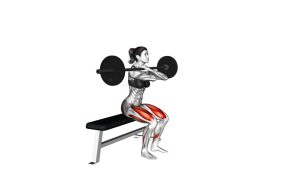
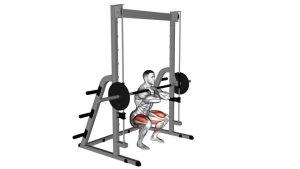
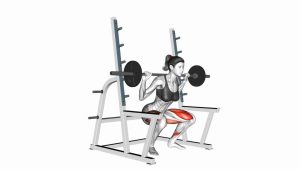
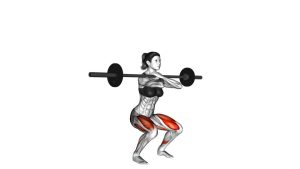
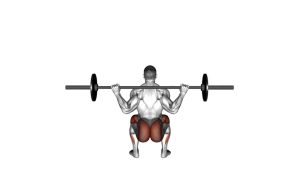
Barbell Full Zercher Squat: Form, Benefits, Sets, Tips & FAQ
Learn the Barbell Full Zercher Squat for stronger quads, glutes, core, and upper back with proper form, setup, sets, tips, mistakes, and FAQs.
Barbell Full Zercher Squat
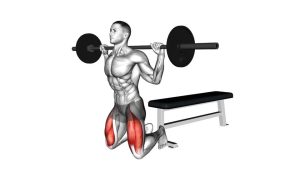
The Barbell Full Zercher Squat is best used when the goal is to build lower-body strength while also challenging the torso to resist forward collapse. Unlike a back squat, the bar position forces the abs, obliques, spinal erectors, and upper back to work hard throughout the entire repetition. The movement also encourages a strong knee bend, making it especially useful for developing the quads and improving deep squat control.
Quick Overview
| Body Part | Legs |
|---|---|
| Primary Muscle | Quadriceps, Glutes |
| Secondary Muscle | Adductors, Hamstrings, Core, Upper Back, Biceps Isometric Support |
| Equipment | Barbell, Weight Plates, Optional Bar Pad or Elbow Sleeves |
| Difficulty | Intermediate |
Sets & Reps (By Goal)
- Strength: 3–5 sets × 3–6 reps with heavier load and 2–3 minutes rest.
- Muscle growth: 3–4 sets × 6–10 reps with controlled tempo and 90–150 seconds rest.
- Technique practice: 2–4 sets × 5–8 reps with light-to-moderate weight and perfect depth.
- Core and posture strength: 3 sets × 6–12 reps with strict bracing and slow control.
Progression rule: Add weight only when you can maintain a stable bar position, full-foot pressure, clean knee tracking, and a braced torso through the full range of motion.
Setup / Starting Position
- Set the bar at a safe height: Place the barbell around lower chest or upper-ab height on a rack so you can lift it without rounding forward.
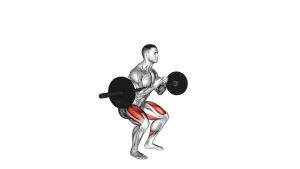
- Secure the Zercher grip: Place the bar in the crease of your elbows and keep your fists close together or hands clasped for stability.
- Brace your torso: Take a deep breath, tighten your abs, and keep your ribs stacked over your pelvis.
- Set your stance: Stand about shoulder-width apart with toes slightly turned out.
- Keep the bar close: Pull the elbows slightly upward and inward so the bar stays connected to the torso.
Tip: If the bar feels uncomfortable on the elbows, use a bar pad, towel, hoodie, or elbow sleeves. Comfort should improve control, not replace good technique.
Execution (Step-by-Step)
- Unrack and stabilize: Stand tall, take one or two controlled steps back, and reset your feet before starting the rep.
- Begin the descent: Bend the knees and hips together while keeping the bar close to your body.
- Stay braced: Keep your abs tight and resist the bar pulling your torso forward.
- Reach full depth: Lower until your hips pass below knee level, as long as you can maintain control and balance.
- Drive upward: Push through the mid-foot and heels while extending the knees and hips together.
- Finish tall: Return to a strong standing position with hips and knees extended, but avoid over-leaning backward.
Pro Tips & Common Mistakes
- Keep the elbows close: Letting the elbows drop or drift forward makes the bar unstable and increases torso collapse.
- Brace before every rep: Treat each repetition like a heavy front-loaded lift, even with moderate weight.
- Use controlled depth: Full depth is valuable, but only if your spine, knees, and feet stay controlled.
- Avoid bouncing at the bottom: Use a smooth transition instead of dropping into the deepest position aggressively.
- Do not let the knees cave inward: Keep the knees tracking in the same direction as the toes.
- Keep full-foot pressure: Avoid shifting fully onto the toes or rocking back onto the heels.
- Do not overload too early: The Zercher position challenges the core and upper back, so build gradually.
- Use a rack when possible: Starting from the floor is harder and may require deadlift or clean-style setup skill.
FAQ
What muscles does the Barbell Full Zercher Squat work?
It mainly works the quadriceps and glutes. It also strongly trains the core, upper back, adductors, hamstrings, and the arms isometrically because the bar is held in the elbow crease.
Is the Zercher Squat good for building legs?
Yes. The full Zercher Squat is excellent for building leg strength because it allows deep knee flexion and strong hip extension while forcing the torso to stay braced under a front-loaded position.
Why does the Zercher Squat feel harder than a regular squat?
The bar is held in front of the body, which increases the demand on the abs, upper back, and arms. Even when the leg load is moderate, the torso must work harder to keep the bar stable.
Should I use a bar pad for Zercher Squats?
You can use a bar pad, towel, hoodie, or elbow sleeves if the pressure on the elbows is uncomfortable. Padding is helpful as long as it does not make the bar unstable.
How deep should I squat?
Squat as deep as you can while keeping the spine controlled, feet planted, knees tracking properly, and bar close to the torso. For this variation, full depth usually means the hips move below the knees.
Is the Barbell Full Zercher Squat beginner-friendly?
It is usually better for intermediate lifters because it requires strong bracing, balance, and bar control. Beginners can start with goblet squats, front squats, or light Zercher box squats before progressing.
Recommended Equipment
- Olympic Barbell — essential for performing Zercher squats with stable loading.
- Barbell Bar Pad — helps reduce pressure on the elbow crease during Zercher loading.
- Weightlifting Elbow Sleeves — adds comfort and support when holding the bar in the arms.
- Squat Rack — allows safer setup, unracking, and reracking for Zercher squat training.
- Weightlifting Belt — useful for heavier sets when extra bracing support is needed.
Tip: Equipment should improve safety and control. Do not use padding or support gear to hide poor technique, unstable bracing, or excessive loading.