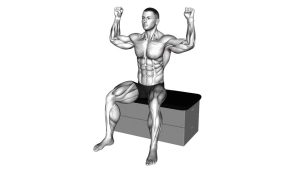
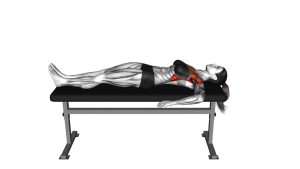
Dumbbell Lying Supine Shoulder External Rotation: Form, Sets, Tips & FAQ
Learn the Dumbbell Lying Supine Shoulder External Rotation to strengthen rotator cuffs, improve shoulder stability, and train safe form.
Dumbbell Lying Supine Shoulder External Rotation
This exercise works best with a light dumbbell, strict elbow control, and a slow tempo. Because the body is supported in a supine position, the torso stays quiet and the shoulder can focus on pure rotation. You should feel the back and side of the shoulder working, not the neck, upper traps, wrist, or biceps.
Quick Overview
| Body Part | Shoulders |
|---|---|
| Primary Muscle | Infraspinatus and teres minor |
| Secondary Muscle | Posterior deltoid, supraspinatus, scapular stabilizers |
| Equipment | Light dumbbell, bench or exercise mat |
| Difficulty | Beginner to intermediate |
Sets & Reps (By Goal)
- Shoulder warm-up: 1–2 sets × 10–15 reps per side with very light weight.
- Rotator cuff strength: 2–4 sets × 8–12 reps per side with controlled tempo.
- Prehab / joint control: 2–3 sets × 12–15 reps per side using a slow 2–3 second lowering phase.
- Technique practice: 2 sets × 8–10 reps per side, focusing on elbow position and smooth rotation.
Progression rule: Increase control before increasing weight. If the elbow moves, the shoulder pinches, or the dumbbell swings, the load is too heavy.
Setup / Starting Position
- Lie on your back: Use a flat bench or exercise mat. Keep your head, ribs, and pelvis relaxed and supported.
- Hold a light dumbbell: Grip the dumbbell with a neutral wrist. Avoid squeezing so hard that the forearm takes over.
- Bend the elbow: Keep the working elbow bent around 90 degrees.
- Stabilize the upper arm: Keep the elbow close to your torso or lightly supported so the upper arm does not drift.
- Start with control: Position the forearm upright or slightly angled, depending on your comfortable shoulder range.
Keep the shoulder blade gently set against the bench or floor. Do not arch your back or shrug your shoulder to create more range.
Execution (Step-by-Step)
- Brace lightly: Keep your ribs down, neck relaxed, and elbow fixed in place.
- Rotate the shoulder: Slowly move the forearm through an arc by externally rotating the upper arm.
- Control the dumbbell: Lower only as far as your shoulder stays comfortable and stable.
- Pause briefly: Hold the end position for a moment without bouncing or forcing the joint.
- Return smoothly: Rotate back to the starting position with the same slow control.
- Repeat evenly: Keep each rep quiet, precise, and free from momentum.
Pro Tips & Common Mistakes
- Use a very light dumbbell: Rotator cuff muscles are small and respond best to clean tension, not heavy loading.
- Keep the elbow stable: Do not let the upper arm drift away from the body during the rotation.
- Avoid wrist bending: Keep the wrist neutral so the movement stays focused on the shoulder.
- Do not turn it into a press: The dumbbell should rotate through an arc, not push upward like a chest press.
- Stop before pain: Mild muscular effort is normal; sharp pinching or joint pain is not.
- Control both directions: The lowering and lifting phases should feel equally smooth.
- Keep the neck relaxed: Avoid shrugging or bracing with the upper traps.
FAQ
What muscles does the Dumbbell Lying Supine Shoulder External Rotation work?
It mainly targets the infraspinatus and teres minor, which are key rotator cuff muscles responsible for external rotation and shoulder stability.
Should I use heavy weight for this exercise?
No. This exercise is designed for control, stability, and rotator cuff activation. A light dumbbell is usually enough when the form is strict.
Where should I feel the exercise?
You should feel light-to-moderate work around the back and side of the shoulder. You should not feel neck tension, sharp joint pain, or strong biceps involvement.
Is this exercise good for shoulder prehab?
Yes. When performed with light resistance and strict control, it can help improve rotator cuff strength, shoulder control, and warm-up quality.
Can beginners do this exercise?
Yes. Beginners can perform it safely with a very light dumbbell, small range of motion, and slow tempo. The focus should be clean rotation, not maximum range.
Recommended Equipment
- Light Dumbbell Set — best for controlled rotator cuff strengthening and small isolation exercises.
- Adjustable Light Dumbbells — useful for gradual progression without jumping too quickly in weight.
- Flat Workout Bench — provides stable support for supine shoulder rotation work.
- Thick Exercise Mat — helpful if performing the exercise on the floor instead of a bench.
- Mini Resistance Bands — useful for pairing with shoulder warm-ups, external rotations, and scapular activation drills.
Choose equipment that allows smooth, pain-free reps. For rotator cuff training, lighter tools and better control usually produce better results than heavy resistance.