Front Plank with Arm and Leg Lift: Core Stability, Form, Sets & Tips
Learn the Front Plank with Arm and Leg Lift for stronger core stability, balance, and anti-rotation control with safe form, sets, tips, FAQs, and gear.
Front Plank with Arm and Leg Lift
This movement works best when the lift is smooth, controlled, and balanced. Instead of raising the arm and leg as high as possible, focus on keeping the torso quiet and the hips level. Additionally, keep the head neutral, press firmly through the supporting hand, and avoid letting the lower back sag. When performed correctly, the exercise feels like a full-body stability challenge rather than a fast leg-and-arm swing.
Quick Overview
| Body Part | Core |
|---|---|
| Primary Muscle | Rectus abdominis and deep core stabilizers |
| Secondary Muscle | Obliques, transverse abdominis, glutes, shoulders, chest, upper back, lower back stabilizers |
| Equipment | No equipment required; optional exercise mat for wrist and floor comfort |
| Difficulty | Intermediate because it requires plank strength, balance, and anti-rotation control |
Sets & Reps (By Goal)
- Core stability: 3 sets × 6–10 controlled reps per side, resting 45–75 seconds between sets.
- Balance and coordination: 2–4 sets × 5–8 reps per side with a 2–3 second hold at the top.
- Strength endurance: 3–4 sets × 8–12 reps per side using a slow and steady tempo.
- Warm-up activation: 2 sets × 4–6 reps per side, keeping each rep smooth and low effort.
Progression rule: First increase control, then increase hold time. After that, add more reps only if your hips stay level and your spine stays neutral.
Setup / Starting Position
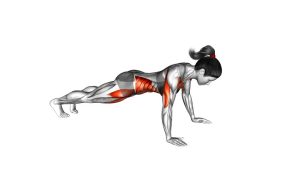
- Start in a high plank: Place your hands under your shoulders and extend both legs behind you.
- Set your feet slightly apart: A wider foot position gives more balance, while a narrower stance makes the movement harder.
- Create a straight body line: Keep your head, shoulders, hips, knees, and heels aligned.
- Brace your core: Gently tighten your abs as if preparing to resist a push from the side.
- Keep your neck neutral: Look down toward the floor instead of lifting the chin forward.
- Press into the floor: Push through both hands so the shoulders stay stable and active.
Setup quality matters. If your plank position is already unstable before lifting a limb, use a regular high plank first until you can hold it with control.
Execution (Step-by-Step)
- Begin in a strong plank: Brace your core, squeeze your glutes lightly, and keep your body long.
- Shift as little as possible: Before lifting, stabilize through the supporting hand and opposite foot.
- Lift one arm forward: Raise the arm in front of your shoulder while keeping it straight and controlled.
- Lift the opposite leg backward: At the same time, extend the opposite leg behind you without arching your lower back.
- Hold briefly: Pause for 1–3 seconds while keeping the hips as level as possible.
- Return with control: Lower the hand and foot back to the floor without dropping or twisting.
- Repeat on the other side: Lift the opposite arm and opposite leg, then continue alternating sides.
Pro Tips & Common Mistakes
Pro Tips
- Move slowly: A slower lift improves core control and reduces unwanted rotation.
- Keep the lifted leg low: Raise the leg only until it lines up with your body, not above your hips.
- Push the floor away: Strong pressure through the supporting hand helps protect the shoulder.
- Use your breath: Exhale gently as you lift, then breathe calmly during the hold.
- Start with short holds: A clean 1-second hold is better than a long hold with poor alignment.
Common Mistakes
- Rotating the hips: This reduces the anti-rotation benefit and shifts work away from the core.
- Lifting too high: Overlifting the leg can cause lower-back arching and poor control.
- Rushing the return: Dropping the hand or foot removes tension and can disturb balance.
- Sagging through the shoulders: Letting the chest collapse can stress the wrists and shoulders.
- Holding the breath: Breath-holding often increases tension and makes balance harder.
FAQ
What is the Front Plank with Arm and Leg Lift good for?
It is useful for training core stability, anti-rotation strength, balance, shoulder support, and glute coordination. Additionally, it helps you practice keeping your torso steady while your limbs move.
Is this exercise beginner-friendly?
It can be challenging for beginners because it requires a strong plank base. However, beginners can modify it by lifting only one arm or only one leg before combining both.
Should my hips stay completely still?
Your goal is to keep the hips as level as possible. Small balance adjustments are normal, but large twisting or rocking means the exercise is too difficult or the lift is too high.
How high should I lift my arm and leg?
Lift the arm roughly to shoulder height and the leg roughly in line with your torso. More height is not always better, especially if it causes your lower back to arch.
Can this exercise help with abs?
Yes. It trains the abs as stabilizers, especially when you resist rotation and keep the spine neutral. Nevertheless, it is more of a stability exercise than a direct crunch-style ab movement.
Recommended Equipment (Optional)
- Exercise Mat — adds comfort for the hands, wrists, knees, and feet during plank work.
- Non-Slip Yoga Mat — improves floor grip so your hands and feet stay stable while lifting.
- Workout Wrist Support — may help provide extra wrist comfort during high-plank variations.
- Push-Up Handles — can reduce wrist extension and create a more neutral hand position.
- Core Sliders — useful for advanced plank progressions once basic control is mastered.
Tip: Equipment should make the movement safer and cleaner. Therefore, avoid adding advanced tools until you can lift the opposite arm and leg without twisting, sagging, or rushing.