Sitting Shoulder Press Toe Touch on a Padded Stool: Form, Sets, Tips & FAQ
Learn the Sitting Shoulder Press Toe Touch on a Padded Stool for shoulder endurance, core control, and seated coordination. Includes proper form, sets by goal, mistakes, FAQs, and optional equipment.
Sitting Shoulder Press Toe Touch on a Padded Stool
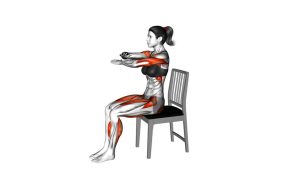
This exercise works best when each rep stays controlled and coordinated. The upward phase trains shoulder drive and posture, while the return phase adds a toe-touch style crunch that challenges the abs and hip flexors. You should feel the movement in the shoulders, core, and front of the hips, not as sharp stress in the neck or lower back.
Quick Overview
| Body Part | Shoulders |
|---|---|
| Primary Muscle | Deltoids (especially front delts) and Rectus Abdominis |
| Secondary Muscle | Triceps, Hip Flexors, Upper Chest, Obliques, Postural Stabilizers |
| Equipment | Padded stool or bench |
| Difficulty | Beginner to Intermediate (more coordination-based than load-based) |
Sets & Reps (By Goal)
- Warm-up / mobility: 2–3 sets × 8–10 reps per side or alternating reps, light tempo, 30–45 sec rest
- Core and shoulder endurance: 2–4 sets × 10–15 reps, steady rhythm, 45–60 sec rest
- Coordination practice: 2–3 sets × 6–8 slow reps, focus on smooth timing and posture
- Light conditioning circuit: 2–4 rounds × 30–40 seconds of controlled reps
Progression rule: First improve coordination and posture, then add reps, time, or a slightly slower tempo. Do not progress by rushing the movement.
Setup / Starting Position
- Sit tall on the padded stool: Place your feet flat and keep enough space to move the torso and legs freely.
- Brace lightly through the core: Keep the chest lifted and avoid slumping at the start.
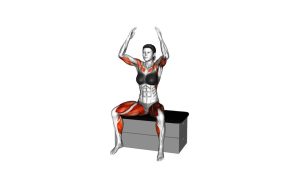
- Bring the arms into position: Elbows bent, hands near shoulder level as if preparing for a shoulder press.
- Set the neck and shoulders: Keep the shoulders down and relaxed instead of shrugged upward.
- Prepare the movement path: Think “press up tall, then fold forward with control.”
Tip: A stable stool height helps. You should be able to sit tall without feeling cramped through the hips.
Execution (Step-by-Step)
- Start upright: Sit tall with the core lightly engaged and elbows bent near shoulder height.
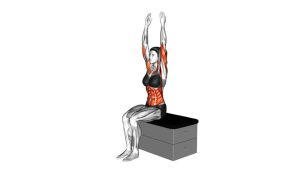
- Press upward: Extend the arms overhead in a shoulder-press motion while staying tall through the torso.
- Lift and coordinate: As the arms reach up, lift the working leg or create the upward phase shown in the movement pattern.
- Reach the top smoothly: Finish the press without shrugging or arching hard through the lower back.
- Fold forward: Bring the arms back down and lean forward into a toe-touch style crunch with control.
- Touch or reach toward the foot: Move only as far as you can without rounding aggressively or collapsing.
- Return to the seated start: Reset tall and repeat with a steady rhythm.
Pro Tips & Common Mistakes
- Press up before folding down: Keep the sequence clean instead of blending both phases too early.
- Stay tall on the press: Avoid leaning backward or over-arching the lower back.
- Use the abs on the toe touch: Don’t just collapse forward from the shoulders.
- Move with rhythm: A steady cadence improves coordination and makes the exercise safer.
- Don’t shrug the shoulders: Keep the neck relaxed during the overhead portion.
- Don’t chase max toe-touch range: Reach only as far as you can while keeping the movement controlled.
- Keep the stool stable: Any wobble will reduce control and make the exercise harder to perform well.
FAQ
What does this exercise mainly work?
It mainly trains the shoulders and core, while also involving the hip flexors and postural stabilizers during the seated movement.
Is this a strength exercise or a cardio exercise?
It is mostly a light functional conditioning and coordination exercise. It can support muscular endurance, mobility, and movement control more than maximal strength.
Should I move fast or slow?
Start slow to moderate. The movement should look smooth and deliberate. Once your coordination improves, you can use a slightly more athletic rhythm without losing form.
What if I can’t touch my toes?
That is completely fine. Reach toward the shin, ankle, or foot only as far as you can without pain or excessive rounding. The goal is controlled flexion, not forcing flexibility.
Who should be cautious with this exercise?
Anyone with active shoulder pain, low-back irritation, poor balance, or recent abdominal or hip issues should keep the range small or choose a simpler seated variation first.
Recommended Equipment (Optional)
- Balance Pad / Foam Stability Pad — useful for seated support work, balance drills, and light mobility training
- Resistance Band Set — great for pairing this exercise with shoulder warm-ups, rows, and posture work
- Exercise Mat — adds comfort and stability around the training area
- Cervical Neck Pillow — optional recovery support for people also doing posture and neck-control work
- Posture Reminder Brace — optional awareness tool for posture habits, not a replacement for training
Tip: Optional gear should support comfort, control, and consistency. It should never replace good exercise technique.