Cable Bent-Over Neutral Grip Kickback with Rope Attachment: Form, Sets, Tips & FAQ
Learn how to perform the Cable Bent-Over Neutral Grip Kickback with Rope Attachment to isolate the triceps with strict form, controlled tempo, setup cues, mistakes, FAQs, and equipment tips.
Cable Bent-Over Neutral Grip Kickback with Rope Attachment
This exercise is best used when the goal is to build a stronger mind-muscle connection with the triceps, improve elbow extension control, and add focused volume to the upper arms without relying on heavy pressing. The movement should feel smooth, controlled, and precise. Your torso stays stable, your upper arms remain close to the body, and the forearms move backward by extending the elbows.
Because the cable pulls forward while you drive the rope backward, the triceps must work hard to finish the rep and control the return. This makes the exercise very useful near the end of an arm workout, after heavier presses, dips, skull crushers, or cable pressdowns. It is not a movement for swinging or chasing heavy weight. The best results come from clean positioning, full extension, and a controlled eccentric phase.
Quick Overview
| Body Part | Triceps |
|---|---|
| Primary Muscle | Triceps brachii, especially the long head and lateral head during full elbow extension |
| Secondary Muscle | Rear delts, core stabilizers, spinal erectors, forearms, and grip muscles for positioning and control |
| Equipment | Cable machine with a low pulley and rope attachment |
| Difficulty | Intermediate because it requires stable hinging, elbow control, and strict cable tension management |
Sets & Reps (By Goal)
- Muscle growth: 3–4 sets of 10–15 reps using a controlled tempo and strong squeeze at full extension.
- Triceps isolation and pump: 2–4 sets of 12–20 reps with lighter weight, short rest, and constant cable tension.
- Form practice: 2–3 sets of 8–12 slow reps, focusing on elbow position and clean rope separation at the finish.
- Finisher after pressing: 2–3 sets of 15–25 reps with moderate-to-light resistance and minimal rest.
- Strength-control accessory work: 3 sets of 8–10 reps with a slightly heavier load, as long as the torso does not swing.
Progression rule: Add reps first, then increase the weight slightly. If your elbows start drifting, your torso starts rocking, or you lose the triceps squeeze at lockout, the load is too heavy.
Setup / Starting Position
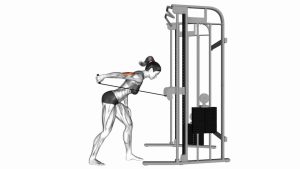
- Attach the rope to a low cable pulley: Set the pulley near the bottom of the cable machine. Clip on a rope attachment and choose a light-to-moderate weight.
- Stand facing the cable machine: Take one or two small steps back so the cable has tension before you begin the first rep.
- Hold the rope with a neutral grip: Grip both rope ends with your palms facing each other. Keep your wrists straight instead of bending them backward.
- Hinge forward at the hips: Bend your knees slightly and lean your torso forward while keeping your spine long and neutral.
- Set your upper arms: Pull your elbows close to your sides and position them slightly behind your torso if your shoulder mobility allows it.
- Brace lightly: Keep your ribs down, abs engaged, chest open, and shoulders away from your ears.
- Start with bent elbows: Your forearms should point forward toward the cable, while your upper arms stay fixed close to your body.
Execution (Step-by-Step)
- Lock in your posture: Keep your torso still, knees soft, spine neutral, and elbows close to your ribs. Your head should follow the line of your spine instead of looking too far up.
- Begin the kickback from the elbows: Extend your elbows by driving the rope backward. The upper arms should stay almost motionless while the forearms move.
- Push the rope behind your body: Continue extending until your arms are straight or nearly straight. Avoid snapping the elbows aggressively at the top.
- Separate the rope ends slightly: At the end of the rep, gently pull the rope handles apart to increase the triceps contraction. Keep the wrists neutral and controlled.
- Squeeze the triceps: Pause briefly at full extension for about one second. Focus on the back of the upper arm, not the shoulders or lower back.
- Return with control: Allow the elbows to bend slowly as the rope travels forward. Do not let the cable pull your arms forward quickly.
- Stop before losing tension: Return to the starting position with the elbows bent, but keep the cable active so the triceps remain engaged.
- Repeat with the same tempo: Every rep should look nearly identical. If the body starts swinging, reduce the weight and reset your position.
Pro Tips & Common Mistakes
Pro Tips
- Use a lighter load than you think: This exercise becomes more effective when you can fully extend the elbows without swinging the body.
- Keep the cable line smooth: Step far enough away from the machine so the rope has tension, but not so far that the shoulders get pulled out of position.
- Pause at the top: A short squeeze at full extension helps improve triceps activation and prevents rushed reps.
- Control the negative: Letting the rope return slowly makes the eccentric phase more productive and reduces elbow stress.
- Keep your elbows slightly behind the torso: This position can help bias the long head of the triceps more effectively.
- Use it after heavier movements: Place it after close-grip presses, dips, skull crushers, or pressdowns for a strong finishing pump.
Common Mistakes
- Swinging the torso: Rocking forward and backward turns the movement into a momentum exercise instead of a triceps isolation drill.
- Letting the elbows drift: When the elbows move too much, the shoulders begin helping and the triceps lose tension.
- Using too much weight: Heavy loads often shorten the range of motion and make the rope snap back during the return.
- Rounding the lower back: A poor hinge position can create unnecessary stress through the spine.
- Flaring the elbows wide: Keep the arms close to the body so the movement stays controlled and targeted.
- Skipping full extension: Stopping short reduces the peak triceps contraction, which is one of the main benefits of this variation.
FAQ
What muscles does the Cable Bent-Over Neutral Grip Kickback with Rope Attachment work?
It primarily targets the triceps brachii, especially during the final elbow extension phase. The long head and lateral head are strongly involved, while the rear delts, core, forearms, and spinal stabilizers assist by helping you maintain the bent-over position and control the rope.
Is this better than a dumbbell triceps kickback?
The cable version often provides more consistent tension than the dumbbell version. With a dumbbell, tension can drop depending on the arm angle. With a cable, the triceps must resist the pull throughout the rep, especially when the rope is controlled properly.
Should I go heavy on this exercise?
No. This is not a max-strength movement. Use a weight that allows full extension, a clean squeeze, and a slow return. If you need to swing your torso or move your shoulders to finish the rep, the weight is too heavy.
Where should I feel the exercise?
You should feel it mainly in the back of the upper arm, especially near the top of the movement when the elbows are extended. You should not feel strong strain in the lower back, neck, front shoulders, or wrists.
Can beginners do this exercise?
Beginners can perform it, but they should start light and learn how to keep the elbows fixed. If the bent-over position feels difficult, a standard cable rope pressdown may be easier to control first.
How do I make the movement more effective?
Keep your upper arms still, extend fully, separate the rope slightly at the finish, and control the return. A slower tempo usually works better than adding more weight.
When should I include this exercise in my workout?
It works well near the end of a push day, arm day, or upper-body workout. Use it after heavier triceps exercises to finish the muscle with clean isolation and constant tension.
Recommended Equipment
- Cable Rope Attachment — essential for neutral-grip kickbacks, rope pressdowns, face pulls, and other cable isolation exercises.
- Cable Attachment Set — useful if you want multiple handle options for triceps, biceps, shoulders, and lower-body cable work.
- Home Cable Pulley System — a compact option for performing cable kickbacks, pressdowns, curls, and rows at home.
- Weightlifting Gloves or Grip Pads — helpful for improving rope grip comfort during higher-rep triceps isolation sets.
- Adjustable Bench — useful for supporting other triceps variations such as incline cable extensions, skull crushers, and pressing work.
Tip: The rope attachment is the most important item for this exercise. A good rope should feel secure, rotate smoothly, and allow you to separate the ends slightly without wrist discomfort.