Long Plank Against Wall: Proper Form, Core Benefits, Sets, Tips & FAQ
Learn the Long Plank Against Wall to build core stability, shoulder control, and posture strength with safe form, sets, tips, FAQs, and equipment.
Long Plank Against Wall
This exercise is useful for people who want to build plank strength with less wrist, shoulder, and lower-back stress than a traditional floor plank. The wall angle makes the movement more accessible, while the longer body position still challenges the abs, deep core, glutes, chest, and shoulder stabilizers. The farther your feet move away from the wall, the more demanding the hold becomes.
Quick Overview
| Body Part | Core |
|---|---|
| Primary Muscle | Rectus abdominis, transverse abdominis, deep core stabilizers |
| Secondary Muscle | Shoulders, chest, serratus anterior, glutes, spinal stabilizers |
| Equipment | Wall only; optional exercise mat for foot comfort |
| Difficulty | Beginner to beginner-plus, depending on foot distance from the wall |
Sets & Reps (By Goal)
- Beginner core activation: 2–3 sets × 15–25 seconds, with 45–60 seconds rest
- Posture and bracing practice: 2–4 sets × 20–35 seconds, focusing on smooth breathing
- Core endurance: 3–5 sets × 30–45 seconds, keeping hips level and ribs controlled
- Warm-up preparation: 1–2 sets × 15–30 seconds before upper-body or core training
- Progressive strength goal: Gradually step the feet farther away from the wall before increasing hold time
Progression rule: Increase difficulty only when you can hold a straight body line without sagging the hips, shrugging the shoulders, or losing core tension.
Setup / Starting Position
- Stand facing a wall: Place both hands flat on the wall at about shoulder height.
- Set your hand position: Keep hands shoulder-width apart with fingers spread for better support.
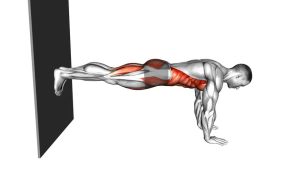
- Step your feet back: Walk the feet away from the wall until your body forms a long diagonal line.
- Stack your posture: Keep the head, shoulders, hips, knees, and ankles aligned.
- Brace the core: Gently tighten the abs as if preparing for a light punch to the stomach.
- Set the shoulders: Push lightly into the wall without rounding aggressively or collapsing between the shoulder blades.
- Keep the neck neutral: Look toward the wall without dropping the head or lifting the chin.
Tip: A shorter distance from the wall makes the exercise easier. A longer distance increases the core and shoulder demand.
Execution (Step-by-Step)
- Start in your wall plank: Hands on the wall, arms extended, feet stepped back, and body in one straight diagonal line.
- Brace before holding: Tighten the abs, lightly squeeze the glutes, and keep the ribs from flaring forward.
- Press evenly through the palms: Maintain stable contact with the wall without pushing so hard that the shoulders shrug.
- Hold the position: Stay still while breathing slowly through the nose or controlled through the mouth.
- Control the hips: Do not let the lower back arch or the hips sink toward the wall.
- Keep the shoulders organized: Avoid collapsing the chest toward the wall. Keep the upper back active and stable.
- Finish smoothly: Step toward the wall to exit the hold instead of suddenly releasing tension.
Pro Tips & Common Mistakes
- Think “long body”: Reach tall through the crown of the head and long through the heels.
- Do not sag the hips: Hip sagging shifts stress into the lower back and reduces core engagement.
- Avoid shoulder shrugging: Keep the neck relaxed and the shoulders away from the ears.
- Do not bend at the waist: The exercise is not a wall push-up. Keep the body straight and still.
- Use controlled breathing: Do not hold your breath. Breathe while maintaining abdominal tension.
- Adjust the wall distance: Move closer for easier form or farther away for more challenge.
- Keep elbows extended but soft: Avoid locking the joints aggressively.
- Brace the glutes lightly: This helps keep the pelvis from tipping forward.
- Use it as a plank regression: This is a strong option before progressing to incline planks, knee planks, or floor planks.
FAQ
What muscles does the Long Plank Against Wall work?
The exercise mainly works the core muscles, including the rectus abdominis and transverse abdominis. It also trains the shoulders, chest, serratus anterior, glutes, and spinal stabilizers because the whole body must stay aligned.
Is the Long Plank Against Wall good for beginners?
Yes. It is one of the most beginner-friendly plank variations because the wall reduces the load compared with a floor plank. Beginners can start close to the wall and gradually step farther back as strength improves.
How long should I hold a wall plank?
Start with 15–25 seconds per set. Once you can hold the position with clean form, progress toward 30–45 seconds. Quality is more important than long hold times.
Why do I feel this in my shoulders?
Some shoulder engagement is normal because your arms support your body against the wall. However, if your shoulders burn before your core activates, reduce the distance from the wall and focus on bracing the abs.
Should my body move during the exercise?
No. The Long Plank Against Wall is mostly an isometric hold. Your goal is to stay still, maintain a straight line, and resist sagging or shifting.
How can I make the Long Plank Against Wall harder?
Step your feet farther away from the wall, increase hold time, slow your breathing, or progress to an incline plank on a bench. Do not increase difficulty if your lower back starts to arch.
Is this exercise useful for posture?
Yes. It teaches core bracing, shoulder control, and body alignment, which can support better posture awareness. For best results, combine it with upper-back exercises and hip stability work.
Recommended Equipment (Optional)
- Exercise Mat — useful for comfortable foot placement and general core training
- Resistance Bands Set — helpful for pairing wall planks with rows, pull-aparts, and posture drills
- Push-Up Handles — useful for progressing to floor plank and push-up variations with neutral wrist support
- Core Sliders — useful for advanced core progressions after mastering basic plank control
- Foam Roller — helpful for warm-ups, mobility work, and upper-back relaxation before core training
Tip: Equipment is optional for this exercise. The most important tool is a stable wall and enough space to step back safely.