Side Bend Arms Above: Form, Oblique Benefits, Sets & Tips
Learn Side Bend Arms Above to train obliques, improve lateral core control, and build torso mobility with safe form, sets, tips, FAQs, and gear.
Side Bend Arms Above
This exercise works best when the hips stay stable and the torso moves as one long line. Although the movement looks simple, it requires clean control from the side abs, deep core, and lower-back stabilizers. Therefore, avoid rushing the bend or bouncing at the bottom. Instead, move slowly, keep the chest open, and let the arms travel with the torso.
Quick Overview
| Body Part | Obliques |
|---|---|
| Primary Muscle | Internal and external obliques |
| Secondary Muscle | Quadratus lumborum, transverse abdominis, rectus abdominis, spinal stabilizers, and lats |
| Equipment | No equipment required |
| Difficulty | Beginner-friendly |
Sets & Reps (By Goal)
- Core activation: 2–3 sets × 10–12 reps per side with a smooth tempo.
- Mobility warm-up: 1–2 sets × 8–10 reps per side, moving slowly through a comfortable range.
- Oblique endurance: 3–4 sets × 12–20 reps per side with steady breathing.
- Beginner control: 2 sets × 6–8 reps per side, focusing on balance and posture.
Progression rule: First improve control and range. Then, gradually increase reps or add a light pause at the bottom position before returning to center.
Setup / Starting Position
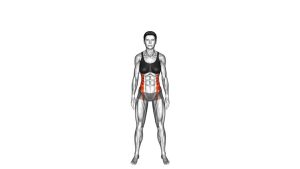
- Stand tall: Place your feet about hip-width to shoulder-width apart for a stable base.
- Raise your arms: Extend both arms overhead and keep them close to your ears.
- Stack your body: Keep your ribs controlled, chest open, and spine long.
- Brace lightly: Engage your core without holding your breath.
- Face forward: Keep your head neutral and avoid rotating your shoulders.
A slightly wider stance can make the exercise easier. However, a narrower stance increases the balance challenge.
Execution (Step-by-Step)
- Start upright: Stand tall with both arms extended overhead and your body aligned vertically.
- Bend to one side: Slowly lean your torso sideways while keeping your hips mostly stable.
- Keep the arms long: Let your arms move with your torso instead of dropping forward.
- Control the bottom: Reach a comfortable side bend without bouncing or forcing the range.
- Return to center: Use your obliques to bring your torso back to upright.
- Repeat opposite side: Bend to the other side with the same smooth rhythm and control.
Pro Tips & Common Mistakes
- Move slowly: A controlled tempo keeps tension on the obliques and reduces lower-back stress.
- Avoid twisting: Keep your chest facing forward throughout the rep.
- Do not bounce: Bouncing at the bottom can irritate the spine and reduce muscle control.
- Keep your ribs down: Overarching the lower back makes the movement less effective.
- Reach through the arms: Long arms help create a better side-body line.
- Use both sides evenly: Match the same range and tempo on the left and right side.
- Breathe naturally: Exhale as you return to center, then inhale as you move into the next bend.
FAQ
What muscles does the Side Bend Arms Above work?
It mainly works the obliques, which help bend and stabilize the torso. In addition, the quadratus lumborum, deep core muscles, spinal stabilizers, and lats assist during the movement.
Is Side Bend Arms Above good for beginners?
Yes. It is beginner-friendly because it uses only bodyweight and a simple standing position. However, beginners should use a smaller range and move slowly until they can control both sides evenly.
Should I feel this exercise in my lower back?
You may feel light stabilizer activity around the lower back. However, sharp pain, pinching, or strong pressure means the range is too large or the core is not controlling the movement well.
Can I use this exercise as a warm-up?
Yes. It works well as a warm-up before core training, full-body workouts, or mobility sessions. For warm-ups, use easy reps and avoid pushing into maximum range.
How can I make Side Bend Arms Above harder?
First, slow the tempo and pause briefly at the bottom. Then, once your form stays clean, you can hold a light towel, stick, or very light weight overhead for extra control.
Recommended Equipment (Optional)
- Exercise Mat — helpful for warm-ups, stretching, and floor-based core work after this drill
- Yoga Strap — useful for overhead arm positioning and shoulder mobility support
- Exercise Dowel / Mobility Stick — helps keep both arms aligned overhead during side bends
- Light Resistance Bands — useful for pairing with anti-rotation and core stability exercises
- Light Adjustable Dumbbell — optional progression tool for advanced users with excellent control
Tip: Keep equipment light. This movement is best for control, mobility, and oblique activation rather than heavy loading.