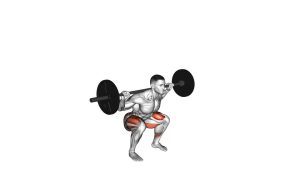
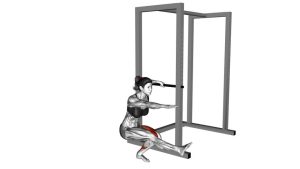
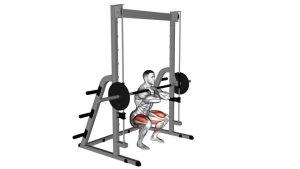
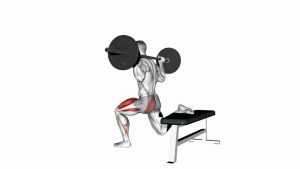
Barbell Rear Lunge: Proper Form, Muscles Worked, Sets, Tips & FAQ
Learn the Barbell Rear Lunge to build stronger glutes, quads, hamstrings, balance, and lower-body control with safe form cues and training tips.
Barbell Rear Lunge
This exercise is excellent for building single-leg strength while reducing some of the forward knee stress often seen in forward lunges. Because the barbell is loaded across the upper back, the movement demands strong posture, core bracing, hip stability, and clean lower-body alignment. It is especially useful for athletes, bodybuilders, and strength trainees who want better leg balance, stronger glutes, and improved control from side to side.
Quick Overview
| Body Part | Legs |
|---|---|
| Primary Muscle | Glutes and quadriceps |
| Secondary Muscle | Hamstrings, adductors, calves, core, spinal erectors, and hip stabilizers |
| Equipment | Barbell, weight plates, squat rack or power rack |
| Difficulty | Intermediate because it requires balance, barbell control, coordination, and lower-body stability |
Sets & Reps (By Goal)
- Strength: 3–5 sets × 4–6 reps per leg using controlled weight and full rest between sets.
- Muscle growth: 3–4 sets × 8–12 reps per leg with a smooth lowering phase and strong front-leg drive.
- Balance and control: 2–4 sets × 8–10 reps per leg using lighter weight and slower tempo.
- Lower-body endurance: 2–3 sets × 12–15 reps per leg with moderate load and clean technique.
- Warm-up or movement prep: 1–2 sets × 6–8 reps per leg using an empty barbell or very light load.
Progression rule: Add reps first, then increase load gradually. Do not increase barbell weight if your front knee collapses inward, your torso tilts excessively, or your rear step becomes unstable.
Setup / Starting Position
- Set the barbell: Place the barbell in a rack slightly below shoulder height so you can unrack it safely.
- Position the bar: Rest the bar across your upper traps, similar to a high-bar squat position. Keep it centered and level.
- Grip firmly: Hold the bar slightly wider than shoulder-width and pull your elbows gently down to create upper-back tension.
- Unrack with control: Stand tall, step back from the rack, and set your feet about hip-width apart.
- Brace your core: Keep your ribs stacked over your pelvis, chest proud, and eyes forward.
- Prepare your stance: Keep the working/front foot planted and ready to support most of your body weight.
Tip: Before loading heavily, practice the movement with an empty barbell or bodyweight until your step length and balance are consistent on both sides.
Execution (Step-by-Step)
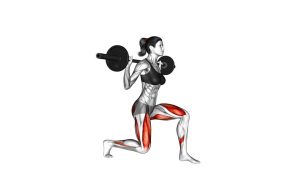
- Stand tall: Begin with the barbell stable across your upper back, feet hip-width apart, and core braced.
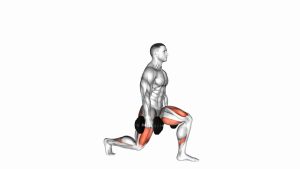
- Step backward: Move one foot behind you into a reverse-lunge stance. Land softly on the ball of the rear foot.
- Lower under control: Bend both knees and drop the rear knee toward the floor while keeping the front foot fully planted.
- Keep alignment: Let the front knee track in the same direction as the toes. Avoid letting it collapse inward.
- Maintain posture: Keep your torso tall with only a slight natural forward lean. Do not round your back or let the bar tilt.
- Reach the bottom: Stop when your rear knee is close to the floor and your front leg is strongly loaded.
- Drive upward: Push through the front heel and midfoot to return to standing.
- Bring the rear foot forward: Step back to the starting position with control before repeating on the same side or alternating legs.
Pro Tips & Common Mistakes
- Step back, then drop down: Avoid stepping too short, which can crowd the front knee and make balance harder.
- Keep your front heel grounded: Lifting the heel reduces force through the glutes and may increase knee stress.
- Control the descent: Do not fall into the bottom position. Lower smoothly and own the movement.
- Keep the barbell level: If the bar tilts, your trunk or hip stability may be breaking down.
- Avoid knee collapse: The front knee should track over the toes, not cave inward.
- Do not overstride: A step that is too long can limit depth and reduce quad engagement.
- Brace before every rep: Treat each lunge like a small squat setup with strong core tension.
- Use both sides evenly: Train the weaker side first if you notice a major left-to-right strength difference.
FAQ
What muscles does the Barbell Rear Lunge work?
The Barbell Rear Lunge mainly works the glutes and quadriceps. It also trains the hamstrings, adductors, calves, core, spinal erectors, and hip stabilizers because the body must control balance and barbell position through each repetition.
Is the Barbell Rear Lunge the same as the Barbell Reverse Lunge?
Yes. The names are commonly used for the same movement. In both versions, you step backward into a lunge, lower under control, and return to standing by driving through the front leg.
Is the rear lunge better than the forward lunge?
It depends on the goal. Rear lunges are often easier to control and may feel more comfortable for people who struggle with forward lunges. Forward lunges create more braking demand, while rear lunges usually allow a smoother front-leg drive and better balance for strength training.
Should my rear knee touch the floor?
The rear knee can lightly approach the floor, but it should not crash into it. Stop slightly above the floor if touching down causes discomfort, loss of tension, or poor control.
How heavy should I go on Barbell Rear Lunges?
Use a load that allows clean depth, stable balance, and consistent knee tracking. If your torso twists, your front heel lifts, or you cannot step back smoothly, the weight is too heavy.
Can beginners do Barbell Rear Lunges?
Beginners should first master bodyweight reverse lunges or dumbbell reverse lunges. The barbell version is better for trainees who already have good balance and can control a split-stance movement safely.
Recommended Equipment
- Olympic Barbell — the main tool for loading rear lunges and building lower-body strength.
- Barbell Pad — adds comfort across the upper back, especially for higher-rep lunge sessions.
- Weight Plates Set — allows progressive overload as your strength and control improve.
- Squat Rack / Power Rack — helps you safely unrack and rerack the barbell before and after your set.
- Weightlifting Shoes — provides a stable base and helps maintain foot pressure during loaded lunges.
Tip: For best results, combine the correct equipment with controlled technique. A stable rack, quality barbell, and secure plates make the exercise safer and easier to progress.