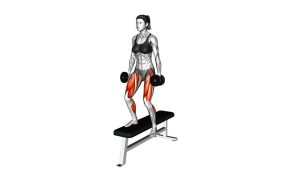
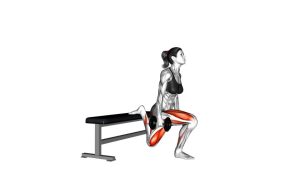
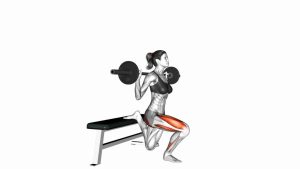
Barbell Step-Up: Safe Form, Muscles Worked, Sets, Tips & FAQ
Learn the Barbell Step-Up for stronger quads, glutes, balance, and single-leg power. Includes setup, form cues, sets, mistakes, FAQs, and equipment.
Barbell Step-Up
This exercise is best performed with a stable bench or box at a height that allows clean knee tracking and strong foot pressure. Keep the barbell secure across the upper back, brace your core, and move with control from start to finish. The lead leg should do most of the work while the trailing leg stays light.
Quick Overview
| Body Part | Legs |
|---|---|
| Primary Muscle | Quadriceps and glutes |
| Secondary Muscle | Hamstrings, calves, adductors, core stabilizers, and hip stabilizers |
| Equipment | Barbell, weight plates, stable bench or plyo box |
| Difficulty | Intermediate |
Sets & Reps (By Goal)
- Strength: 3–5 sets × 4–6 reps per leg with 90–150 sec rest
- Muscle growth: 3–4 sets × 8–12 reps per leg with 60–90 sec rest
- Balance and control: 2–4 sets × 8–10 reps per leg with slow lowering
- Conditioning: 2–3 sets × 12–15 reps per leg using a lighter load
Progression rule: Increase control first, then reps, then load. Do not increase the barbell weight until both legs can complete smooth reps without knee collapse or rear-leg jumping.
Setup / Starting Position
- Set the platform: Use a stable bench or box that does not slide or wobble.
- Position the bar: Place the barbell across your upper back like a back squat.
- Brace your body: Keep your ribs down, chest tall, core tight, and eyes forward.
- Plant the lead foot: Place one foot fully on the bench with the heel secure.
- Align the knee: Keep the lead knee tracking in the same direction as the toes.
The lead foot should stay flat on the platform. Avoid balancing only on the toes because it reduces force transfer and increases instability.
Execution (Step-by-Step)
- Brace before moving: Tighten your core and keep the barbell stable across your upper back.
- Drive through the lead foot: Push through the heel and mid-foot of the foot on the bench.
- Stand tall: Extend the lead knee and hip until your body reaches a strong upright position.
- Control the top: Avoid leaning back, twisting, or locking out aggressively.
- Lower slowly: Step down under control, letting the lead leg manage the descent.
- Reset each rep: Regain balance before beginning the next repetition.
Pro Tips & Common Mistakes
- Use the full foot: Keep the lead heel down and press through the mid-foot.
- Do not bounce: Avoid using momentum from the rear leg to launch yourself upward.
- Control the descent: The lowering phase builds strength and protects the knee.
- Keep the knee aligned: Do not allow the working knee to collapse inward.
- Choose the right box height: Too high can force hip compensation and poor posture.
- Keep the bar stable: Grip the bar firmly and avoid side-to-side shifting.
- Train both sides evenly: Complete the same reps and quality on each leg.
FAQ
What muscles does the Barbell Step-Up work?
The Barbell Step-Up mainly trains the quadriceps and glutes. It also works the hamstrings, calves, adductors, core, and hip stabilizers because the body must control balance on one leg.
Is the Barbell Step-Up good for glutes?
Yes. The glutes work strongly when you drive through the lead heel and fully extend the hip at the top. A slightly higher but still controllable box can increase glute demand, but form should always come first.
How high should the bench or box be?
A good starting height allows your lead thigh to be around parallel to the floor or slightly below. If the platform is too high, you may lose posture, push too much from the rear leg, or allow the knee to cave inward.
Should I alternate legs or complete one side first?
Both methods work. Completing one side first is better for focused strength and control. Alternating legs can work well for conditioning or lighter training.
Is the Barbell Step-Up better than lunges?
It depends on your goal. Step-ups emphasize vertical drive, balance, and single-leg strength, while lunges involve more forward or backward stepping control. Both are useful lower-body exercises.
Recommended Equipment
- Olympic Barbell — essential for loading the step-up safely and progressively
- Weight Plates Set — allows small, steady increases in training load
- Adjustable Plyo Box — useful for choosing the right step height for your strength and mobility
- Barbell Squat Pad — optional comfort support for the upper back during loaded step-ups
- Weightlifting Shoes — helps create stable foot contact and better force transfer
Tip: Use a non-slip platform and stable shoes. The Barbell Step-Up requires balance, so equipment security matters as much as load selection.