Prayer Chest Squeeze: Proper Form, Sets & Reps, Tips + FAQ
Learn the Prayer Chest Squeeze (standing prayer press) to activate and build your chest using an isometric squeeze. Step-by-step form, sets & reps by goal, common mistakes, FAQs, and recommended equipment.
Prayer Chest Squeeze
This movement is all about quality tension. You don’t need a huge range of motion—just a strong, steady squeeze and controlled breathing. The best reps feel like the chest is doing the work, not the shoulders, traps, or wrists.
Quick Overview
| Body Part | Chest |
|---|---|
| Primary Muscle | Pectoralis major (sternal fibers emphasis through horizontal adduction tension) |
| Secondary Muscle | Anterior deltoids, serratus anterior (stabilization), triceps (minor) |
| Equipment | None (optional: small ball/pad between palms for feedback) |
| Difficulty | Beginner (scales by squeeze intensity and hold time) |
Sets & Reps (By Goal)
- Warm-up / activation: 2–3 sets × 8–12 reps (2–3 sec squeeze each rep, 30–60 sec rest)
- Muscle pump / finisher: 3–5 sets × 10–20 reps (3–5 sec squeeze, 30–45 sec rest)
- Mind-muscle connection: 2–4 sets × 6–10 reps (5–8 sec squeeze, 45–75 sec rest)
- Desk break “reset”: 1–2 sets × 6–10 reps (easy effort, smooth breathing)
Progression rule: Increase hold time first (e.g., +1–2 seconds), then add reps/sets. If shoulders take over, lower effort and keep elbows in a comfortable line with your chest.
Setup / Starting Position
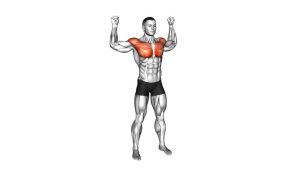
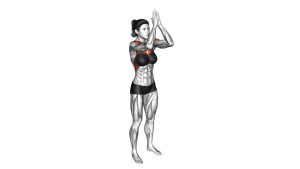
- Stand tall: Feet hip-width, knees soft, ribs stacked over hips, core lightly braced.
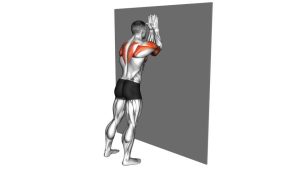
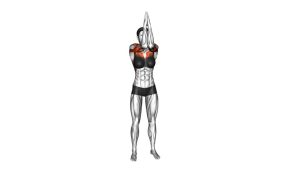
- Hand position: Place palms together at mid-chest (sternum level), fingers pointing up.
- Elbow angle: Bend elbows ~90° and keep them slightly out—comfortable, not forced.
- Shoulders down: Keep shoulders relaxed and away from ears; avoid shrugging.
- Neutral wrists: Don’t crank wrists back—press palm-to-palm evenly.
Tip: If you struggle to “feel” the chest, place a small foam ball or rolled towel between palms to improve squeezing feedback.
Execution (Step-by-Step)
- Set posture: Stay tall, neck neutral, chest proud (no rib flare), shoulders down.
- Build pressure: Press palms together gradually until you feel the pecs tighten.
- Squeeze hard: Hold a strong contraction for 2–5 seconds while breathing smoothly.
- Keep elbows steady: Don’t let elbows drop or shoulders roll forward as you squeeze.
- Release with control: Reduce pressure slowly, then repeat for clean, consistent reps.
Pro Tips & Common Mistakes
- Keep shoulders down: Shrugging shifts tension away from the chest.
- Don’t flare ribs: Stay stacked—overarching the back is a common compensation.
- Press evenly: Avoid wrist bending; think “palm pressure,” not finger pressure.
- Elbows in a comfy lane: Too high can irritate shoulders; too low reduces chest tension.
- Breathe through the squeeze: Exhale gently as you press, inhale as you release.
- Use it smart: Great before push-ups/bench/pressing, or as a finisher for a chest pump.
FAQ
Where should I feel the Prayer Chest Squeeze?
Mostly in the chest, especially the inner/center pec region. A little front-shoulder involvement is normal, but the squeeze should feel chest-dominant. If shoulders or traps take over, reduce effort and keep shoulders down.
Is this exercise good for building chest muscle?
It’s best as an activation and pump tool, and to improve mind-muscle connection. For maximal growth, pair it with progressive resistance pressing/fly variations (push-ups, dumbbells, machines, cables).
How hard should I squeeze?
Aim for about 6–9/10 effort—strong but controlled, with no joint pain. If you’re doing high reps or long holds, use a slightly lower effort so form stays clean.
My wrists hurt—what should I do?
Keep wrists neutral and press palm-to-palm evenly. You can also squeeze a small ball or foam pad between palms to reduce wrist strain and improve comfort.
Can I do this every day?
Many people can do light activation sets frequently, especially as a posture-friendly chest “wake up.” For harder squeeze holds and high volume, treat it like training: allow recovery if you get lingering soreness.
Recommended Equipment (Optional)
- Small Exercise Ball / Soft Pilates Ball — squeeze between palms to increase feedback and comfort
- Foam Stress Ball / Grip Squeeze Ball — simple palm-to-palm squeezing alternative for joint-friendly tension
- Resistance Bands Set — pair with band presses or band flys for progressive chest training
- Push-Up Handles / Parallettes — add a strong chest builder after activation work (often wrist-friendlier)
- Adjustable Dumbbells — upgrade from isometrics to presses/flys for long-term chest growth
Tip: This exercise shines when you use it as a primer (before pressing) or a finisher (for a pump). Keep reps smooth and prioritize chest tension over “max force.”