Stick Lat Stretch: Proper Form, Benefits, Sets, Tips & FAQ
Learn how to do the Stick Lat Stretch with proper form to improve lat flexibility, overhead mobility, and upper-body movement quality. Includes setup, execution, tips, FAQ, and recommended equipment.
Stick Lat Stretch
This stretch works best when you focus on length instead of force. The goal is to reach the stick overhead, keep the torso tall, and gently bend to one side so the opposite lat can fully lengthen. You should feel a broad stretch from the outer upper back down through the side of the ribcage, not pinching in the shoulder or compression in the low back.
Quick Overview
| Body Part | Back |
|---|---|
| Primary Muscle | Latissimus dorsi |
| Secondary Muscle | Teres major, obliques, serratus anterior, upper back stabilizers |
| Equipment | Mobility stick, dowel, PVC pipe, or lightweight bar |
| Difficulty | Beginner |
Sets & Reps (By Goal)
- General mobility: 2–3 sets × 6–10 reps per side with a 2–4 second stretch at end range
- Warm-up before upper-body training: 1–2 sets × 5–8 reps per side using a smooth controlled tempo
- Flexibility focus: 2–4 sets × 20–30 second holds per side
- Recovery / light movement days: 1–3 sets × 6–8 easy reps per side
Progression rule: First improve control and breathing, then gradually increase hold time or range. Do not force the stretch by leaning aggressively.
Setup / Starting Position
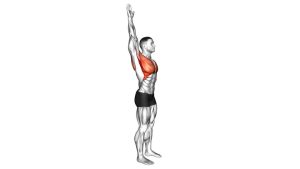
- Stand tall: Place your feet around hip-width to shoulder-width apart for a stable base.
- Grip the stick: Hold a stick or dowel with both hands using a wide overhand grip.
- Raise the arms overhead: Extend the elbows and bring the stick above your head without shrugging excessively.
- Brace lightly: Keep the ribcage controlled and the core lightly engaged so the lower back does not overarch.
- Start in neutral: Keep the chest open, head relaxed, and body aligned before beginning the side bend.
Tip: A wider grip often makes the movement more comfortable, especially if your shoulders feel tight overhead.
Execution (Step-by-Step)
- Lock in your overhead position: Reach the stick upward and create length through both sides of the torso.
- Bend to one side: Slowly lean your torso to the right to stretch the left lat, or to the left to stretch the right lat.
- Keep the arms long: Maintain straight or softly extended elbows while the stick stays overhead.
- Hold briefly: Pause at the end range and breathe into the stretched side without twisting the torso.
- Return to center: Come back under control and repeat on the other side.
Pro Tips & Common Mistakes
- Reach before you bend: Create upward length first so the stretch hits the lat instead of just crunching the side body.
- Keep the ribs controlled: Avoid flaring the ribcage or turning the drill into a low-back arch.
- Don’t twist: This is a side bend stretch, not a rotational movement.
- Use a relaxed neck: Let the head follow naturally without straining or jutting the chin.
- Keep the shoulders down: Mild elevation is normal overhead, but avoid aggressive shrugging.
- Stay smooth: Do not bounce into the end range. Controlled movement makes the stretch more effective.
- Adjust grip width if needed: A grip that is too narrow can make overhead positioning uncomfortable.
FAQ
Where should I feel the Stick Lat Stretch?
You should mainly feel it along the side of the upper torso, under the armpit area, and through the lat on the side being stretched. Some people also feel mild tension in the obliques and upper back.
Is this a warm-up or a flexibility exercise?
It can be both. Use shorter controlled reps before training as a mobility warm-up, or use longer holds after training to work on flexibility.
Should my elbows stay completely straight?
They should stay mostly extended, but a very soft bend is fine. The main priority is keeping the arms long and the stretch comfortable.
What if I feel it more in my shoulders than my lats?
Try a wider grip, reduce the depth of the bend, and focus on reaching upward before leaning sideways. Tight shoulders can limit the overhead position and shift stress away from the lats.
Can beginners do this safely?
Yes. It is beginner-friendly when performed slowly and within a pain-free range. Start with a light stick and moderate range rather than trying to stretch as far as possible.
Recommended Equipment (Optional)
- Mobility Stick / Stretching Bar — ideal for overhead mobility drills, posture work, and guided stretching
- Exercise Dowel — simple lightweight option for stretching, shoulder mobility, and warm-up work
- Mobility Resistance Bands — useful for pairing with shoulder mobility and upper-back activation drills
- Yoga / Stretching Mat — provides a comfortable surface for mobility sessions, warm-ups, and floor-based stretching
- Assisted Pull-Up Bands — great for combining lat mobility work with light activation and shoulder preparation
Tip: Choose tools that help you move with control. For this stretch, a light stick or dowel is usually all you need.