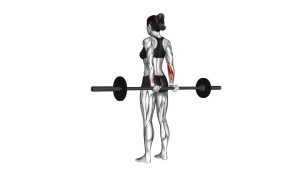
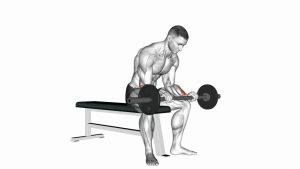
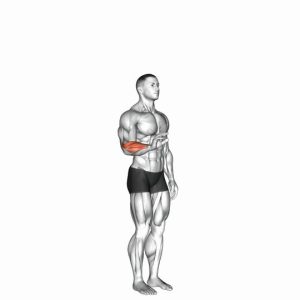
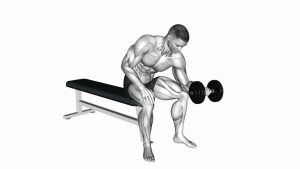
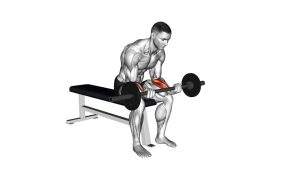
Barbell Palms-Down Wrist Curl Over a Bench: Form, Sets, Tips & FAQ
Learn the Barbell Palms-Down Wrist Curl Over a Bench to build stronger forearm extensors with strict form. Includes setup, step-by-step execution, sets by goal, common mistakes, FAQs, and recommended equipment.
Barbell Palms-Down Wrist Curl Over a Bench
This movement is ideal for building stronger forearms, improving wrist control, and balancing lower-arm development— especially if you already do a lot of gripping, curling, or pulling work. Because the range of motion is short and the target muscles are relatively small, strict technique matters more than heavy weight.
Quick Overview
| Body Part | Forearms |
|---|---|
| Primary Muscle | Wrist extensors / forearm extensors |
| Secondary Muscle | Brachioradialis, grip muscles, stabilizers of the wrist and forearm |
| Equipment | Barbell, flat bench |
| Difficulty | Beginner to Intermediate |
Sets & Reps (By Goal)
- Muscle growth: 3–4 sets × 12–20 reps, 45–75 sec rest
- Forearm endurance: 2–4 sets × 18–25 reps, 30–60 sec rest
- Strength/control: 3–5 sets × 8–12 reps, 60–90 sec rest
- Finisher work: 2–3 sets × 15–30 reps with light-to-moderate weight
Progression rule: Increase reps first, then add small amounts of weight. Keep every rep strict—once momentum takes over, the exercise loses its value.
Setup / Starting Position
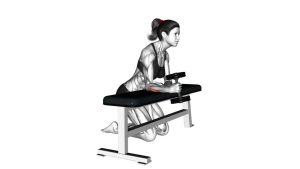
- Set up a flat bench: Sit behind the bench so your forearms can rest comfortably on top.
- Place the forearms on the bench: Keep them supported from elbow to near the wrist, with the hands hanging just off the edge.
- Grab the barbell palms down: Use a pronated grip about shoulder-width apart or slightly narrower.
- Let the wrists move freely: The bench should support the forearms, not block wrist motion.
- Start in the stretched position: Allow the wrists to bend downward slightly under control.
Tip: Use a lighter bar or fixed barbell if a standard Olympic bar feels too heavy for clean wrist-only movement.
Execution (Step-by-Step)
- Brace the forearms: Keep them flat against the bench throughout the set.
- Lower into the stretch: Let the wrists bend downward slightly to feel the forearm extensors lengthen.
- Extend the wrists upward: Curl the backs of your hands upward using only the wrists.
- Squeeze at the top: Pause briefly when the wrists reach peak extension.
- Lower slowly: Return to the starting stretch under control without dropping the bar.
- Repeat smoothly: Maintain a steady rhythm and avoid bouncing between reps.
Pro Tips & Common Mistakes
- Keep the motion small: Wrist extension is a short-range movement, so don’t force exaggerated reps.
- Use controlled tempo: Smooth reps create better forearm tension than fast, jerky reps.
- Don’t lift the forearms: They should stay planted on the bench from start to finish.
- Avoid excessive weight: Heavy loading usually turns this into a sloppy momentum exercise.
- Don’t squeeze the bar too hard: Grip it firmly enough to control it, but not so hard that your hands fatigue before the target muscles.
- Train both sides of the forearm: Pair this with palms-up wrist curls or grip work for more balanced lower-arm development.
FAQ
What muscles does the Barbell Palms-Down Wrist Curl Over a Bench work?
It primarily targets the wrist extensors, which run along the top side of the forearm and help extend the wrist.
Is this the same as a reverse wrist curl?
Yes. This is essentially a reverse wrist curl performed with the forearms supported on a bench and the palms facing down.
How heavy should I go on this exercise?
Much lighter than most people expect. Because the target muscles are small, strict reps with moderate or even light resistance usually work best.
Should I let the wrists drop fully at the bottom?
You should allow a controlled stretch, but not an uncontrolled drop. Keep tension on the muscles and avoid jamming the wrists into an uncomfortable position.
Can beginners use this exercise?
Yes. It’s beginner-friendly as long as the load is light, the setup is stable, and the movement stays wrist-dominant instead of momentum-driven.
Recommended Equipment
- Wrist Roller / Forearm Exerciser — useful for building wrist strength, grip endurance, and forearm stamina outside standard barbell work
- DMoose Fitness Forearm Strengthener & Wrist Roller — a dedicated forearm tool that combines rolling and wrist-strength training
- Fitarc Wrist Bar / Forearm Strengthener — useful for wrist curls, rotation drills, and targeted forearm loading with small plates
- Lifting Wrist Straps — helpful on heavier pulling days so your forearms don’t get over-fatigued before targeted accessory work
- Resistance Bands Set — versatile for forearm warm-ups, rehab-style wrist work, and higher-rep extension drills
Tip: Accessories should support your training, not replace strict barbell execution. For this exercise, technique still matters more than gear.