Bodyweight Pulsing Triceps Kickback: Form, Sets, Tips & FAQ
Learn the Bodyweight Pulsing Triceps Kickback to build triceps burn and constant tension with no weights. Includes form cues, sets by goal, common mistakes, FAQs, and recommended equipment.
Bodyweight Pulsing Triceps Kickback
This variation works best when you think small range, strict elbows, and smooth pulses. Your upper arms should stay tucked close to your torso while the forearms move through short extension reps. You should feel the effort mainly in the back of the upper arms, not in the neck, lower back, or shoulders. Because the reps are short and continuous, the exercise is excellent for creating a deep burn without needing heavy weights.
Quick Overview
| Body Part | Triceps |
|---|---|
| Primary Muscle | Triceps brachii |
| Secondary Muscle | Rear delts, posterior shoulder stabilizers, core, and upper back stabilizers |
| Equipment | None required (optional: mat, bench, light wrist weights, resistance bands) |
| Difficulty | Beginner to Intermediate |
Sets & Reps (By Goal)
- Muscle burn / finisher: 2–4 sets × 15–30 pulse reps, or 20–40 seconds continuous tension
- Home arm training: 3–4 sets × 12–20 pulse reps with 30–45 seconds rest
- Technique practice: 2–3 sets × 10–15 controlled reps with slower tempo
- Endurance / conditioning: 2–3 sets × 30–45 seconds continuous pulses
Progression rule: First increase control, pulse quality, and time under tension. Then add light resistance such as wrist weights or bands only after you can keep the elbows still and the torso stable.
Setup / Starting Position
- Stand with feet hip-width apart: Keep a soft bend in the knees for balance.
- Hinge at the hips: Lean your torso forward while keeping your chest open and spine neutral.
- Brace your core: Tighten the abs lightly so the lower back does not arch.
- Bring the elbows up and back: Upper arms stay close to the torso and slightly behind the body.
- Bend the elbows: Start with the forearms angled down or slightly forward, ready to extend.
- Set the neck neutral: Look slightly ahead and down rather than craning the head up.
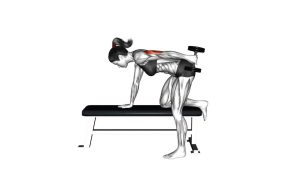
Tip: If your lower back tires too quickly, practice the same motion chest-supported on an incline bench.
Execution (Step-by-Step)
- Lock in the upper arms: Keep the elbows tucked and lifted so the shoulders do not swing.
- Extend the elbows: Straighten the arms backward until the triceps contract hard.
- Pulse in the shortened range: Perform small bend-and-re-extend reps near the top instead of dropping all the way down.
- Keep tension continuous: Avoid resting between pulses or letting the arms hang.
- Stay controlled: Breathe steadily and keep the torso fixed while the triceps do the work.
- Finish with control: End the set when the triceps fatigue enough that you can no longer hold elbow position cleanly.
Pro Tips & Common Mistakes
- Keep the elbows high: Letting them drop turns the exercise into a loose arm swing.
- Use short pulses: This is a constant-tension variation, not a full-range speed rep.
- Do not rush the torso: The trunk should stay stable while only the elbows move.
- Avoid shrugging: Keep the shoulders down and away from the ears.
- Do not overarch the lower back: Brace the core and keep the rib cage controlled.
- Chase quality over duration: Ten clean pulses are better than thirty sloppy ones.
- Use it as a finisher: This variation works especially well after presses, dips, or band pushdowns.
FAQ
What muscles does the Bodyweight Pulsing Triceps Kickback work?
It primarily targets the triceps brachii. The rear delts, upper back, and core also help stabilize the position while you hold the bent-over posture.
Is this better than a regular triceps kickback?
It is not necessarily better—it is just a different stimulus. The pulsing version increases constant tension and burn, while a regular full-range kickback may be better for more complete elbow extension practice.
Can beginners do this exercise?
Yes. Beginners can use short sets and slower pulses. The key is learning to keep the torso steady and the elbows tucked rather than chasing long sets too soon.
How should I make it harder without weights?
Increase time under tension, slow the pulses slightly, add a brief hold at peak extension, or reduce rest time between sets. Once form is solid, you can also add light wrist weights or resistance bands.
Where should I feel it?
You should feel it mainly in the back of the upper arms. If you feel it mostly in the lower back or upper traps, reset your hinge position and reduce the set length.
Recommended Equipment (Optional)
- Resistance Bands Set — useful for adding light triceps resistance or pairing this movement with pushdowns and pull-aparts
- Non-Slip Exercise / Yoga Mat — gives you a more stable training surface for home workouts and arm finishers
- Adjustable Workout Bench — great for chest-supported kickback variations when you want more torso stability
- Wrist Weights — a simple way to add light resistance while keeping the movement bodyweight-focused
- Push-Up Bars — helpful for pairing with bodyweight triceps work like close-grip push-ups and arm-focused finishers
Tip: Choose equipment that supports cleaner form and better consistency, not just more difficulty. For this exercise, constant tension and good elbow control matter more than heavy loading.