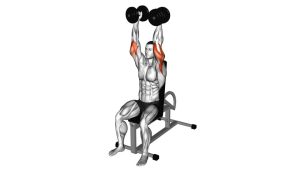
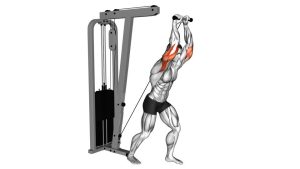
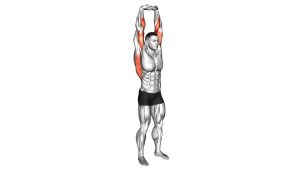
Cable Seated High Pulley Overhead Triceps Extension: Form, Sets, Tips & FAQ
Learn the Cable Seated High Pulley Overhead Triceps Extension to build stronger upper arms with better long head triceps activation. Includes setup, step-by-step execution, sets by goal, common mistakes, FAQs, and recommended equipment.
Cable Seated High Pulley Overhead Triceps Extension
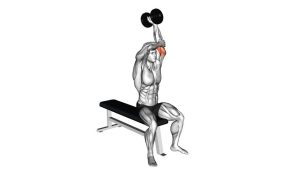
This variation works best when you stay tall on the seat, brace your core, and move with a smooth tempo. You should feel the triceps doing the work from the stretched bottom position all the way to the lockout. If your elbows flare too wide, your lower back arches, or the rope drops too quickly behind your head, reduce the load and regain control.
Quick Overview
| Body Part | Triceps |
|---|---|
| Primary Muscle | Triceps brachii (long head emphasis) |
| Secondary Muscle | Lateral head and medial head of the triceps; shoulders and core stabilize |
| Equipment | Cable machine, high pulley, bench or seat, rope attachment |
| Difficulty | Intermediate |
Sets & Reps (By Goal)
- Muscle growth: 3–4 sets × 8–15 reps with 45–75 seconds rest
- Strength-focused accessory work: 3–4 sets × 6–10 reps with 75–120 seconds rest
- Technique and control: 2–3 sets × 10–15 reps using a slower eccentric
- Finisher / pump work: 2–3 sets × 12–20 reps with controlled tempo and short rest
Progression tip: Add reps first, then increase the load once you can keep your elbows stable, get a full stretch, and lock out without losing posture.
Setup / Starting Position
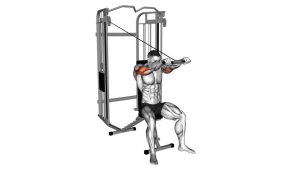
- Set the pulley high: Attach a rope handle to the high pulley and position a bench or seat so you can sit facing away from the machine.
- Grab the rope securely: Bring the rope behind your head with both hands, palms facing inward in a neutral grip.
- Sit tall: Keep your chest up, core braced, and feet flat on the floor for stability.
- Raise the elbows: Point your elbows upward and keep them close to your head rather than letting them flare wide.
- Start in the stretch: Begin with the elbows bent and the rope positioned behind the head under steady cable tension.
Execution (Step-by-Step)
- Brace before each rep: Keep the torso upright, ribs down, and neck neutral.
- Extend the elbows: Push the rope upward by straightening your arms while keeping the upper arms mostly fixed.
- Separate the rope slightly: At the top, allow the rope ends to move apart naturally as you squeeze the triceps.
- Pause at lockout: Briefly hold the fully extended position without slamming the elbows.
- Lower with control: Bend the elbows slowly and return the rope behind the head for a deep triceps stretch.
- Repeat smoothly: Maintain the same elbow path and posture on every rep.
Pro Tips & Common Mistakes
- Keep your elbows tucked: A slightly narrow elbow position usually improves triceps tension and reduces wasted motion.
- Do not rush the stretch: The bottom position is where this variation becomes especially effective for the long head.
- Avoid lower-back arching: Stay seated tall with the abs engaged instead of leaning back to move the weight.
- Use full but controlled range: Stretch deeply, but never force painful shoulder mobility.
- Don’t turn it into a shoulder exercise: The upper arms should stay relatively fixed while the elbows do the work.
- Use moderate loads well: This exercise often feels best with clean reps rather than maximal weight.
- Keep wrists neutral: Don’t over-bend the wrists to finish the rep.
FAQ
What part of the triceps does this exercise emphasize most?
It strongly emphasizes the long head of the triceps because the arms are positioned overhead, placing that portion of the muscle under more stretch.
Should I go heavy on seated overhead cable triceps extensions?
You can use challenging loads, but this exercise usually works best with controlled moderate weight that lets you keep your elbows stable and reach a full stretch without compensating.
Why do my elbows flare during the set?
Elbows often flare when the load is too heavy, shoulder mobility is limited, or the lifter loses core stability. Lower the weight and focus on keeping the upper arms pointed up and slightly inward.
Is a rope attachment better than a straight bar here?
For many lifters, yes. A rope attachment allows a more natural hand position and a smoother finish at lockout, which can feel better on the wrists and elbows.
Where should I include this exercise in my workout?
It fits well in the middle or later part of an upper-body, push, or arms workout after compound presses, when you want direct triceps hypertrophy work.
Recommended Equipment (Optional)
- Triceps Rope Cable Attachment — the most direct accessory for comfortable overhead cable triceps work
- Adjustable Weight Bench — useful for stable seated positioning in front of the cable machine
- Cable Machine / Functional Trainer — provides the high pulley setup needed for this exercise
- Lifting Straps — optional support if grip fatigue limits your cable training volume
- Elbow Sleeves — can provide warmth and comfort during high-volume arm sessions
Choose equipment that improves stability and comfort, not just load. Better setup usually leads to better triceps isolation.