Single-Leg Stability Ball Hamstring Curl: Form, Sets, Tips & FAQ
Learn the Single-Leg Stability Ball Hamstring Curl to build hamstrings, glutes, hip stability, and core control with safe step-by-step form.
Single-Leg Stability Ball Hamstring Curl
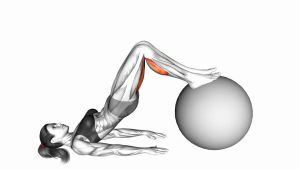
This movement is best used when you already have solid control with regular glute bridges and two-leg stability ball hamstring curls. Because the exercise uses only one working leg, the hamstrings must control both the inward curl and the outward extension while the glutes keep the pelvis lifted. The raised non-working leg increases the balance demand and makes the core resist rotation.
Quick Overview
| Body Part | Hamstrings |
|---|---|
| Primary Muscle | Hamstrings |
| Secondary Muscle | Glutes, calves, core stabilizers, hip stabilizers |
| Equipment | Stability ball / Swiss ball |
| Difficulty | Advanced |
Sets & Reps (By Goal)
- Hamstring strength: 3–4 sets × 6–10 reps per side with slow control.
- Posterior-chain stability: 2–4 sets × 8–12 reps per side using a smooth tempo.
- Core and hip control: 2–3 sets × 6–8 reps per side with a 2–3 second pause at the curled position.
- Warm-up activation: 1–2 sets × 5–8 reps per side at low intensity.
Progression rule: First improve control and hip height. Then add reps, slower tempo, or longer pauses. Do not progress if your pelvis rotates or your hips drop during the curl.
Setup / Starting Position
- Lie on your back: Place your upper back, shoulders, and arms firmly on the floor.
- Set the ball position: Place one heel on top of the stability ball with the working leg extended.
- Lift the opposite leg: Keep the non-working leg straight and raised upward to increase the single-leg challenge.
- Brace your core: Keep the ribs down and the pelvis level before lifting your hips.
- Lift into a bridge: Drive through the heel on the ball and raise your hips until your body forms a strong line from shoulders to knee.
The starting position should feel stable before you begin curling the ball. If the ball moves before the rep starts, reset your foot position and brace again.
Execution (Step-by-Step)
- Start in the single-leg bridge: Keep your hips elevated and your working heel pressing into the ball.
- Pull the ball inward: Bend the working knee and curl the ball toward your hips using your hamstrings.
- Keep the pelvis level: Avoid letting one hip drop or twist as the ball rolls closer.
- Pause briefly: Hold the curled position for a moment while squeezing the hamstring and glute.
- Extend with control: Slowly roll the ball away by straightening the working leg.
- Finish without collapsing: Return to the extended position while keeping the hips lifted and core tight.
Pro Tips & Common Mistakes
- Keep your hips high: The exercise loses effectiveness when the hips drop during the curl.
- Drive through the heel: Pressing through the heel helps target the hamstrings more effectively.
- Control the outward phase: Do not let the ball roll away quickly. The eccentric extension is one of the most valuable parts.
- Do not overarch the back: Keep your ribs down and glutes engaged to protect the lower back.
- Avoid twisting: Keep both hip bones facing upward throughout the rep.
- Use the arms for balance only: Do not push aggressively through the arms to fake control.
- Master the two-leg version first: If single-leg reps feel unstable, build strength with regular stability ball hamstring curls.
FAQ
What muscles does the Single-Leg Stability Ball Hamstring Curl work?
It primarily targets the hamstrings. It also trains the glutes, calves, hip stabilizers, and core because the body must stay lifted and balanced on an unstable ball.
Is this exercise beginner-friendly?
No. This is usually an advanced variation. Beginners should start with glute bridges, stability ball bridges, and two-leg stability ball hamstring curls before progressing to one-leg reps.
Why do my hips drop during the curl?
Hip dropping usually means the hamstrings, glutes, or core are not maintaining enough tension. Reduce the range of motion, perform fewer reps, or use the two-leg version until your bridge stays stable.
Should I keep the non-working leg straight up?
Yes. Keeping the opposite leg lifted increases the unilateral challenge and helps train pelvic control. If that is too difficult, keep the opposite knee bent or lightly touch the heel to the floor as a regression.
Can this help improve hamstring strength for sports?
Yes. It trains hamstring strength, eccentric control, hip extension, and stability, which are useful for running, jumping, sprinting, and lower-body athletic performance.
Recommended Equipment
- Stability Ball / Swiss Ball — the main tool needed for single-leg hamstring curls and bridge variations.
- Exercise Mat — provides comfort and grip when lying on the floor.
- Non-Slip Stability Ball — helps improve control during rolling movements.
- Resistance Bands Set — useful for glute activation drills before hamstring training.
- Exercise Sliders — a good alternative for hamstring curl progressions on the floor.
Tip: Choose a stability ball that matches your height and allows your hips to stay controlled without excessive wobbling.