Resistance Band Standing Leg Curl: Form, Sets, Tips & FAQ
Learn the resistance band standing leg curl for stronger hamstrings, better knee control, and balanced legs with setup, form cues, sets, FAQs, and equipment.
Resistance Band Standing Leg Curl
This exercise is especially useful for home workouts, warm-ups, knee-friendly hamstring training, and athletes who need better control through the back of the thigh. Because the band creates more resistance as it stretches, the top of the curl becomes the hardest part. Use a controlled tempo and focus on clean hamstring contraction rather than rushing the movement.
Quick Overview
| Body Part | Hamstrings |
|---|---|
| Primary Muscle | Hamstrings — biceps femoris, semitendinosus, semimembranosus |
| Secondary Muscle | Glutes, calves, core, hip stabilizers, support-leg muscles |
| Equipment | Loop resistance band or tube band with ankle strap; low anchor point |
| Difficulty | Beginner to Intermediate, depending on band tension and balance demand |
Sets & Reps (By Goal)
- Beginner control: 2–3 sets × 10–12 reps per leg with light band tension and slow form.
- Muscle growth: 3–4 sets × 12–20 reps per leg with a 1-second squeeze at the top.
- Hamstring endurance: 2–4 sets × 15–25 reps per leg using steady tempo and short rest.
- Warm-up or activation: 1–2 sets × 10–15 reps per leg before lower-body training.
- Balance and control: 2–3 sets × 8–12 reps per leg, performed without holding support if safe.
Progression rule: First improve control and range of motion. Then increase reps, hold the top position longer, or use a slightly stronger band. Do not progress if your torso swings or your hip moves excessively.
Setup / Starting Position
- Anchor the band low: Secure the resistance band close to floor level behind you using a stable anchor.
- Attach the band to the working leg: Place the loop or ankle strap around the ankle of the leg you will curl.
- Stand tall: Face away from the anchor with your feet about hip-width apart and your torso upright.
- Create light pre-tension: Step forward until the band has gentle tension before the first rep begins.
- Stabilize the support leg: Keep the standing knee slightly soft and press the foot firmly into the floor.
- Use support if needed: Hold a wall, rack, chair, or post to maintain balance without leaning heavily.
- Set the working thigh: Keep the thigh mostly vertical and avoid letting the knee drift far forward or backward.
Tip: The band should pull from behind the working ankle. If the angle feels awkward, adjust your distance from the anchor until the resistance feels smooth.
Execution (Step-by-Step)
- Brace gently: Stand tall, keep your ribs stacked over your hips, and lightly engage your core.
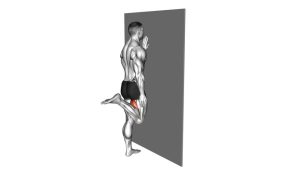
- Begin the curl: Bend the working knee and bring your heel toward your glutes.
- Keep the thigh quiet: Avoid swinging the whole leg back. The main movement should happen at the knee.
- Squeeze the hamstring: Pause briefly at the top when the heel is closest to your glutes.
- Control the return: Slowly straighten the knee as the band pulls the foot back down.
- Stop before losing tension: Return to the start without letting the band go completely slack.
- Repeat evenly: Finish all reps on one leg, then switch sides and match the same tempo and range.
Pro Tips & Common Mistakes
- Do not swing the leg: Momentum reduces hamstring work and makes the exercise less effective.
- Keep the knee pointing down: Let the knee bend, but avoid lifting the thigh high behind you.
- Control the eccentric phase: The return should be slow because the band wants to pull your foot forward.
- Use a light-to-moderate band: Too much resistance often causes hip movement, torso leaning, or partial reps.
- Keep the hips square: Do not rotate the pelvis as you curl the heel upward.
- Maintain a tall posture: Avoid leaning forward to make the curl easier.
- Point the toes naturally: Keep the ankle relaxed instead of forcing an extreme toe point or flex.
- Train both sides equally: Match reps, tempo, and range of motion on the weaker side first.
- Use support when learning: Holding a stable object lets you focus on the hamstring instead of fighting for balance.
- Pause at the top: A short squeeze improves control and helps prevent rushed, bouncy reps.
FAQ
What muscles does the resistance band standing leg curl work?
It mainly works the hamstrings, especially through knee flexion. The glutes, calves, core, and support-leg stabilizers also help maintain balance and hip position.
Is the standing band leg curl good for beginners?
Yes. It is beginner-friendly when performed with a light band and stable support. Beginners should prioritize smooth reps, balance, and controlled returns before increasing resistance.
Should I hold onto something while doing this exercise?
Holding a wall, rack, or chair is recommended if balance limits your form. Support is not cheating; it often helps isolate the hamstrings more effectively by reducing unnecessary body movement.
Why do I feel this more in my calf than my hamstring?
The calf can assist knee flexion, especially if you point the toes hard or cramp during the curl. Relax the ankle, slow the tempo, and focus on bending the knee with the back of the thigh.
How can I make the resistance band standing leg curl harder?
You can use a stronger band, step farther from the anchor, add a longer squeeze at the top, slow the lowering phase, or perform higher reps. Increase difficulty only if your hips and torso stay controlled.
Can this replace machine leg curls?
It can be a strong home-training alternative, especially for high-rep hamstring work. However, machine leg curls may allow heavier loading and more stable isolation. Both can be useful depending on your equipment and training goal.
How often should I perform this exercise?
Most people can train it 2–4 times per week depending on intensity and recovery. Use lighter sets for activation and heavier or higher-rep sets for hamstring strength and growth.
Recommended Equipment
- Ankle Strap for Resistance Bands — helps secure the band comfortably around the ankle for smoother leg curl reps
- Resistance Bands with Door Anchor — useful for creating a low anchor point at home
- Loop Resistance Bands Set — compact option for hamstring curls, glute work, and lower-body activation
- Exercise Mat — provides a stable training surface for warm-ups, stretching, and band setup
- Balance Pad — optional progression tool for improving ankle, knee, and hip stability
Tip: Choose equipment that lets you keep clean form. A lighter band with better control is usually more effective than a heavy band that causes swinging.