Kettlebell One-Arm Snatch: Proper Form, Sets, Benefits, Tips & FAQ
Learn how to do the Kettlebell One-Arm Snatch with proper form. Discover muscles worked, setup, execution, sets and reps by goal, common mistakes, FAQs, and recommended equipment.
Kettlebell One-Arm Snatch
This exercise blends power and precision. Although the arm guides the kettlebell, the real engine is the lower body. A strong hip hinge, explosive extension, and crisp timing allow the bell to travel upward with less strain on the shoulder and forearm. When performed well, the rep looks smooth, athletic, and controlled from swing to lockout.
Quick Overview
| Body Part | Shoulders |
|---|---|
| Primary Muscle | Deltoids (especially anterior deltoid and overhead stabilizers) |
| Secondary Muscle | Glutes, hamstrings, core, traps, lats, forearms, and upper back |
| Equipment | Kettlebell |
| Difficulty | Intermediate to advanced |
Sets & Reps (By Goal)
- Power development: 4-6 sets × 3-5 reps per arm with full rest between sets
- Muscular endurance: 3-4 sets × 6-10 reps per arm with 60-90 sec rest
- Conditioning: 3-5 rounds × 20-40 seconds per arm or alternating reps
- Technique practice: 3-5 sets × 2-4 clean reps per arm with light to moderate load
Progression rule: First improve timing, overhead control, and a smooth punch-through. Then increase weight, volume, or density only when every rep stays crisp and balanced.
Setup / Starting Position
- Place the kettlebell slightly in front of you: Stand with feet about shoulder-width apart and hinge at the hips.
- Grip with one hand: Keep the opposite arm free for balance and counter-movement.
- Set your hinge: Push the hips back, keep the chest proud, and maintain a neutral spine.
- Brace the trunk: Engage your core before the pull so the torso stays stable during acceleration.
- Hike the kettlebell back: Pull it deep between the legs to create a strong backswing and load the hips.
Tip: Think of the start like a powerful one-arm kettlebell swing. A better backswing usually leads to a cleaner snatch.
Execution (Step-by-Step)
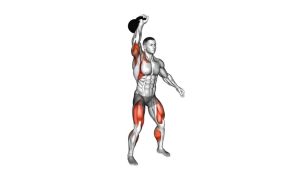
- Drive through the hips: Explosively extend the hips and knees to propel the kettlebell upward.
- Keep the bell close: Guide it along a tight path near the body instead of letting it arc too far forward.
- Let the elbow bend naturally: As the kettlebell rises, keep it compact and controlled.
- Punch through the handle: At the top, rotate the hand through so the kettlebell wraps around the wrist smoothly.
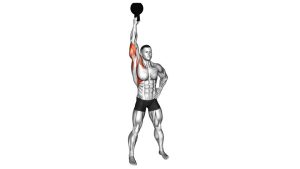
- Reach a strong lockout: Finish with the arm straight overhead, shoulder packed, ribs down, and core braced.
- Control the descent: Guide the kettlebell down from overhead, fold back into the hinge, and cycle into the next rep.
Pro Tips & Common Mistakes
- Drive with the hips first: The lower body creates the force; the arm mainly guides the bell.
- Keep the wrist neutral: A smooth punch-through reduces forearm impact and improves lockout control.
- Do not cast the kettlebell forward: A wide arc wastes energy and increases stress on the shoulder.
- Avoid overextending the lower back: Finish tall with ribs stacked instead of leaning back under the bell.
- Use the free arm for balance: This helps maintain rhythm and body control during single-arm reps.
- Build from the swing and high pull: If your snatch is inconsistent, master those patterns first.
- Do not rush the drop: A controlled return keeps the next rep safer and more efficient.
FAQ
What muscles does the kettlebell one-arm snatch work most?
It strongly challenges the shoulders in the overhead position, while the glutes, hamstrings, core, upper back, and grip contribute heavily throughout the movement.
Is the kettlebell one-arm snatch a shoulder exercise or a full-body exercise?
It is both. The shoulders stabilize the overhead finish, but the movement is powered by the hips and supported by the entire body. That is why it is often considered a full-body ballistic exercise with major shoulder involvement.
Why does the kettlebell hit my wrist during snatches?
This usually happens when the kettlebell flips over the hand instead of wrapping smoothly around it. Focus on keeping the bell close and punching your hand through the handle at the top.
Should beginners do kettlebell one-arm snatches?
Beginners should usually learn the kettlebell swing, clean, and high pull first. Once those patterns are solid, snatches become safer and much easier to learn.
Can I use this exercise for fat loss and conditioning?
Yes. Because it is explosive, full-body, and demanding on the heart and lungs, it can be very effective for conditioning-focused training.
Recommended Equipment
- Cast Iron Kettlebell — the main training tool for practicing snatches, swings, cleans, and other ballistic lifts
- Competition Kettlebell — a great option for smoother handling and more consistent technique work
- Gym Chalk — helps improve grip security during higher-rep snatches and longer conditioning sets
- Wrist Wraps — useful for extra wrist support if overhead work or repeated catches feel demanding
- Exercise Mat — provides a stable surface and helps protect flooring in home-gym setups
Tip: Choose a kettlebell weight that allows you to maintain smooth mechanics. For most people, clean technique beats heavier loading when learning the snatch.