Wall Lateral Raise with Towel: Proper Form, Sets, Tips & FAQ
Learn how to perform the Wall Lateral Raise with Towel to isolate the side delts with stricter form and better shoulder control. Includes setup, execution, sets and reps by goal, common mistakes, FAQ, and recommended equipment.
Wall Lateral Raise with Towel
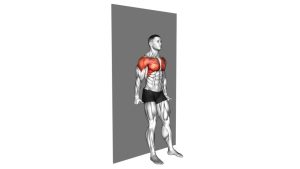
This exercise is especially useful for lifters who struggle to feel their side delts during standard lateral raises. The wall acts as a form guide, while the towel makes the motion smoother and more controlled. Instead of thinking about throwing the arm upward, think about sliding the arm up the wall with steady tension. The goal is shoulder isolation—not momentum, shrugging, or swinging.
Quick Overview
| Body Part | Side Shoulders |
|---|---|
| Primary Muscle | Lateral deltoid |
| Secondary Muscle | Supraspinatus, anterior deltoid, rotator cuff stabilizers |
| Equipment | Wall, small towel or microfiber cloth, optional light dumbbell for related progressions |
| Difficulty | Beginner to Intermediate |
Sets & Reps (By Goal)
- Technique practice / activation: 2–3 sets × 10–15 reps per side
- Shoulder hypertrophy: 3–4 sets × 12–20 reps per side
- Warm-up before pressing: 1–2 sets × 10–12 controlled reps per side
- Rehab-style control work: 2–3 sets × 8–12 reps using a reduced range and very slow tempo
Progression rule: First improve control, range, and smoothness. Then increase volume, tempo difficulty, or move into a light-loaded lateral raise variation once you can keep the shoulder down and the arm path consistent.
Setup / Starting Position
- Stand next to a wall: Position the working side beside the wall so your arm can slide along it comfortably.
- Place a towel between the hand or forearm and the wall: This reduces friction and helps the arm glide smoothly.
- Start tall: Keep the chest up, ribs stacked, core braced lightly, and neck relaxed.
- Set the arm position: Begin with the arm near your side and the elbow softly bent—not locked straight.
- Relax the trap: Let the shoulder stay down and away from the ear before each rep.
Tip: A slight staggered stance can improve balance and help you stay still during the raise.
Execution (Step-by-Step)
- Create light wall pressure: Press the towel gently into the wall so the arm stays connected throughout the movement.
- Raise the arm out to the side: Slide the arm upward in a lateral raise path with a controlled tempo.
- Keep the elbow angle consistent: Maintain a soft bend and avoid turning the movement into a press or a shrug.
- Stop around shoulder height: Lift until the arm is about parallel to the floor, or slightly below if that feels cleaner.
- Pause briefly: Hold the top for a moment while keeping the shoulder down and the side delt engaged.
- Lower slowly: Slide the arm back down under control without dropping or losing tension.
- Repeat on the other side: Perform all reps on one side or alternate sides depending on your program.
Pro Tips & Common Mistakes
- Lead with the upper arm, not the hand: Think about lifting from the side shoulder rather than flicking the wrist upward.
- Keep the shoulder down: Shrugging shifts tension away from the lateral delt and into the upper trap.
- Do not rush the lowering phase: The eccentric portion helps build control and shoulder awareness.
- Avoid swinging or leaning: The wall is there to clean up the path, not to support momentum.
- Stay slightly bent at the elbow: A soft bend is usually more shoulder-friendly than locking the arm completely straight.
- Don’t force extra height: Raising above shoulder level often adds compensation instead of more side-delt tension.
- Use it as an activation tool: This variation pairs well before dumbbell lateral raises, machine lateral raises, or shoulder press work.
FAQ
What muscles does the Wall Lateral Raise with Towel work?
The main target is the lateral deltoid, which helps build shoulder width. Supporting muscles include the supraspinatus and smaller shoulder stabilizers.
Why use a towel against the wall?
The towel reduces friction and helps the arm move smoothly along a more controlled path. This makes it easier to focus on the side delts and harder to cheat with momentum.
Is this better than a regular dumbbell lateral raise?
It is not necessarily better for every goal, but it is excellent for learning strict mechanics, improving shoulder control, and building a stronger mind-muscle connection in the side delts.
How high should I raise my arm?
In most cases, lifting to around shoulder height works well. If you feel shoulder pinching or lose control, use a slightly smaller range.
Can beginners use this exercise?
Yes. It is a beginner-friendly variation because the wall helps guide the motion. Start with slow reps and prioritize control over fatigue.
Where should I feel it?
You should mainly feel the exercise in the side of the shoulder. If you mostly feel the upper traps or neck, reduce the height, slow down, and keep the shoulder depressed.
Recommended Equipment
- Microfiber Gym Towel — ideal for smooth wall contact and quick-dry gym use
- Light Dumbbell Set — useful for progressing into traditional lateral raise variations
- Resistance Band Set — great for shoulder warm-ups, lateral raises, and rotator cuff activation
- Shoulder Pulley for Mobility Work — helpful for gentle range-of-motion work and shoulder prep
- Loop Resistance Bands — compact option for accessory shoulder and upper-back work
Tip: For this exercise itself, you only need a wall and a towel. The other items are useful for progression, activation, and general shoulder training support.